Zettelkasten Forum


What's happening in your ZK this month, October 2026?

The idea: a general chat about what we're working on currently.

---

Evermore increasing expectations at work leave me with limited time, but especially limited energy, to work on my Zettelkasten. But ironically, I am using what time and energy I have to work on finding a new job. So right now my notes are all about interviewing skills.

Using the tags and flowing inline links I talked about in my previous post, I have a nice structure note now:
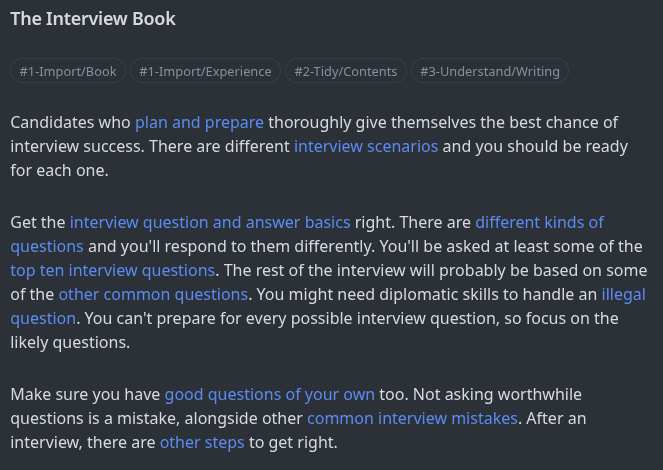
I miss the days when I could choose my topics for note taking with more freedom, but I have to get my priorities straight. Having said that, I know it's not healthy to only have a job search to focus on outside of work, so I'm setting aside some time for relaxation and fun too.

"You're allowed to be human" ... one of the best things I've ever read. It was in a psychology book, but I think it's good to hear or read it from any source. I do believe it's something we should remind ourselves of: We're allowed to be human.

---

And how is it going for the rest of you? What's happening in your Zettelkasten this month?

Comments

  • edited October 2

    In my backwards way of doing things, I use my Zettelkasten as a lab notebook to track my progress with various projects, such as Pointwise provable equality and the failure of composition.

    The story is that one of two constructions described in papers I was relying on for another project was fatally flawed. (It made assumptions violating Gödel's second incompleteness theorem; there is another proof avoiding the second incompleteness theorem.) The construction appeared in two refereed papers, the first published in the Notre Dame Journal of Formal Logic, and the second in The Journal of Symbolic Logic. Because the papers had undergone peer review, I decided to formalize the proof of the flawed construction in the Lean proof assistant and register the formalization in the Palomar Registry.

    That detour was good news, since it eliminated one half of the examples I needed to formalize for the original project I was and still am working on.

    Zettel GitHub. Zettel Wiki Erdős #2. Problems worthy of attack prove their worth by hitting back. -- Piet Hein. PROBLEMS. Grooks, 1966. CC BY-SA 4.0.

  • @Will_Jenkins Thanks for keeping this up in October! 💪

    *  *  *  *  *  *  *  *  *  
    

    @ZettelDistraction I clicked around and didn't understand anything, but the .lean file looked really clean. What a language :)

    Since I'm a noob, I can only ask newbie questions: why did you pick the form

    def fin0 {n : ℕ} : Fin (n + 1) := ⟨0, Nat.zero_lt_succ n⟩
    def fin1 {n : ℕ} : Fin (n + 2) := (fin0 (n := n)).succ
    def fin2 {n : ℕ} : Fin (n + 3) := (fin1 (n := n)).succ
    def fin3 {n : ℕ} : Fin (n + 4) := (fin2 (n := n)).succ
    

    where a fin0 and a recursive generalization for finN would've been possible? I asked the tutor bots of course whether Lean supports these kinds of statements as a proof assistant (Agda does!) but it sounded like bit of a hassle, even though perfectly possible to write. The ℕ type probably does something like that under the hood and 4 names aren't exactly too much to bear or maintain. Just curious about your proof assistant reasoning there!

    *  *  *  *  *  *  *  *  *  
    

    Last month I upgraded some libraries I wrote for apps, including The Archive, to help with new system features and Swift 6.x programming language additions.

    I experimented with a Lisp-1 language embedding, Janet, and it's a really nice language to write.
    https://learnxinyminutes.com/janet Short intro
    https://janet.guide/xenofunctions/ Longer intro

    Culminated in the generation of a Swift package, swift-janet, to have a portable way to ship Janet scripts in apps and executables:
    https://github.com/CleanCocoa/swift-janet

    For that topic I learned about the term "quasiquote", which also applies to Emacs Lisp, but as a concept didn't enter my Zettelkasten before.

    *  *  *  *  *  *  *  *  *  
    

    The 'house' department of my Zettelkasten grows slowly as the influx of new information and changes outpaces my capability to carefully create notes. -- Things move too fast for me to catch up! Talking about the same topics over and over is less of an investment, and opposed to Zettelkasten work can be done in a car or at the building site or anywhere, really. So I'm learning more things with my first brain, the old-fashioned way, than with my extended ZK brain :)

    Author at Zettelkasten.de • https://christiantietze.de/

  • @ctietze said:
    @ZettelDistraction I clicked around and didn't understand anything, but the .lean file looked really clean. What a language :)

    Since I'm a noob, I can only ask newbie questions: why did you pick the form

    def fin0 {n : ℕ} : Fin (n + 1) := ⟨0, Nat.zero_lt_succ n⟩
    def fin1 {n : ℕ} : Fin (n + 2) := (fin0 (n := n)).succ
    def fin2 {n : ℕ} : Fin (n + 3) := (fin1 (n := n)).succ
    def fin3 {n : ℕ} : Fin (n + 4) := (fin2 (n := n)).succ
    

    where a fin0 and a recursive generalization for finN would've been possible?

    It could have been

    def finN {n : ℕ} : (k : ℕ) → Fin (n + k + 1)
      | 0 => fin0 (n := n)
      | k + 1 => (finN (n := n) k).succ
    

    Then the names could have been abbreviations

    abbrev fin1 {n : ℕ} : Fin (n + 2) := finN (n := n) 1
    abbrev fin2 {n : ℕ} : Fin (n + 3) := finN (n := n) 2
    abbrev fin3 {n : ℕ} : Fin (n + 4) := finN (n := n) 3
    

    These return a pair consisting of an index, either 0, 1, 2, 3 together with a proof that the index lies within an index.

    I don't know why not use recursion. There's no performance penalty.

    Zettel GitHub. Zettel Wiki Erdős #2. Problems worthy of attack prove their worth by hitting back. -- Piet Hein. PROBLEMS. Grooks, 1966. CC BY-SA 4.0.

  • Lies within a range defined by Fin.

    Zettel GitHub. Zettel Wiki Erdős #2. Problems worthy of attack prove their worth by hitting back. -- Piet Hein. PROBLEMS. Grooks, 1966. CC BY-SA 4.0.

  • @ZettelDistraction I would love to be able to handle maths at that level, but I'm happy I even remember my school maths at this point. I've taken a Udemy course in maths as a refresher, and intend to get back into both maths and statistics in preparation for a future PhD or DBA (doctor of business administration). I'm not entirely sure what level of maths and statistics ability I would need, but at the very least I'll have to be able to handle some analysis and plotting.

    I've considered Operations Research as a possible future career, and knowing what that entails gives me good guidance for what skills I need to develop.

    I've never heard of the Lean language before. I'm always amazed how many languages there are out there. That goes for Janet too @ctietze, that's another Lisp dialect I've never heard of. There are so many languages and not enough time to learn them all! I'll be happy to be good at 2 or 3 in the long-run.

  • What are the words of the year? For 2025, I found these: Slop (Merriam-Webster), Rage bait (Oxford English Dictionary), Parasocial (Cambridge Dictionary) and Vibe coding (Collins English Dictionary). All of these words are related to AI. But what are the words of the year from my own Zettelkasten?

    I filtered the index of my Zettelkasten by date. I rated the terms for each month, and then rated the resulting shortlist to get the Word of the Year.

    Here are my results for 2026: augmented intelligence, clarity, concept map, context principle, family resemblance, generative learning, journey map, mimetic desire, modular thinking, resonance, self directed learning, syntopical reading, technocapitalism, and zone of proximal development. One of them will win the race.

    Do you have a word of the year? What criteria did you use to decide?

    Edmund Gröpl — 100% organic thinking. Less than 5% AI-generated ideas.

  • @Edmund said:
    What are the words of the year?

    Here are my results for 2026: augmented intelligence, clarity, concept map, context principle, family resemblance, generative learning, journey map, mimetic desire, modular thinking, resonance, self directed learning, syntopical reading, technocapitalism, and zone of proximal development. One of them will win the race.

    Do you have a word of the year? What criteria did you use to decide?

    My Zettelkasten word of the year is 'friction', as I've changed the way I organize my ZK to reduce friction in it, partly thanks to your book on ZK minimalism, and partly thanks to the blog post The Friction Fallacy.

    I realized I was making things too complicated, with too many unnecessary notes, and that it was over-organized. I've simplified things a lot this year, and my ZK has a lot less friction because of it.

    Funnily enough, simplifying the organization has made it more organized now, as I can more easily find what I'm looking for, and I enjoy using it more too.

  • As I continue refining my Zettelkasten workflow, I’ve started reviewing another card-based note-taking method that has long been popular in Japan. Developed by the ecologist and anthropologist Tadao Umesao, the method was outlined in his 1969 book, The Art of Intellectual Production (『知的生産の技術』).

    It remains one of the country’s most popular knowledge management methods to date. As far as I know, Umesao (who was a few years older than Luhmann) was unaware of Luhmann’s Zettelkasten, yet striking similarities exist between them (e.g., one atomic or granular unit per note, writing clearly for others and one’s future self).

    Where they diverge is interesting. Luhmann was explicit about connecting notes, culminating in methodologies like Folgezettel, whereas Umesao avoided this. Instead, his method relies on sorting and shuffling notes based on loosely connected themes of interest or ongoing projects. Periodically, or when a project ends, you reorganize the notes according to evolving themes.

    In a sense, Umesao was more radical in avoiding top-down categorization and hierarchy, always attempting to let ideas emerge bottom-up from newly related notes. The trade-off is that the method does not scale well as notes accumulate. This downside is somewhat counterbalanced by the fact that each note in Umesao’s system is larger (B6, as opposed to A6 in the ZK) and he encouraged writing them as if they were micro journal papers. Though perhaps an imperfect analogy, it is as if Umesao’s method deals with chemistry, whereas Zettelkasten deals with atomic physics.

  • @zettelsan said:
    Developed by the ecologist and anthropologist Tadao Umesao, the method was outlined in his 1969 book, The Art of Intellectual Production (『知的生産の技術』).

    Interesting! Can you recommend an English translation of the book?

  • @zettelsan said:
    As I continue refining my Zettelkasten workflow, I’ve started reviewing another card-based note-taking method that has long been popular in Japan. Developed by the ecologist and anthropologist Tadao Umesao, the method was outlined in his 1969 book, The Art of Intellectual Production (『知的生産の技術』).

    Sadly, it seems that there is no English translation. :/

    It remains one of the country’s most popular knowledge management methods to date. As far as I know, Umesao (who was a few years older than Luhmann) was unaware of Luhmann’s Zettelkasten, yet striking similarities exist between them (e.g., one atomic or granular unit per note, writing clearly for others and one’s future self).

    Where they diverge is interesting. Luhmann was explicit about connecting notes, culminating in methodologies like Folgezettel, whereas Umesao avoided this. Instead, his method relies on sorting and shuffling notes based on loosely connected themes of interest or ongoing projects. Periodically, or when a project ends, you reorganize the notes according to evolving themes.

    In a sense, Umesao was more radical in avoiding top-down categorization and hierarchy, always attempting to let ideas emerge bottom-up from newly related notes. The trade-off is that the method does not scale well as notes accumulate.

    This downside is somewhat counterbalanced by the fact that each note in Umesao’s system is larger (B6, as opposed to A6 in the ZK) and he encouraged writing them as if they were micro journal papers.

    He seems to have come to similar conclusion as me: Don't treat the writing as a necessary evil to achieve the end of storing, but lean in because writing itself creates the value as a byproduct.

    Though perhaps an imperfect analogy, it is as if Umesao’s method deals with chemistry, whereas Zettelkasten deals with atomic physics.

    The focus on micro journals confirms this evaluation. I'd still disagree because if you write complete and well-formulate atomic notes, they would feel non-atomic. Even if you write purely atomic notes, you'll have to still write about the knowledge atom and it is good practice to provide yourself with commentary. Also: The link context will add to the note. In the end, you often have a relatively long note compared to the idea of atomicity out there.

    I am a Zettler

  • edited October 28

    @zettelsan said:
    As I continue refining my Zettelkasten workflow, I’ve started reviewing another card-based note-taking method that has long been popular in Japan. Developed by the ecologist and anthropologist Tadao Umesao, the method was outlined in his 1969 book, The Art of Intellectual Production (『知的生産の技術』).

    Unfortunately, I couldn't find an official English translation. But with some OCR and LLM magic, I was able to create a full translation from a scan of the Japanese book.

    @zettelsan said:
    It remains one of the country’s most popular knowledge management methods to date. As far as I know, Umesao (who was a few years older than Luhmann) was unaware of Luhmann’s Zettelkasten, yet striking similarities exist between them (e.g., one atomic or granular unit per note, writing clearly for others and one’s future self).

    I have a different understanding of Luhmann's system. It is not atomic. Structurally it resembles more a notebook with page numbers. You can only append and branch, but never rearrange.

    The principle of one item per note is much older. For example, European library catalogs from the late 18th century already had one book per card. Umesao used the same principle. He describes in chapter 2 that he was writing bibliographical notes since high school, where each card described exactly one source.

    Umesao reinvented topical index cards for his research material after WWII, when he needed to process material from field notebooks.

    @zettelsan said:
    Where they diverge is interesting. Luhmann was explicit about connecting notes, culminating in methodologies like Folgezettel, whereas Umesao avoided this. Instead, his method relies on sorting and shuffling notes based on loosely connected themes of interest or ongoing projects. Periodically, or when a project ends, you reorganize the notes according to evolving themes.

    Umesao's method reminds me of Beatrice Webb's method from the late 19th century. She also prioritized the ability to shuffle.

    @zettelsan said:
    In a sense, Umesao was more radical in avoiding top-down categorization and hierarchy, always attempting to let ideas emerge bottom-up from newly related notes. The trade-off is that the method does not scale well as notes accumulate.

    I'm not aware that Umesao had a problem with scalability. In chapter 3 he writes:

    "Certainly, each card is a record of experience or knowledge. But classifying and storing knowledge was not the purpose of putting it onto cards. Tens of thousands of cards accomplish nothing if they simply lie unused. They must be put to work.

    What does putting cards to work mean? It means manipulating them to carry out the work of intellectual production. Their capacity to be manipulated is what distinguishes cards. If accumulation and storage were all that mattered, a notebook would be sufficient. Was not the whole point of switching to cards that knowledge written in notebooks so often ends up buried and unused?

    The most important way of manipulating cards is recombination. Try combining pieces of knowledge in different ways. Rearrange their order. Often, you will notice an unexpected connection between two cards that initially seemed unrelated. When that happens, immediately make a card recording the discovery itself. In time, further rearrangement can produce still more discoveries, even from the same material. This is not merely the accumulation of knowledge. It is a form of intellectual creation.

    Cards are not so much a device for accumulation as a device for creation. (…) For this reason, however many cards accumulate, there is no need to become excessively anxious about their classification. Establishing a classification system actually means imposing a framework on thought. When a card is thrown into a rigidly defined classification system, it often suffocates and dies.

    A loose classification is better. In a sense, it may not even be classification at all. Rather than sorting knowledge according to its objective content, it is better to divide it according to the nature of your own interests.

    Quite often, something interests you vaguely, but you cannot clearly identify what kind of interest it is. In that case, simply establish a category such as “Unsorted” or “Undecided” and put the card there. It does not matter how many unsorted cards accumulate. They are precisely the source from which new creation emerges. Let me emphasize again: classifying cards is not what matters. What matters is browsing through them repeatedly. Take some out and try different combinations. Keep doing this, and even tens of thousands of cards will not become a dormant stockpile."

    Whereas Luhmann's system was static. Every note had a permanent place ("feste Stellordnung"). And because every note was permanently connected to a predecessor in a sequence, they did not have to be atomic. Each note had a permanent context.

    @zettelsan said:
    This downside is somewhat counterbalanced by the fact that each note in Umesao’s system is larger (B6, as opposed to A6 in the ZK) and he encouraged writing them as if they were micro journal papers. Though perhaps an imperfect analogy, it is as if Umesao’s method deals with chemistry, whereas Zettelkasten deals with atomic physics.

    I think it's the other way round. Luhmann's Zettelkasten was chemistry, because it's all about the connections between the smallest units ("Anschlussfähigkeit"). Umesao's cards are atomic. Shuffling requires that each card can stand on its own.

  • @harr Can you send me the translation?

    I am a Zettler

  • @harr I would also like to get the translation. I assume it would be interesting to others on this forum too, so perhaps you could share it in a more general way, if you have a sharing method you like?

  • @zettelsan said:
    As I continue refining my Zettelkasten workflow, I’ve started reviewing another card-based note-taking method that has long been popular in Japan. Developed by the ecologist and anthropologist Tadao Umesao, the method was outlined in his 1969 book, The Art of Intellectual Production (『知的生産の技術』).

    It remains one of the country’s most popular knowledge management methods to date.

    I wasn’t aware that this method was well-known in Japan. It piqued my interest, so I immediately read the book; a Korean edition is available.

    While reading, I also got the impression that Umesao intentionally avoids establishing a fixed structure. Umesao suggests using cards (rather than a notebook) to reconstruct content. His key point is to avoid rigid categorization; instead, you should repeatedly review the cards and combine them, regardless of their specific subject matter. Following this approach means that any structure created is merely temporary. Since the cards have no fixed position, finding a specific card might require a bit of luck. This is a point @Sascha has already touched upon when discussing the potential downsides of the PARA method.

    Umesao mentions using this card system for a diary as well. He notes that diary entries can be combined with other cards, and since every card is dated, they could theoretically be re-sorted chronologically. In practice, however, once the number of cards grows large, reconstructing them in chronological order becomes nearly impossible.

    @harr said:

    @zettelsan said:
    In a sense, Umesao was more radical in avoiding top-down categorization and hierarchy, always attempting to let ideas emerge bottom-up from newly related notes. The trade-off is that the method does not scale well as notes accumulate.

    I'm not aware that Umesao had a problem with scalability. In chapter 3 he writes:

    "Certainly, each card is a record of experience or knowledge. But classifying and storing knowledge was not the purpose of putting it onto cards. Tens of thousands of cards accomplish nothing if they simply lie unused. They must be put to work.

    What does putting cards to work mean? It means manipulating them to carry out the work of intellectual production. Their capacity to be manipulated is what distinguishes cards. If accumulation and storage were all that mattered, a notebook would be sufficient. Was not the whole point of switching to cards that knowledge written in notebooks so often ends up buried and unused?

    The most important way of manipulating cards is recombination. Try combining pieces of knowledge in different ways. Rearrange their order. Often, you will notice an unexpected connection between two cards that initially seemed unrelated. When that happens, immediately make a card recording the discovery itself. In time, further rearrangement can produce still more discoveries, even from the same material. This is not merely the accumulation of knowledge. It is a form of intellectual creation.

    Cards are not so much a device for accumulation as a device for creation. (…) For this reason, however many cards accumulate, there is no need to become excessively anxious about their classification. Establishing a classification system actually means imposing a framework on thought. When a card is thrown into a rigidly defined classification system, it often suffocates and dies.

    A loose classification is better. In a sense, it may not even be classification at all. Rather than sorting knowledge according to its objective content, it is better to divide it according to the nature of your own interests.

    Quite often, something interests you vaguely, but you cannot clearly identify what kind of interest it is. In that case, simply establish a category such as “Unsorted” or “Undecided” and put the card there. It does not matter how many unsorted cards accumulate. They are precisely the source from which new creation emerges. Let me emphasize again: classifying cards is not what matters. What matters is browsing through them repeatedly. Take some out and try different combinations. Keep doing this, and even tens of thousands of cards will not become a dormant stockpile."

    It seems to me that Umesao primarily used these cards as prompts—as sparks for new ideas. In Chapter 3, Umesao argues that (1) human memory is unreliable, (2) we should record things rather than relying on memory, and (3) since there is no need to record what is already in one’s mind, the card system he proposes is distinct from simple note-taking. He states:

    We use cards so that we can forget. This is the core of the card system. Once something is recorded on a card, you can safely forget it. Therefore, when you record information on a card, keep the act of forgetting in mind. In other words, when you look at the card later, it should feel as though you are encountering information that was previously completely unknown to you. (Umesao, 2018, p. 82, translated using Google Translate)

    This seems to account for the fact that one might even forget what one had placed in the card box in the first place. It appears, then, that Umesao intentionally embraced the idea of ​​relying on such chance encounters.

    Furthermore, the kozane method (こざね法) is reminiscent of the working process of Dustin Lance Black.

    Reference (Korean Edition)
    우메사오 다다오. (2018). 지적 생산의 기술 (김욱, Trans.). 에이케이커뮤니케이션즈.

  • edited November 1

    @iylock said:
    Furthermore, the kozane method (こざね法) is reminiscent of the working process of Dustin Lance Black.

    Yes, thanks for making that connection! The parallels can be found in chapter 11 of Umesao's book (I'm relying on machine translations of the Japanese edition, p. 201):

    Many novelists seem to have acquired the ability to draw out an uninterrupted stream of images, one after another, and depict them as though unrolling a picture scroll, without first having to organize their thoughts. Ordinary people have no such ability. In any case, ordinary prose cannot be written that way. I believe writing is fundamentally something you construct, not something you simply draw out.

    My colleagues and I have reached a shared conclusion: unfortunately, the inside of the human mind is a jumble. It is crammed with bits of knowledge and images in the form of disconnected fragments, [Page 202] and when they rise to the surface of consciousness, they do not emerge neatly arranged in logical order. When we put them into writing, we have to make an effort to reconstruct them in a logical form. If we wrote things down “just as they came to mind,” the result would scarcely qualify as a coherent piece of prose.

    Interestingly the kozane method is also about note sequences (compare them to Luhmann's technique at your own peril…). Umesao (p. 202, emphasis added):

    I have already discussed several times in this book techniques for accumulating material to write about. The discovery notebook is one example. The cards on which you have jotted things down from time to time can also all serve as material. Occasionally, simply arranging those cards in a suitable order may be enough to produce something close to a logical outline for a piece of writing.

    Generally, however, merely laying out your material does not mean you have organized your thoughts.

    The following technique can help you use fragmentary material to construct a coherent body of thought or a piece of writing.

    First, get some small slips of paper. Earlier, when discussing standard paper sizes, I explained that I cut all nonstandard paper into B8-size pieces—6.4 by 9.1 centimeters. Those are the slips we will use now.

    On these slips, write down things related to your present subject, one item per slip, using a word, a phrase, or a short sentence. Write them down freely, in whatever order they occur to you. Take everything that might be useful—the cards you have already accumulated, your clippings, knowledge gained from books—and put it all [Page 203] onto these slips. Once you think you have more or less exhausted the possibilities, spread the slips out on a desk or on the tatami floor. You have now laid bare all the material in your mind concerning that subject.

    Next, look at the slips one by one and see whether any others are connected with them. If you find some, place them together. At this point, you must not classify the slips.

    As I cautioned in discussing how to store cards, the purpose of intellectual production is not classification. Classification requires a framework established in advance. Sorting your material into an existing framework will not, by itself, generate any ideas.

    Instead of classifying the slips, bring together those that seem to have a logical connection. Once you have assembled several, arrange that group in an order that seems to make logical sense. Then overlap their edges and staple them together. You have now given a thought a fixed form.

    I call the resulting chain of slips a “kozane.” Medieval Japanese armor was made by lacing together small plates of iron or leather with cord; those plates were called kozane. Since the stapled slips reminded me of them, I adopted the name. I also call each individual slip a kozane, and I will call this technique [Page 204] the kozane method.

    Umesao continues (p. 204):

    Once you have made several chains of kozane, consider the relationships among them. Gradually bring together those that are logically connected. Sometimes you may take a chain apart and rearrange it. Since the slips are only stapled together, you can easily tear them apart and staple them again. If new material occurs to you while you are working, keep adding more kozane.

    When you have assembled a logically coherent group of kozane chains in this way, fasten them together with a clip and attach a slip bearing a heading. Then lay out several of these groups and, looking at their headings, consider the structure of the piece as a whole.

    At this point, you can arrange them in the familiar pattern of introduction, development, turn, and conclusion, or you can devise a less conventional sequence. You can also think concretely about the balance of the entire [Page 205] piece. Once you have reached this stage, you have not only settled what you want to say but have also largely worked out the structure of what you will write.

    At his point Dustin Lance Black is so familiar with the future movie, that he can write down the first draft of the script from memory. Whereas Umesao looks at each individual slip. Both ignore the slips after they're done writing. Black stores the boxes filled with slips (dare I say zettelkasten…) in a closet. Umesao throws the slips away. The book continues (p. 205):

    All that remains is to take up the slips in order, one at a time, from the top of the stacked chains, and write out their contents in prose. When the task is finished, you no longer need the kozane. Crumple them up and throw them away.

    The kozane method can be described as a way of taking the activity inside your head and bringing it outside in the form of slips of paper. It is rather like an abacus. Calculation with an abacus is ultimately mental calculation, but the beads simulate, outside the mind, what is happening within it. The kozane method is an abacus for thought, and each individual slip corresponds to an abacus bead.

    One advantage of this method is that it encourages creative thinking. As you look over scattered materials and try combining them in different ways, you discover new relationships you had never imagined.

    In other parts of the book, Umesao explicitly encourages non-writers to write (a thought similar to the US-American Writing across the curriculum I mentioned in another thread). On page 205 he continues:

    Another point that matters for writing is that this method enables anyone to produce prose that is reasonably logical and coherent. A born writer will have no need for such a technique. This is a writing method for ordinary people. But writing should not be left to geniuses alone. We must put the ability to write back into the hands of ordinary people [Page 206] who suffer from an inability to write or an allergy to writing.

    I find it fascinating how people around the globe come up with similar yet different solutions for similar problems.

  • edited November 1

    If I understand the book correctly, Umesao uses two different sizes of index cards:

    • B6 for information gathering with Kyoto University–style cards (described in chapter 3)
    • B8 for organizing thoughts with the kozane method (described in chapter 11)
Sign In or Register to comment.