Anchored Model Layering • Zettelkasten Method

 Anchored Model Layering • Zettelkasten Method
Having an idea is not the actual eureka moment. It is the long work that follows. Anchored model layering is a tool for that work: relate many overlapping models to each other through a shared anchor, and you get one meta-model you can keep extending across long thinking sessions.
Howdy, Stranger!
Categories
- 3K All Categories
- 153 Research & Reading
- 703 The Zettelkasten Method
- 12 Knowledge Work
- 102 Writing
- 474 Software & Gadgets
- 158 Workflows
- 733 The Archive
- 15 Plug-In Showcase
- 88 Resolved Issues
- 225 Projects Logs and Journals
- 86 Project: Zettelkasten.de
- 53 Critique my Zettel
- 179 Random
- 375 Introduce Yourselves!
Comments
Extremely insightful and helpful on a conceptual level.
Thanks!
I am a Zettler
Interesting post.
I had to look up "eureka moment". I learned the story of Archimedes' insight. When he got into the bath, he noticed the water level rise and suddenly understood something new about the physics of water displacement. He euphorically cried out "Eureka!" ("I have found (it)"). This sudden realization is also known as an Aha! moment, when you think or say "Aha! Now I get it." Some people use the metaphor of a lightbulb lighting up in the moment they have the idea. 💡
I'm trying to connect the post's concepts to previous knowledge. The idea that we need to "earn" an idea or should try to "fully grasp" an idea reminds me of the The Complete Guide to Atomic Note-Taking.
The term "model" seems to refer to one of the six types of knowledge building blocks mentioned in The Guide.
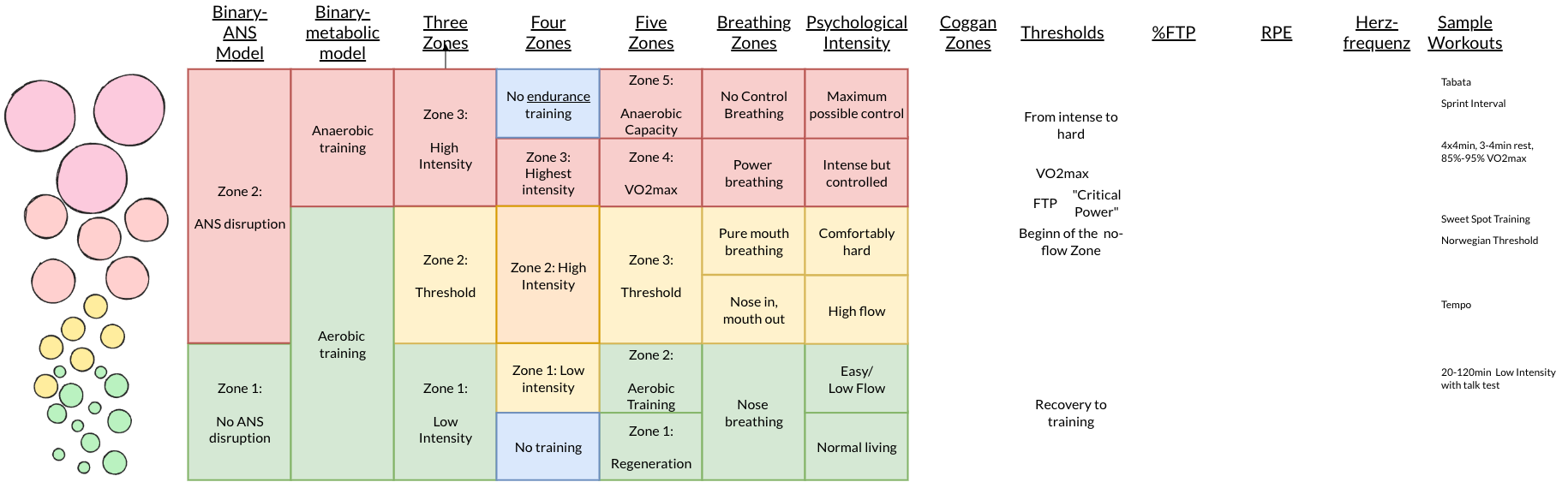
However, I don't understand where "meta-model" fits in. The chart doesn't look like an atomic note that represents an atomic idea, but like a structure note that links various atomic notes about models for the purpose of comparison.
The "anchor" reminds me of a tertium comparationis. What is it that the compared things have in common? In this case it seems to be a scale of "endurance intensity".
The "anchor" also reminds of a hypothesis. What phenomen does the comparison examine? In this case the hypotheses seem to be:
The "persistent effort to think about one problem or idea that spans multiple long thinking sessions" reminds me of a project. In this case maybe a research project about intensity thresholds in endurance training?
The visualization reminds me of a table: one model per column, one intensity level per row. I find such comparison tables useful as simplified overviews of my current understanding of a research interest.
In Obsidian I'd use a Markdown table, because Markdown is quick to update and easy to link.
It's a metamodel because it's a model that allows to express other models, such as the endurance model developed in the article
I'm trying to make this compatible with atomic notes, structure notes and the six default knowledge building blocks.
Where does such a "meta"-model sit? And do we really need to introduce a "meta"-model, if we just want to express what the post expresses?
I think we're dealing with a straightforward structure note that compares simple models along one discrete axis.
In my mind, the own model is just another model. If we add it explicitly as another column to the table, I don't see the need for anything "meta".
Once the column is added, it becomes easy to make details of the own model explicit. Does it have three levels or six levels? I don't know. I chose the labels 1a/b, 2 a/b, 3a/b as a compromise that assumes two major thresholds and still allows to label all six rows. What would be better labels for the 3 or 6 levels? I don't know. But I'd know where to put them in the table.
Thinking of it as a simple comparison table allows you to add multiple versions of your own model. This makes it easy to try out different labels or attributes for each level.
It depends on how you intend to treat it in your Zettelkasten.
If in your Zettelkasten you want to discuss, describe, or reflect on this meta-model, I think it boils down to being treated as a model represented within your Zettelkasten.
On the other hand, if you want to use it alongside, in support of, or as a tool for your Zettelkasten, it isn't something that falls under individual "blocks", but rather a cognitive tool for tackling a subject. Comparable to the principle of atomicity, for instance.
Yes, I think we can compare it to the concept of structure notes. At the end of the day, it's a tool that supports building a sort of map of a knowledge domain. It allows you to bring together and compose other ideas/thoughts into a coherent composition that makes sense as a whole.
In my opinion, as a concept, this meta-model (and I believe it can be considered a mental model, and there are some discussions about mental models in the forum) is analogous to a Structure Note. It's something that allows you to organize and compose thoughts into a structure that makes overarching sense. Perhaps more specialized for a specific function.
Yes, that's a useful distinction.
Yes, in this case the "meta"-model would just be another model.
Yes, that's the primary use case I have in mind. Structure notes or project notes as a tool to keep an overview.
(skipped)
Yes. That's what I had in mind with the comparison table.
I think the post only describes a pattern for structure notes. I don't see a mental model that would justify the term "meta-model".
If you can see more than a simple comparison, what is it? How do you interpret the "anchor" metaphor?