The Complete Guide to Atomic Note-Taking

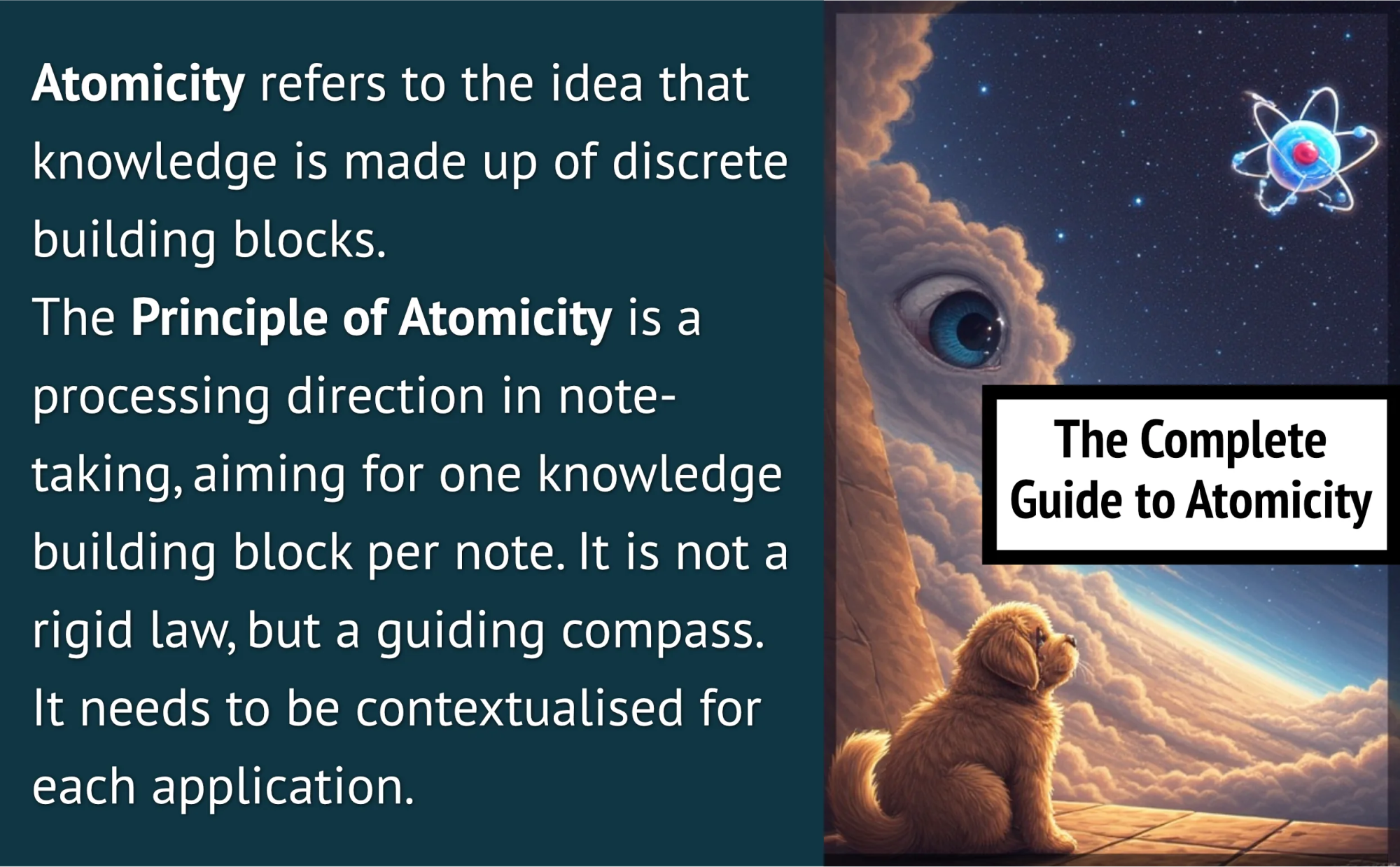
Atomicity refers to the idea that knowledge is made up of discrete building blocks. The Principle of Atomicity is a processing direction in note-taking, aiming for one knowledge building block per note. It is not a rigid law, but a guiding compass. It needs to be contextualised for each application.
Post edited by ctietze on
Author at Zettelkasten.de • https://christiantietze.de/
Howdy, Stranger!
Categories
- 3K All Categories
- 153 Research & Reading
- 707 The Zettelkasten Method
- 12 Knowledge Work
- 102 Writing
- 474 Software & Gadgets
- 160 Workflows
- 733 The Archive
- 15 Plug-In Showcase
- 88 Resolved Issues
- 225 Projects Logs and Journals
- 86 Project: Zettelkasten.de
- 53 Critique my Zettel
- 179 Random
- 375 Introduce Yourselves!
Comments
Some thoughts:
I feel you are missing a third option where they are not saying you have to rely on heuristics and are willing to engage (not stating this is the case here, just an observation). They hear you out and just believe you are over-complicating a concept because you don't have a strong grasp of what is important in relation to the concept and are adding details /or sub-concepts that are unimportant.
I am not following what the problem of level 3 is in the context of this article. I looked back and was not able to work out what it is. I also don't think I have a strong grasp of what are the details that make up level 3 overall. Could have used 1-2 sentences stating what the procedures of the method are that differentiate from keeping a zettelkasten without the zettelkasten method.
I love level 4 and think about it a lot. I secretly wish I had my own coding skills (don't have the will to try vibe coding) to experiment with creating Obsidian plugins that can help with pushing one towards better thinking.
I really like Super Memo Guru (Piotr Wozniak) definitions for Concept and Model. I think of a model as a set of concepts connected by rules. I also don't quite agree with your knowledge building blocks, as they don't seem discrete enough from each other. As to me models are made up of concepts. Hypotheses are made up of arguments. I have no clue what I would say the building blocks of knowledge are instead.
I was completely lost on this aspect. I understand the zettelkasten iceberg level 2 and 3 but am not following along with what actually is atomicity level 2 and 3.
This is big to me and something I wonder a lot about. It makes me think this Andy Matuschak Patreon article. It unfortunately is locked behind a Patreon wall and I didn't make a copy of it, so I don't have exact quotes of what I'm thinking about. But he discusses how he abandoned his evergreen notes practice as it was accumulating too much technical debt, much better to just create a flat outline of sorts (Cal Newport style) per project. I thought that would be an interesting topic to tackle on the blog and see how you've handled that concern of technical debt over the years in your zettelkasten.
Impulse of creating/notes without directly moving to a later stage of maturity seems dangerous to me. Getting into Collector's Fallacy territory. This reminds me of how the brain generates an overabundance of neurons and synapses then prunes them to become more efficient. I think the worry is if you spend to much time in impulses than you never get around to pruning and aren’t particularly efficient. I’d say a certain level of efficiency is necessary due to our limited time/energy on this planet. Why do I say all this? Because impulsing without pruning or maturation feels good (collectors fallacy).
I got confused because you put your comment before the quote. I am pretty sure that it is the convention to put the quote first and then your comment. The dividers didn't show in the post, which would've helped.
It is based on a specific pattern-language of meaning. The eye is the all-seeing eye that emerges as a phenomonon in schizophrenia as a result of an overactive left hemisphere and a dysfunctional right hemisphere. A feeling of being constantly watched. (Based on Iain McGilchrist)
The puppy is the self, still unformed and full of potential. It can be both the user and the idea aiming up.
It is AI-generated.
This is based on my observation. So, I miss the third option, since I wished people would engage with the level 3 concepts.
Level 3 lacks the justification. The problem of level 3 is that it solves level 2 problems by giving a formal framework on how to make sure that you understand what an atom is (scuba diver directly looking). With this framework, you can actually make sense of heuristics more and use them more effectively. But level 3 still lacks a deeper justification of why this actually should work. Level 4 provides the justification by stating that atomicity is a trait of knowledge itself and the principle of atomicity is a principle of treating knowledge accordingly.
"Level 4 is reached when you see that level 3 is actually about sound thinking and not some methodological gimmick."
I think it is a good idea to learn to code for one's thinking ability. I am not sure how to learn to code to gain general benefits. I think it is the same with strength training for athletics. If you are really weak, any strength training will benefit you. But none of the people who are reading this are the equivalent of weak. So, a more sophisticated approach is needed.
You are mixing two frameworks here. If you go with the definitions of Wozniak, you can't make any consistency claim about the inventory, since the consistency is dependent on the condition that you go with the definitions. It is like exchanging sugar for honey, wheat flour with rice flour and then claim that the recipe is not working.
But I won't defend my inventory here. You can use any inventory of building blocks that you like. Well, the inventory should be working. Meaning: It should not just be a bunch of definitions but a bundle of ideas, methods, thinking tools etc.
To create an inventory, you need to have a reasonable framework of completeness of what you are mapping. If we are talking about knowledge building block, the inventory should map the process of knowledge work.
Atomicity level 2 means that you applied heuristics, level 3 means that you identified the knowledge building block and made sure that the note just contains this one building block.
I had a short exchange with Andy over this very topic. There were quite some issues with his practice, which explain the problems he had, at least in part.
It is indeed an interesting topic which I wouldn't label as technical debt but the problem maintenance. But there is no conscious solution on my part. The reason why I have almost zero technical debt is that my Zettelkasten practice is pretty much just a thinking practice. So, I don't have to clean anything up, just to keep everything tidy and working on the level of the method. If something is messy, it is messy for a good reason: My level of thinking is still messed up. I don't engage with messy areas of my Zettelkasten, unless I want to progress my understanding. If I need to connect a new idea to something that is messy in my Zettelkasten, I will clean that mess up as an act of furthering my understanding.
One aspect, for example, why Andy accumulates technical debt is that his Evergreen Note are public. This creates the need for them to be understood by others. There is a lot of stuff in my Zettelkasten that nobody than me can understand, that violates good practices etc. But it is my personal Zettelkasten and I don't need to care. When I see that something is inconsistent, incoherent or whatever, I can just accept it or write a comment with a quick idea on how to fix this and then move on. Impossible if the notes are available to others.
But I don't want to dissect Andy's notes in a thread in a forum because Andy's work warrants a more careful approach than a spontaneously generated answer.
Your stages seem to be on the level of workflow. I oriented myself by the maturation stages in practical knowledge work.
It is a straightforward condition: If you want to make the Zettelkasten a home for your mind and thinking, you should move the complete thinking process into the Zettelkasten.
You are right that there is a problem of the Collector's Fallacy. However, the root cause of the problem is not to be found in the method, but in one's approach to knowledge. A person that never disciplined his mind to follow through after the first impulse, will not do it with any system and external pressure (e.g. a deadline for an essay) will be the mechanism of making this happen.
If you try to deligate the mind's disciplination to external constraints, you risk of detraining your mind or never developing its discipline in the first place.
But you can watch the video to see that it works if you practice it.
I am a Zettler
I encourage whoever is reading this to check out S.S. Seward’s Note-taking (available free on Google Books). He anticipates the concept of atomicity when he instructs the reader to capture the idea of a curious portion of a text or lecture. That’s all the principle of atomicity is about. Capturing ideas. Not a summary, or an enumeration of facts and the secondary details pertinent to an idea but the special discrete points that the author is trying to communicate throughout the text.
Knowledge building blocks give you a mental bank of the type of ideas you that you find in a text. The stages of an atomic note are just ways to track the development of an idea—from a speculative bit of information into a concrete intimation that affects how you think and behave after its registered in your mind as correct.
Only taking notes on things that you intend to advance according to an implicit timeline sounds dangerous too. Like Sascha, I think this disrupts an inherently internal phenomenon by introducing external stakes. This is something that inhibited my own processes in the past. I reckon as of late that efficient impulses are a matter of taste—being able to distinguish what bits of information are relevant to your broader research and anticipating their usefulness. This is where having a “toolbox of building blocks” comes in handy. Luc B. Beaudoin’s CUP’A method is a terrific heuristic for processing information. I use Notenik to store my knowledge base and it gives you different ways to view your collection of note files in the UI. With the
Statusfield I can store the stages of my notes as numerical values and sort them. This is just an example of ways you can track the progress of notes made on an impulse. Although I must confess, I can’t think of any note of my own that wasn’t conceived like this.I think this is one of the strongest distinctions to make when talking about knowledge work. Productivity is one thing with its own set of practices and interests. “Practical knowledge work” (researching, note-taking, composing, publishing) is another. Atomic note-taking is an epistemic framework or a toolkit for working with knowledge. Something than your workflow can adapt to. I find that Nick’s reservations with impulsive notes are addressed here and in the broader section from where this passage originates:
The Zettelkasten Method as a whole seems impartial to any one productivity method. Bring your own. Sascha’s integration of BASB into his own system gave me some insight into this.
What we’re looking to achieve with our notes is made straightforward in this piece:
When it comes to cultivating knowledge I don’t think empirical data is always an appropriate metric for efficiency.
Resources like “SuperMemo Guru” appear inclined toward productivity. Beaudoin has a term that I’m fond of, “Cognitive productivity”. These kind of methods can help aid your knowledge work but I don’t think that success in this area alone can constitute for excellence when it comes to understanding things—the comprehensiveness of the methods not withstanding. The cultivation of knowledge is the objective of knowledge work and productivity workflows facilitate this effort. However I think that workflows are often confused as the either the means—or worst—the end.
Devising a productive system of learning does not bring one any closer to the discovery and recognition of Truth. But it can help keep you consistent on the journey. This is similar to the path of spritual reformation in Islam. For example, a seeker may be prescribed or adopt practices in addition to the obligatory and customary acts of worship. But these auxiliary practices in and of themselves do not bring them closer to their ultimate objective (viz. salvation in the afterlife).
Nice recommendation! (It is also available via the internet archive: https://archive.org/details/cu31924012997627/page/n3/mode/2up if you want to download it in various formats. It is public domain)
Yes! I made a connection with what you wrote further down: Knowledge Building Blocks give you an external reference point if you got the idea right. (Just an addition to what your wrote)
To add to that: External stake to the internal process could be translated to: You put public pressure on your private sphere. It is absolutely not correct to make this translation, but it echoes the problem of specific restrictions.
This is speculative: If you only pursue for what you already have a plan, you might become less creative because creativity is dependent on a more open-ended, playful attitude.
Yes, exactly!
You will be quoted. This is exactly it!
I am a Zettler
I appreciate the comments.
@Sascha
>
This captures the tension perfect and may additionally result in one pursuing less ambitious work/research. Of course this implies a certain level of control over your work/output that may escape a lot of people. I found Cal Newport’s Slow Productivity a useful read in general but I felt like it makes this assumption. Indeed it may be a privilege overall, to be so good you can afford to work slow and deep.
Ah! Still I dream.
I did it — I have reviewed and processed the essay, the video, and the discussion.
A lot of work, and there would be a lot to say.
The short answer is that this is a very meaningful and relevant work.
In my view, it is essentially the transposition of bottom-up object-oriented development — taken from software development and brought into idea development. The process is especially evident in the video.
It seems to me that this work marks a major evolution in the theme of atomicity.
It addresses some of the limits of the simple model of “one idea per note.” It presents tools for achieving atomicity in a rational way, as well as techniques to avoid fragmentation.
The video, in particular, is a powerful example — not only of how atomization can be done, but of how general Zettelkasten work can be done. A pure organic development, very similar to how, in software development, a cluster of classes, objects, modules emerges from a coding task. That use of refactoring is exactly how I see Zettelkasten (and in fact, thanks to my background as a developer, that’s how the model of atomicity came to me “naturally”).
One observation I can make — a possible completion of the work — would be to better explain why pursuing atomization is worthwhile. That would make the value of the effort clearer. Understanding ideas better, clarifying them, and being able to make connections are only three of many benefits.
I’ll just mention a few (non-exhaustive list):
I see a potential critical point in the block-based model, which should probably be discussed more deeply.
Perhaps there’s too much implicit focus on the structural properties of the blocks for retrieving the architecture of ideas, and less on their ability to express creativity, taste, subjectivity, and personal perspectives. Of course, the article does not exclude this possibility in any way, but it might be worth emphasizing it explicitly. Not only can I “capture the truth,” but I can also “interpret” or have my own perspective.
When we talk about blocks, patterns, and structures, it’s very easy to be distracted by their formal and representative properties — while subjectivity, which distinguishes Zettelkasten from other models, risks being overlooked. For example, if I have a “model block” or an “argument block,” it’s easy to end up expressing only the descriptive part of the model, capturing the idea "as it is" from the source.
In the last minutes of the video, you briefly mention your personal reason for using that dynamic about IQ — it’s a short but very important moment to me. Presented so briefly, it might not be perceived as fundamental.
In general, despite the soundness of the atom-based model, or its block-based evolution as you’ve shown, over time I find it easier to introduce the concept of atomicity using the photography metaphor rather than the atomic one.
In the future, when asked to explain it, I think I’ll rely more on photographic metaphors.
The great advantage of photography is that everyone understands it — you can bring up relatable examples of photos that “work” or don’t work:
At the same time, however, the photographic model works well for showing what works and what doesn’t, but perhaps provides fewer tools for explaining how to do it well.
That might just be my personal limitation, since I’m much more experienced as a developer and system modeler — I master those two mindsets better than that of a photographer. I can recognize a good photo but wouldn’t be able to teach how to take one, while a good photographer could develop a sound photography based mindset for atomization. Nevertheless, simple photographic metaphors have, in the past, illuminated for me very clearly how to pursue atomicity (landscape, portrait, and so on).
I’ve made this side discussion about photography mindset not to diminish the block-based mindset you presented, but to highlight what I believe is a valuable opportunity.
I’m quite sure there are Zettelkasten practitioners who don’t fully feel comfortable thinking in terms of “blocks.”
That’s fine: these people can use the same method as a “template framework,” inserting their preferred mindset (for example, the photographic metaphor) in place of the block vocabulary, while keeping the same skeleton that provides progressive modeling on four levels, organicity, refactoring and so on.
So, if you don’t like blocks, try replacing them — keeping everything else the same — with a vocabulary of models that you resonate with more.
Used as a framework with interchangeable mindsets, this model has a much broader scope than originally intended
I’ve personally found as many as five different mindsets. One of these is a "making cookies" mindset
In a nutshell, learning to master atomicity is like learning to master photography or OOP development.
Same thing, same dynamics, same learning path, same "thinking in objects" once the highest level reached.
And if someone is lucky enough to know how to do either of the latter two, I think they’ve already got a clear path ahead.
Many thanks for your kind words.
Even as a non-programmer (I only learned Pascal and a bit of Delphi), I envision the process very similar to coding. The similarity stems from a specific shared pattern of information mapping that is beneath both processes. I can't summarise it enough to make it part of a post here, but to give you a preview: It has to do with the strange fact that mathematics doesn't care about nature, yet nature seems to speak math perfectly. More: I don't think that the Logical Empirism is as dead as it is proclaimed.
The notion that knowledge is a malleable social construct is as bizarre as stating that 2+2=4 is a social construct.
You are correct. This is already planned in two dimensions:
My focus stems likely from two sources:
I don't understand. You mean the above?
Atomicity is not a mere metaphor. My claim is that knowledge is organised in discrete building blocks that serve a specific function (taken directly from the article). Knowledge is not like atoms. Knowledge is atomic.
The atomic model of knowledge is not a metaphor. The difference between a model and a metaphor is that a model is based on assumption about reality, a metaphor is an epistemic/didactic device to give you a feel and a rough direction to start your thinking process.
The similarity of both introduce two fallacies:
The photography metaphor works great as many level 2 approaches work great. However, as a metaphor it still is subject the the level 2 problems as layed out in the article.
"Showing" would mean that you convince by providing learning experiences. The How depends on understanding the underlying learning reality.
It seems to me that something got mixed up because of the AI-translation.
I have to cite myself: The individual in individualisation is the specific task and not the individual person.
I am not 100% confident in the completeness of the inventory of knowledge building blocks. But the underlying reality of knowledge isn't anything that you can avoid. Take arguments a an example: There are languages that work (first/second order logic, syllogisms, etc.). All of them are annoying if you are not in love with math. But you can use some vivid metaphor about logic and argumentation to understand it. The same is true for any knowledge building block.
Hopefully not.
I am a Zettler
I've split the off-topic detail discussion about photography as a kind of knowledge work:
https://forum.zettelkasten.de/discussion/3341/photography-is-knowledge-work
Hard to make clean cuts with the cross quotes everywhere. But interested readers can read up to here, then follow the link to continue.
Author at Zettelkasten.de • https://christiantietze.de/
Thanks for the read Sascha. I am sort of confused on the models relating part-to-part/part-to-whole topic. Do you have any references to think about the topic?
Zettler
There are all kinds of books about modelling that I can think of. All of which address a different aspect.
My thinking about models is tightly connected to my thinking about systems, which is massively influenced by Luhmann and Dietrich Dörner (tips: The Logic of Failure: Recognizing And Avoiding Error in Complex Situations).
And just to throw it in there: One of my secret tipps: La métamorphose explosive de l'humanité by Henri Prat. If you speak French or German. I am not aware of a translation to English.
I am a Zettler
Sprinkled around the forum it has been said level four is achieved:
I see level 4 as demonstration of mastery via application in any knowledge domain. Perhaps I'm reading into the levels too much but it does seem fruitful.
Zettler
Concepts in the author's words
I'd like to share a technique I'm using to process the Complete Guide to Atomic Note-Taking. The goal is a condensed overview of the concepts in the source.
I extract phrases from the source and group them with the related concepts. I use literal quotes, because they document the author's terminology and because they are easy to locate in their original context with full-text search. The process is iterative. After the initial round of extraction, I went repeatedly through the list, rearranged items, added/dropped/renamed concepts, added/dropped/edited the quotes. This is the result:
Knowledge
Knowledge work
Knowledge building blocks
Atomicity
Principle of Atomicity
Atomic Note
Thinking
Thoughts
Ideas
Atomic idea
The Zettelkasten Method
The Zettelkasten
(Zettelkasten) Notes
Concepts in my own words
In the next step I'm trying to describe the concepts in my own words. The following examples are drafts:
If anybody has suggestions how to modify these descriptions, so that they better capture the source's content and intention, please share!
I don't know this book; even so I think you are missing something that appears in Sasha's essay on atomicity on our site. And I think you are missing a chance to help these notes do more for you in the future.
Notes don't have to atomic to begin. At the beginning you probably aren't clear enough on the concepts to even know what could be atomic. Over time (if you work at it) you get more understanding of the concepts and can start to rework the card(s). If and when the concept has become crystal clear will you be able to whittle the card down to a good atomic note.
When one needs to write a quote for a job, one usually doesn't know enough to bid it realistically. But one has to move on it anyway. That's going to be a common situation when you are creating cards and working on their concepts.
What about that time in between? The card isn't going to be useless, I hope. What does the book say about how to have the card be useful before it has become distilled down to atomicity? If the book has nothing to say about this, you could note in the card(s) that this subject needs to be worked on. You could - I would say should - create one or more cards to start exploring the subject.
I suggest that you might think about whether you want to be a mason or a sculptor. Masons assemble blocks; it's an honorable profession. Then reflect this facet in the cards you are deriving from processing the book.
"The Principle of Atomicity guides note-writing towards atomicity."
Ok, how does that happen? Use your proposed note as a springboard to start understanding that.
"Atomic notes contain exactly one atomic idea."
Ok, what will be the outcome if they don't? If you put that question into that note, maybe the note will be more productive. If not, then put it into its own linked card. If you think you know, put that into the card, or start a new sequence to capture your idea.
I have some cards much the same as your drafts, and the only thing they are good for at the moment is to remind me where I have more thinking to do, sometime if I want to spend the effort.
Good catch. Thanks, @tomp. The Guide calls the ideal atomic note "purely atomic note". And the Principle essay describes atomicity as "desired outcome". What do you think of this?
I took a try at creating these notes myself. These are no doubt not their ultimate form but represent what I understand and the level of effort I am willing to put in right now. Here is their immediate neighborhood -
Zettelkastens - Atomic Notes
    The Atomic Note - What?
    The Atomic Note - Why?
    The Atomic Note - When?
    The Atomic Note - How?
I chose the titles because -
Here are the cards themselves, in the outline order -
What Is An Atomic Note?
:id: tom.20260817223811.1
:created: 2026-08-17 22:38
:seealso: tom.20260817224518.1 The Atomic Note - Why?
:seealso: tom.20260817230424.1 The Atomic Note - When?
:seealso: tom.20260817230940.1 The Atomic Note - How?
Contains
- A single, well-developed concept.
- The outcome of thorough, well-developed understanding of the subject of interest.
- Cannot be simplified further.
Advocated by many writers on Zettelkasten.
Note - Concept rarely explained clearly.
Note - Not universally agreed to be essential principle.
Similar to one entity in an Entity-Relationship diagram.
- E-R diagrams are incomplete without connecting edges.
- Similarly, notes are incomplete without links.
The Atomic Note - Why?
:id: tom.20260817224518.1
:created: 2026-08-17 22:45
:seealso: tom.20260817223811.1 The Atomic Note - What?
Serves as a link target.
Is a marker that the concept is well-understood.
The Atomic Note - When?
:id: tom.20260817230424.1
:created: 2026-08-17 23:04
:seealso: tom.20260817223811.1 The Atomic Note - What?
The Atomic Note - How?
:id: tom.20260817230940.1
:created: 2026-08-17 23:10
:seealso: tom.20260817223811.1 The Atomic Note - What?
**Purpose* of note?
Write clearly.
Layout and format important for
Use cognitive science, e.g.:
Other media useful.
Expect note to evolve.
Aim for fully atomic character.
Write good titles
Most notes are not
The whole process including writing and editing this post took me about 40 minutes.
Before I wrote these cards, I was pretty sick of the whole subject. I had no interest in creating any new cards about Atomicity ever again. As I got into it I got interested all over again, and I came to understand the ideas better than before. I also for nearly the first time deliberately created a sequence of titles that is not a Folgezetel, with the specific intent of creating a trail that could pull my mind along. I enjoyed applying some of the principles of card craftsmanship I have been advocating.
So the ZK was doing its job - promoting my thinking, interest, and understanding.
I was eating my own dog food, as the saying goes.
Haven't heard that saying in while. It captures nicely what I miss.
* * *
Can you imagine a Zettelkasten about The Zettelkasten Method, that implements The Zettelkasten Method? In my imagination it would be a clickable hypertext system such as Andy Matuschak's working notes, but it would also apply all the conventions of The Zettelkasten Method. It would look like The Archive. Every note would be an atomic note (or a structure note?). Atomic notes would contain only one idea. You'd navigate the Zettelkasten by clicking on links. It would contain indexes and support object tags. etc.
One can dream. :-)
* * *
Back on Earth I find it interesting how you intentionally create a "neighourhood". I think that your example illustrates that outlines are of practical value in a digital zettelkasten and that the outliner paradigm works well for a digital zettelkasten. But that might be a topic for a separate thread.
* * *
I've also examined the concept atomic note in my Zettelkasten, but I didn't get anywhere. So I'm trying out something new here.
When I reread the Guide, I noticed how the various concepts depend on each other. This is one of my favorite passages in the Guide:
I agree. Rereading the Guide, I noticed how closely the concept idea is linked to concepts like knowledge building block and thought.
So I'm extracting all the relevant concepts, instead of just one.
Seeing all those concepts as a concise list, makes it easier for me to understand them individually and how they depend on each other.
Here's an updated list of concepts found in the Guide:
Note: I wrapped the list with
<details> … </details>.Just for fun, trying out alternatives, one might say:
An idea is a thought put into writing.
My friend, I'm afraid you are being lured into analysis paralysis. You seem to be "extracting" for its own sake, or as an exercise in trying out a "method". But what a ZK is good for, if you allow it, is to help you develop and clarify ideas (whatever they might be). Not extract content, but to help you.
What you propose will take a long time. What will help a lot is to memorialize your intermediate understanding while you keep working. At this time, the best thing a card can do for you is to keep the concepts and their relationships alive so *that you can do your work better.
When you are done (but the work never truly gets done), the cards will remind you of the whole and the parts, which will otherwise fade over time. Not as a matter of cataloging or PKM practices, but as a way of bringing it all back to life.
If you write catalog cards, you will get a PKM. If you write card sequences that can bring the concepts and their interconnections back to light, you will get a Zettelkasten. Yes, I know, "what do you mean by a Zettelkasten?". Well, now you know what I think.
Here is a new card I have written in the "Atomic Notes" series.
The Atomic Note - Importance of Scale
:id: tom.20260818092841.1
:created: 2026-08-18 09:29
A concept's unity depends on scale:
For a general planning a deployment, the unit is a division or army.
For a medical student, units may be nerves, muscles, and organs.
Pursuing a very small scale can be counter-productive
But what about future needs?
As I look over my card series, I am struck by that fact that it has taken 5 cards (so far) to talk about the "atomic note" idea, and there is obviously more that could be said.
So the idea of the atomic note is not atomic. No wonder people have trouble defining and expressing it! For the most part, they haven't been able to clarify it for themselves enough yet. The work hasn't been taken to the point of conceptual clarity.
I created these cards as part of my endeavor to gain clarity to the point where I could share my understanding with members of this thread. Mentally writing these posts brought be some clarity. Crafting the cards helped bring more. Being able to refer back to the cards helped the whole structure stay alive even while it was developing. At the end point (such as it is so far), I even let the cards speak directly to you. I hope they spoke clearly enough.
Do you see how there is no "Method" I am following here? It is an interactive process between me and my ZK (and with the thread and with you) and my intent and my desire for clarity and understanding.
In the long run, these cards will have value if they can bring this whole mental scene back to me.
Notice that I did not include any link in this last card. Horrors! Not so fast: my system is based on an outliner, and the card is automatically linked via the outline. The outline is very malleable so I'm not locked in.
No. I think of the technique as an exercise in reading comprehension. Classic reading tutorials like Adler & Doren's How to Read a Book recommend similar approaches:
The result is what you see in an earlier comment. In my Zettelkasten I saved it in a source note about the Guide.
OK, there's a bit more to it. The Guide is a complex text that uses it's own terminology. For example, atomic idea or knowledge building block have very specific meanings in this text. The challenge is to extract those specific meanings from the text. I was showcasing a simple technique that worked for me, ie collecting and grouping literal quotes.
That's a different goal. I've suffered a severe case of analysis paralysis when I tried to write meaningful zettels about atomic notes. :-) I've learned from this and similar experiences, that sometimes I better choose smaller goals and use simpler tools.
Not sure what you mean. I'm already done. I'll update the list, when I get feedback here in the forum, learn something new or change my mind. :-)
What is a catalog card? I'm not familiar with the term.
No need to rehash the "What is a Zettelkasten" debate. :-) In this thread here I'm only interested in understanding the Guide.
In the context of the thread here, I'm only interested in trying to understand, how the Guide defines atomicity.
If I understand the Guide's terminology correctly, you might be using The Zettelkasten Method to "create knowledge".
I'm wondering why you want to do that, in the context of enhancing your ZK. It seems to me that what would matter, in that context, is to clarify your own understanding, and ripple that into the ZK.
I want to stay on-topic. This thread is attached to the Guide. The topic of this thread is the Guide: a text about atomic note-taking. The text talks about atomicity in a specific way. In this thread I'm interested in such specifics, because I want to understand the text. Identifying and understanding key concepts of the text is part of the process. My goal here is to understand the text.
Ah, I see. I read books of that sort mainly to learn something new or to see if my own thinking needs some updating. The results might add to my note collection along the way.
Where do problem-solving solutions or improvement measures fit among the six categories? (Concepts, Arguments, Counter-arguments, Models, Hypotheses and theories, Empirical observations)
I would describe problem-solving solutions or improvement measures as the application of theories or principles to specific problem situations. While I consider an ingenious solution to a specific problem to be an "idea" in its own right, I am struggling to decide which of the six categories it falls into. I initially thought of classifying it as a "model," but since it deals with a specific case—and hasn't been abstracted into a model applicable to other domains—it didn't seem to fit that category. Or perhaps this doesn't fall under the category of "knowledge" at all? (Though, as an application of knowledge, it could be viewed as a product derived from knowledge.) Regardless, I do see it as something that warrants its own standalone note.
For reference, here is how I’ve been categorizing types of solutions or improvements:
1. Model + Model (classified as a "model" in this case)
2. Applying a model to a specific case
3. ??? (Could there be something else?)