Howdy, Stranger!
Categories
- 3K All Categories
- 153 Research & Reading
- 705 The Zettelkasten Method
- 12 Knowledge Work
- 102 Writing
- 474 Software & Gadgets
- 158 Workflows
- 733 The Archive
- 15 Plug-In Showcase
- 88 Resolved Issues
- 225 Projects Logs and Journals
- 86 Project: Zettelkasten.de
- 53 Critique my Zettel
- 179 Random
- 375 Introduce Yourselves!
Comments
I don't believe that using a Zettelkasten inevitably leads to writing Luhmann-like books either. Do with it what you like. If, after spending time with your Zettelkasten, you gain clearer insights, then it's serving its purpose. Books are written over weeks, months, or even years (like this punctilious second edition... :-)), and the Zettelkasten is a tool that supports that gradual process. I'm always happy if I gain clarity on one or two things after spending some time with my notes.
Yes, combining the recent read of Allosso book with reading again the issue presented in this topic I think I've understand the origin of the problem.
Using Zettelkasten doesn't imply that I can write a book "easily".
To believe in this ease I have to think that I can write a book simply assembling the ideas and concepts I've developed using Zettelkasten. I think it's not like that.
Developing that content is only a part of the work. A well done Zettelkasten helps me to have something meaningful and well argumented to say to others (having this something to say is not a small thing, of course), but I need to guarantee other properties for my writing. My readers need to find my writing readable, interesting, they need to be able to extract what I have to say.
@andang76 Well put; that is my experience as well. I've written many reports and technical papers over the years and love the creative writing process. But getting ideas into and then out of your ZK is just one small step in the overall process. A lot has to go on inside your brain before you reach the final product.
Just because your ZK is a "second" brain doesn't mean you can stop using your "first" brain, which is, after all, the most important, active and creative of the two
I wrote a book, while having and using my Zettelkasten for it (actually three, but one bigger one) and I don't write luhmanesque. So, at least, it is not a necessity.
I am a Zettler
I have had very good experiences in developing the shape and structure of a work (a paper or a book) using mind maps. At a high level, I work out the overall headings or sections. Then I can create a mind map of each chapter or major section. Of course, this is a very interactive process because during the writing I may see that I need to change the structure.
A mind map can be converted directly into an indented list and that list can be put directly into a z-card or cards. Of course, you lose visual enhancements but you at least get the gist.
With Freeplane, the mind map creation program I'm using, you can paste an indented list into a new mind map and it will create and populate the branches. So you can work back and forth.
The way I work is that I can explode an indented list into the whole node structure of the work, ready to be populated when I'm ready to do the actual writing. This resides in my ZK although I don't usually turn it into actual z-cards. This way I can link each part to the relevant z-cards, but when everything is done I can remove it from the ZK structure without harming anything.
With the links in the nodes I can use them to open each in a window and move that those windows up to a second monitor, as if spreading physical cards on a desk. I also put links to other graphics like mind maps and can open them as well, right from withing the node.
I just finished a 13,000 word conference paper this way. It was the first time I've actually enjoyed writing such a paper.
Here's an example. I used my planning mind maps, with a little polishing, as a lead-in to each chapter in my book. Here's the one that starts the chapter on Topic Maps, a subject I think is relevant to Zettelkasten.
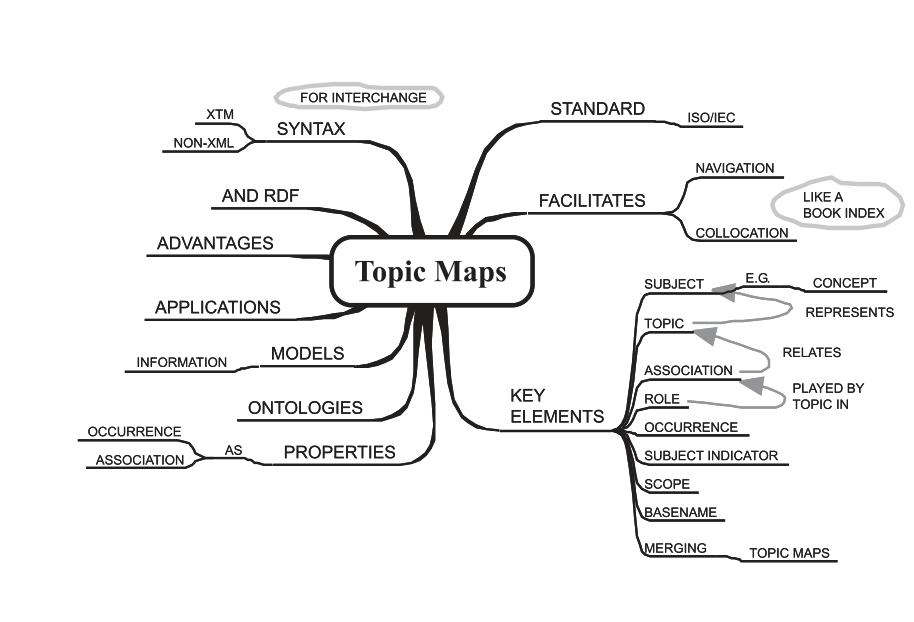
This work is from 2004, well before I came across the concept of Zettelkasten. Now that I have worked out how to combine both mind maps and my Zettelkasten I'm very happy.
Note the branches in the upper right labeled "Collocation" and "Navigation". Those are terms used in library science and are especially relevant to Zettelkastens.