Writing without AI

What has always been natural for mankind is dwindling: Writing without AI.
In Science, there was a piece on it recently, maybe interesting to compare with our own experiences?
https://www.science.org/content/article/i-had-unplug-ai-rediscover-my-love-writing?utm_campaign=Science+Magazine&utm_medium=ownedSocial
Y'all have a wonderful week
Marcel
How to zettel for stellar revelations? What a fantastic journey!
Howdy, Stranger!
Categories
- 3K All Categories
- 153 Research & Reading
- 703 The Zettelkasten Method
- 12 Knowledge Work
- 102 Writing
- 474 Software & Gadgets
- 158 Workflows
- 733 The Archive
- 15 Plug-In Showcase
- 88 Resolved Issues
- 225 Projects Logs and Journals
- 86 Project: Zettelkasten.de
- 53 Critique my Zettel
- 179 Random
- 375 Introduce Yourselves!
Comments
Was it ever natural? Writing without AI was the only option. But writing itself has never been natural for humans. Writing has been invented only a few thousand years ago. Writing has been only taught to all boys for maybe 200 years or so, to girls even later. Even today widespread literacy isn't a given in all parts of the world.
There's no need to learn writing when you can talk to people—or machines. :-)
Maybe this is less about AI and more about rediscovering the value of composing text in writing? When I was researching the origin of the phrase "writing is thinking" I found a manual for composition in secondary schools, published in 1913. It's neither the first nor the only occurance of the phrase. But I find the context interesting: schools. It has been known in pedagogy for a while that school kids needed some convincing, why they should care about text composition.
I think we're discussing the same question as the author did over 100 years ago: "why should I learn to write?"
What's new about AI is that you can produce apparently perfect text, but without thinking and without understanding.
Obviously, the problem for losing part of ourselves by AI (or better: The reckless neglect we engage in) is urgent and important.
I have two points of criticism:
(1) The author is mainly highlighting the hedonic damage done by the process. The verdict is not the result of a comparative and weighing but a unidimensional evaluation of a single aspect. Imagine a scientist who could vastly improve his productivity with AI which would give him a shot at curing cancer. But because he doesn't enjoy the process, he forgoes the opportunity. This would be a person who values his personal pleasure more than lives saved and life-shattering tragedies prevented. I omit the next step which would be the ethical judgment. The point is that this article offers a very limited quality of evaluation.
You'll find phrases like "AI was making me a less critical scientist". But at the same time, there seems to be little complaint from others who were impressed by both the quantity and the quality of the output.
(2) "(R)eviewers commended the quality of my writing. Except I did not author most of those texts. I came up with the idea, the experiments, the data, and the references. (...) I would feed the chatbot my results and ask it to write the story I wanted to tell, and it would always oblige, never questioning my ideas."
The author critiques that "the papers [AI] produced seemed good on the surface, once I started to actually read them in detail, I found they often said very little." However, it seems that both his supervisor and his peers were praising him for the quality of his articles.
Something doesn't add up.
To me, the first point of criticism is more important as it feeds into the second point, too. It just takes too much time, both individually and collectively, to arrive at an evaluation that is reasonably complex enough to meet the demands of the problems if you approach the problem with such methods.
My personal experience with AI usage for writing is overall very positive. I might be a special case because my natural English writing is pretty jagged and the smoothing effect of AI offers reasonable counter-balance. But I never use AI to produce other than in utilitarian situations like title suggestions for articles.
My negative experiences are the result of me thinking that AI is surprisingly incompetent when I think it should be more confident. Comprehensive criticisms are as much slop as its output is.
I make it a point to develop specific skills for my needs. I have, for example, a line editor skill that I stuffed with the specific rules and patterns of writing advice that makes sense to me. It basically guarantees that certain bad habits of mine are highlighted and shoved in my face, once I was made conscious of them. But I have to manually edit the text myself.
With the first question, you introduce the problem how to distinguish between what is natural and non-natural per se. The same criticism could be pointed towards language itself as we are lingual creatures for a comparatively period of time.
I think we can steelman a little bit by accepting that writing without AI is a well-established and deeply examined cultural technique that feels "natural" enough to individuals who practice this cultural technique. (Culture is also natural... )
)
There is also no need to chew since you can grind everything to mash. However, your teeth, your jaw, your digestion, your mood, and a lot more won't be in good shape (which you only can experience, when you are aware of the alternative).
The concept of "need" is not the right one to apply here.
With the rest, I have to agree.
I'd like to connect what you brought up with my criticism: You are pointing the attention towards the cognitive benefit. The students ask why they should engage in something unpleasurable when there is no clear upside for them. The counterpoint to them is a simple "because it makes you smarter which benefits you independent of writing".
A more comprehensive perspective, especially, when it is not questionable if writing is beneficial, is how to balance pleasure and outcome (given that you can improve the outcome by using AI).
My take is to go one step beyond and examine the purpose of pleasure itself. But this would be one step to far for this topic I think.
I'd add one caveat which makes this statement even more extreme: You can produce apparently perfect texts without thinking, understanding, and without immediate access to the quality of the text. If the produced artifact is beyond your competence, you can't even evaluate its quality.
I am a Zettler
Right now, I am deeply reflecting on my personal relationship with artificial intelligence in the realm of developing knowledge and ideas.
I use it for certain things, and there are significant impacts, both positive and negative.
I am taking the time to formulate a personal conclusion, which will inevitably be two-sided.
Excuse me for not expressing it properly. I meant: When writing (in a certain intellectual sense, beyond shopping lists and the like), then it has been without AI (naturally, because it was not around then).
I think it resonated with me because when reading that title, "Writing without zettelkasten" came to my mind. What huge gap this is! Verbose, semi-digested training material from AI, but concise, thoughtful input from my former self in the zettelkasten. And still, all material, also from AI, may inspire me. In those cases I turned to AI, it usually was for more examples for some teaching material. Mostly, it were inspirations rather than directly usable answers.
How to zettel for stellar revelations? What a fantastic journey!
Bastien Le Guellec's' Science post opens with a remark about learning to write: "I felt like I was learning to write again". He describes the experience as intimidating and overwhelming. As a reader I immediately wondered why he makes the effort.
We learn about his intrinsic motiviation: "I had loved writing since I was a teenager." We learn about the pride he takes in his writing style. We also learn that he was frustrated by the supervisor's feedback.
Interesting hypothetical. Under what circumstances should individuals sacrifice personal pleasure for the greater good?
I don't think that Le Guellec is facing such a choice. AI-assistance not only harms his motivation, it also reduces the quality of his work (emphasis added): "And although the papers it produced seemed good on the surface, once I started to actually read them in detail, I found they often said very little. I realized writing is a process that not only transforms ideas into text, but also allows the writer to continuously question and refine those ideas."
The same could be said about keeping dogs or building houses. But I didn't say such thing. I'm emphasizing that nothing is "natural" about writing, it's cultural.
Yes, a cultural technique can feel natural to an individual. But that's a different claim than saying that this cultural technique has "always been natural for mankind".
Chewing isn't a cultural technique that people have to learn. It comes naturally. (And yes, we live in times where you can conveniently buy and process food that you don't need to chew anymore. And if you combine it with a sedentary life-style you ruin your body. But that's a different topic.)
No. It doesn't benefit them "independent" of writing. Writing itself has benefit.
Writing enables them to do things that they couldn't do without writing. Richard Feynman once told Charles Weiner in an interview that his writing doesn't record work done in the head, but that he works on paper. If you can't write, such work is out of your reach.
Yes! And that's why I consider AI not only a challenge to my text composition skills and subject-matter competence, but also to my reading comprehension skills.
Thanks for the clarification! I hope you don't mind that I went beyond what you intended. :-)
I enjoyed the article, thanks for sharing. I liked how the author describes both sides of writing, an intrinsic motivation and the struggles.
The relationship between AI, Zettelkasten and writing is an interesting topic. My instinct is to look at history. :-) Let's see where this threads goes. Thanks for the inspiring title!
Please reread the second point I brought up. Something doesn't add up.
You operationalized naturalness (or the lack of it) by time ("But writing itself has never been natural for humans. Writing has been invented only a few thousand years ago. Writing has been only taught to all boys for maybe 200 years or so, to girls even later."). Therefore, I chose a rather extreme example to show that what the concept of naturalness doesn't hold up to scrutiny, unless you want to say that being lingual at all is not natural to use people. Then I'd say that being people isn't natural to us, since we exist as homo sapiens sapiens only for a small fraction of our evolutionary history.
We don't need to nitpick words. "Always" as @Marcel_Liauw wrote is a typical casual hyperbolism to indicate that it is a long time. When I say "I always tied my shoes in this particular way.", you don't object and say: "Even when you were a baby...?". Hopefully at least.
I didn't make any claims about the naturalness or unnaturalness of chewing as you didn't refer to the naturalness when you claimed the lack of need of learn to write when you can talk to people and machines. The point is about utility being the framework to argue within opposed to need, not about naturalness.
Perhaps, I phrase my point differently: You tell the students that writing is not about becoming a better writer, but to improve as a thinker.
I am a Zettler
So much depends on your goals. If you have taken up painting and want to have a pleasant wall decoration, getting a chatbot to produce one may be much better than you painting one. If you want to get good at painting because you love to explore subtle patterns of light and dark, you need to develop that skill; the chatbot can't take its place.
If we all lose our cognitive skills then we won't be fit to pass judgement on the work of chatbots.
What doesn't add up is that the author's readers prefer the AI-assisted output. We don't know why. The author is critical of the AI-assisted work, but the readers apparently are not.
I do think that a few hundred or thousand years are rather short compared to the whole history of mankind. In my mind I was comparing the history of writing to the history of other human inventions like steam machine, horseback riding, farming, metallurgy.
I could have explained it better. I should have mentioned terms like "culture", "evolution" or "tool usage". Thanks for pointing out, what was missing.
I wouldn't have objected, because the "I" in the example implies that "always" refers to your life span. And because we're talking about an acquired skill, the common understanding is that you mean "always since you learned that skill".
I didn't get your point, because chewing isn't a learned skill.
Let me take the shoes as an example. I don't say that you should learn to tie shoes because it trains your fine motor skills, but because you will be able to tie your shoes.
If becoming a better thinker is the goal, one could argue that interacting with a well-designed AI tutor might be more effective than thinking in writing. The AI tutor adapts the challenges to your skill level, constantly tests your knowledge and gives you exact the kind of feedback you need to improve. This kind of learning is much more common in the history of humankind, considering that most of the time writing hadn't been invented yet or was limited to a small group.
Composing texts in writing is a skill that needs to be learned. So why invest the time and effort to learn the skill, now that we have AI?
I think we should listen to educators who encouraged students to write, like the one mentioned earlier. The old book suggests that thinking in writing increases the precision of your thinking.
But who says that he is still correct? Maybe an apprenticeship or regular debate with an AI is a more effective training tool? Maybe you write better papers when you don't chat with yourself but with a bot?
@harr said:
I am too sceptic to jump on AI as enthusiastically as others (often younger people) do. I found an example fascinating by a pupil who prepared his final exam (Abiprüfung). Here is a screenshot.
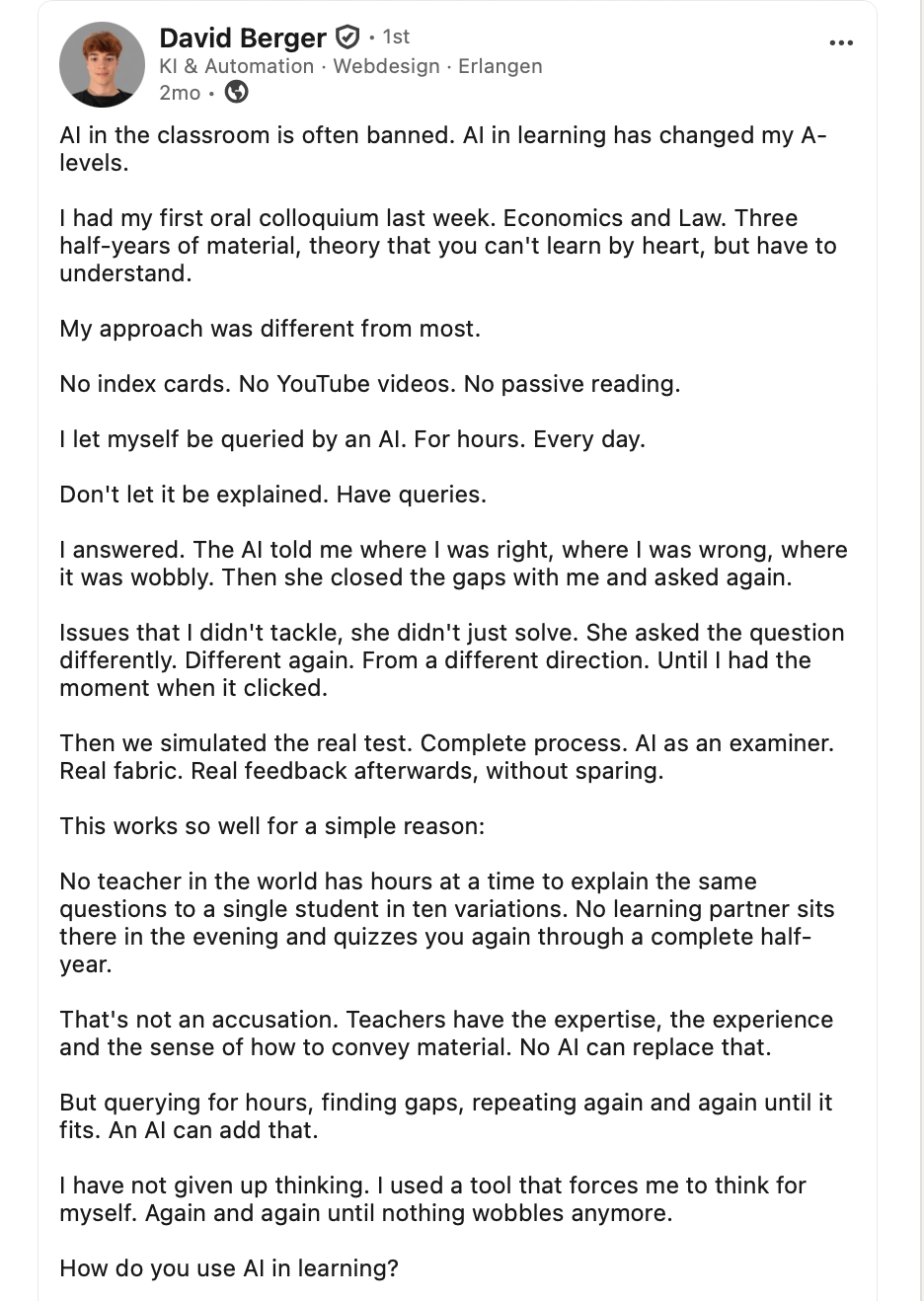
If I translate this to myself and my zettelkasten, maybe supported by some smart AI, it might be a fruitful story, following @harr's thoughts. Use of AI has been reported in this forum more than once. Maybe I try more than before after this discussion.
How to zettel for stellar revelations? What a fantastic journey!
I have read the article you posted, thank you.
I am not particularly surprised by what I read.
It is something I foresaw a few years ago.
Our cognitive abilities need to be trained; otherwise, we lose the habit of using them and, consequently, their effectiveness.
The use of AI un-trains us in certain cognitive skills. There is a huge hidden cost behind the productivity benefits it offers.
I am always very afraid of this effect. I use AI for some things, but I have reflected deeply on how to try to avoid its negative effects. After I've saw this discussion, I've spent hours today to reorganize and consolidate my position about AI in these contexts.
Of one thing I am certain: I was very fortunate to discover the Zettelkasten method first, and only later ChatGPT. Had it been the other way around, my cognitive life would have turned into a disaster. The practice of Zettelkasten, learning and knowing it have, in a way, shielded me significantly against the effects discussed in the article.
P.S. I wrote this post without any AI, but I translated it into English using Gemini.
Fully aware that while this practice will preserve my ability to reason and put my thoughts on paper, I will end up losing my ability to translate :-)
Update
In my reflection today, I built a framework crossing four different motivations for using AI I've identified in cognitive contexts (producing something based on ideas and knowledge, developing ideas and knowledge, learning, and art) with my three distinct personal motivations for using Zettelkasten (producing something, developing knowledge and skills, and deriving gratification from what I do). Within this framework, I tried to map out the risks, opportunities, and even the necessity of using AI.
It is something very personal, not based on any research that could support my ideas, but purely on my own feelings and reasoning. Still, it remains a bit more nuanced than simply saying "AI is good" or "AI is evil." I've realized that there is no single path in one unique direction; in every context of use, the weight of risks and opportunities shifts.
I arrived at a particularly deep conviction, for example: a under 18 student should not have access to AI. Studying is not a productivity exercise.
I set myself a challenge: try to do all this work without any help from AI, using the Zettelkasten. I succeeded—it took some time, but perhaps I am still a thinking being.
Yesterday, I had a personal reflection on a similar point.
I hypothesized that the use of Artificial Intelligence could be a tool for better learning. However, my thought was that there is likely a major problem: the conventional learning paradigm, as it currently exists, is not compatible with such a tool.
It could work if the way we learn were revolutionized. But that is not happening right now. We have a "new" tool inserted into an "old" way of learning. And I don't think it works.
To give a very rough example: today, the standard practice is to learn by "doing exercises": writing more or less complex essays, solving problems, translating passages of text, reading a text to understand it and extract its meaning, and so on. If you introduce AI into this "old" system, you essentially obliterate the exercise.
I think there is a complete lack of a pedagogical theory regarding the use of AI (I don't know what else to call it); perhaps the tool exists, but the school system has not yet grasped how to use it.
These are just my own speculations, of course, as I don't have any studies on the topic at my disposal.
It's an interesting point. As I mentioned earlier, new tools might require new ways of being used. It remains to be seen whether the learning was truly solid or just this guy's subjective perception.
Nice! That's how I imagine working with an AI tutor.
Interesting detail: the post describes preparations for an oral exam. The interaction between AI tutor and student prepares for a conversation between humans.
The clipping obviously was from LinkedIn, and the guy was asked a lot about how he did it. He had uploaded all class material in the AI, and where the AI made mistakes, he corrected those.
Reminds me of "Smart people work with the AI, non-smart people let the AI work for them." There are exams where students are permitted to bring one double-sided handwritten page with all information they anticipate needing in the exam. By that time, after condensing and writing up everything, they have memorized and understood so much that the page is no longer needed.
Along the same line, once you have trained the AI as a perfect exam preparing helper, you have nailed it anyway.
How to zettel for stellar revelations? What a fantastic journey!
That's the fascinating part of technological revolutions. The new tools are changing everybody's lives fundamentally, yet it's difficult for contemporaries to predict in what way. It's not only the schools who are struggling. We're all in this together. :-)
At the same time the tools themselves are changing. The first time I talked to a chatbot was less than 4 years ago, when ChatGPT was released. Now I'm running LLMs locally on my Mac with some (tiny and timid) agentic workflows. Context windows are getting bigger and the AIs are using a more iterative approach to answering, so I can ask more complex questions and create more complex workflows.
Personally, I experience my lack of imagination as the biggest limiting factor. :-) I'm working with AI now in a way that I couldn't even imagine four years ago. Maybe four years from now I will be using tools I can't imagine now in a way I can't imagine now?
I can imagine that AI tutors will become a standard tool in education, because they already have been imagined in science fiction and because they are an obvious next step in educational technology and because students (and their parents) are already spending lots of money on tutoring. There's also plenty of pedagogical theory available, if an AI tutor is supposed to simulate interactions with a human tutor and/or extend current paradigms in ed-tech.
The school system will have to adapt to such developments. I can imagine that schools will put more emphasis on social, emotional and motor skills. But maybe schools and universities will cease to exist in the current form, because other forms of education work better?
I find it challenging to imagine possible futures of writing. Maybe "writing without AI" will become a niche interest like writing without computers? :-)
Forgive me if I crush the party, but given that SI-supported writing devours incredible amounts of energy and cooling water, makes our every move and thought seen by third parties and is vulnerable in times of war or crisis, "writing without AI" may be what we may never fully abandon.
How to zettel for stellar revelations? What a fantastic journey!
Local, on-device AI already solves some of the ecological, availability and privacy problems.
I don't expect that we will fully abandon "writing without AI" either. But it might go the way of cursive handwriting since we have devices with keyboards and dictation.
I'm neither enthusiastic nor pessimistic about AI. But I'm convinced that we're experiencing a technological and cultural revolution, that will fundamentally change cognitive work.
Absolutely, thank you for putting it in perspective.
The beauty of handwriting over typing is found by several studies such as
https://www.mdpi.com/2075-1729/15/3/345
"Handwriting activates a broader network of brain regions involved in motor, sensory, and cognitive processing. Typing engages fewer neural circuits, resulting in more passive cognitive engagement."
While I do type in my digital zettelkasten, my small (5.12" * 3.66") notebooks for collecting material are still filled by hand and pen.
How to zettel for stellar revelations? What a fantastic journey!
I use a chatbot as a kind of sounding board to evolve ideas. I don't pay close attention to its replies but trying to correct its errors and misunderstandings clarifies the ideas for me. I sometimes find myself getting into a flow and having ideas flow and evolve almost faster than I can keep up.
Right now I have a text file with enough snippets from my recent conversations that it will take me a long time to convert them into z-cards.
Talking with a person can have the same effect except I don't usually have such a person and it would be unfair to inveigle one to such long sessions unrelated to their own interests.
However, the chatbot sometimes tries to impose what it thinks are my patterns and desires, and it can be hard to get it to change course. CoPilot, at least, tends to invent jargon and insist on using it.
I have noticed that chatbots are very weak on tasks like free association. Their responses have been timid and boringly conventional. Of course that's what one would expect, given to how they generate text.
Very interesting remark indeed. Indeed, there are rarely true surprises, which us zettelkastonauts are wishing for. The same is true for many zettelkasten that turn out less surprising than expected.
I think for true surprises, there are several criteria to meet. I only recently started thinking about it and will keep following it.
When I can come up with more meat, I will be happy to share it. Some recipe for high-quality keywords would be desirable. I might search this forum for inspiration.
How to zettel for stellar revelations? What a fantastic journey!
I think this is very important: if you can't find it you can't work with it. This quality seems the opposite of surprise, though.
I have written a script for my ZK system that picks a z-card randomly and shows its immediate (semantic) neighborhood. That lets me see what I have that's similar to the chosen card in some way. Sometimes the chosen card is something I have forgotten about. A recent example is a z-card for a recipe. I had completely forgotten that a year ago I experimented with putting recipes into the system.
Surprise is partly a function of one's own receptivity, let's not forget this. When you are very focused on some task, some specific search, some particular idea you can overlook connections and new associations. Another time with the same search, you may notice something that leads in a few steps to something entirely unexpected. The whole thing works as an interaction between you and the system. The system can't do it all but the system can be designed and used to help.
You may find that pre-coordinate indexing, a concept in library science, to be of help. The search function of my system was influenced by this concept. Here's a definition:
See https://dictionary.archivists.org/entry/precoordinate-indexing.html
Elaine Svenonius wrote [1]:
[1] Svenonius, E., The Intellectual Foundation of Information Organization", 2003, The MIT Press
This is essentially the same as using compound keywords. The art is in how to construct a good set. They should cover semantic regions that have turned out to be useful to the user (you!), and those regions should arise as you learn more about how you regard your z-cards (as opposed to trying to figure them out beforehand).
In terms of their equivalents in an outline, the "subject language terms" (as they are called) are the nodes that organize the outline - to be inserted as the outline grows and develops.
I keep thinking about said M.Z. Ahmad. In his example-stuffed book, the zettelkasten probably belongs to a business consultant. The numerous "payoff sections" always follow the same pattern: When facing a case, he extracts two keywords (e.g. "strategy" and "operations") that supply him with good zettelkasten material he may already have forgotten. Two other keywords may add to this. That sounds nice for that business consultant.
I am in chemistry and reaction engineering. If I look for real-life examples for low solubility, I only find those examples I entered in my zettelkasten before and which I probably would have remembered anyway. No surprise. The quality of my zettelkasten lies in filling it, not in tapping surprises. Most zettels are straight, face value, no hidden layer.
I may need to remember serendipitous lightbulb moments before I started the zettelkasten, and look for the surprise mechanism.
(Written before your latest post)
How to zettel for stellar revelations? What a fantastic journey!
Thanks a lot, will check it out!
How to zettel for stellar revelations? What a fantastic journey!
I think that the importance of individual z-cards is over-rated. What counts for more (if we want to go beyond the world of ordinary fact retrieval) are trains of thought (or, as Vannebar Bush wrote in his 1945 article about the Memex) trails.
Say I want to refresh myself on my thinking about concepts, beliefs, and their relationship. Maybe I want to check my own definition. Maybe I think I'm ready to extend that line of thought. Maybe I'm not satisfied with where I left it. What can I search for? I probably won't remember any exact title and there might not be one exactly like that anyway. As long as I can intercept that trail somewhere, I'll be able to proceed. The z-cards that form the trail should be able to sync up my mind again to what I was thinking.
So I run a search for the simplest possibility: "belief". In my organizing headings, what do I find?:
Knowledge/Beliefs
Knowledge/Beliefs/Definitions of Belief
Knowledge/Concepts/My framework for Concepts And Beliefs
Good, that last one, that looks like the place to start. I can also look at the other search display, where card titles get clustered under their organizing label (equivalent to compound keywords):
Zettel Matches for belief
Knowledge /Beliefs /Definitions of Belief
Wikipedia on Belief
Mirriam-Webster Dictionary On Belief
Stanford Encylopedia of Philosophy On Belief
Knowledge /Concepts /My framework for Concepts And Beliefs
Definition of Belief - A Space of (Concept × Attachment)
Knowledge /Concepts /My framework for Concepts And Beliefs /Definition of Belief - A Space of (Concept × Attachment)
Rhetorical Argument's Purpose Is To Induce A Belief
"Oh, yes, I remember. Say, look at that last one - not what I had in mind but let's check it out - [why did I put it there? where else would I put it?] very cool, very nicely worked out." Like any trail, it may grow new branches as you think about it, and that can become more material to put into the collection.
It's rare that I remember enough to identify a specific z-card. The best I can hope for is to get into its neighborhood, then scan. Sometimes the same search phrase shows up in an entirely different neighborhood, about something else altogether. This can be a pleasant surprise and stimulate me in some new direction.
Neighborhoods and trails - IMO this is where a Zettelkasten can shine.
Great!
After a good night's sleep, I saw clearly that I could take the "neighborhood" idea up along the line
https://en.wikipedia.org/wiki/System_archetype
The basic mechanisms of dampening, reinforcing and delaying govern almost all processes. I would add the relevant archetype to each zettel where it is warranted. For a given problem, I would get examples and applications from most diverse areas for certain.
I realize @GreenBeing already addressed systems theory eight years ago
https://forum.zettelkasten.de/discussion/252/the-zettelkasten-method-applied-to-systems-thinking
How to zettel for stellar revelations? What a fantastic journey!
The example of David Berger is a perfect example of a hidden danger. The more you adapt challenges to your needs, the less you will be prepared for situations in which you have a bad teacher, you feel overwhelmed or anxious, etc.
A typical thought school for creativity is to remove all pressure, judgment, make you feel safe, etc. It is often advertised as in itself valuable, a good way of living. I think that this is yet another modern sanitization of Life (capital L).
Learning to be creative while the world is crushing down on you is a serious skill and also lets you be creative more freely and access your creativity outside a sanitized place like the perfect dream library or the cozy artist's shop.
This is why I am much more interested in creativity in the trenches of the first world war, in the gulags, and concentration camps (how could such a beautiful book like Man in Search of Meaning be written in such a disgusting place?). How is it possible that some people preserve the beauty of their souls in places that destroy other people? How to some people become obsessive and yet avoid being crushed by the obsession.
It reminds me off the topic inspiration. I wrote a short essay on the dark side of inspiration (actually, an essay about the essay that I never published). Inspiration is typically thought as light and positive, though there is a lot of darkness involved when it comes to people who inspire.
Perhaps, I am a little bit offtopic and a little bit too much of a mood killer approaching the topic from this side. Still, I think that the repression of the shadow, like Jung would call it, is creating a blind spot.
I am a Zettler
Well, that has certainly been an unexpected twist in this thread, but not necessarily a bad one. For me, it evoked a scene where I am locked in a tight spot and mentally delve into my zettelkasten to keep my sanity.
This image may have come up because after working with a zettelkasten for quite a while, it may feel like chatting with a close friend - one with a huge memory and a love for surprises.
(post written without AI in spite of "delve" and em-dash)
How to zettel for stellar revelations? What a fantastic journey!
I've run into the problem that when I want to write something, and specifically in a certain way, trying to do it with AI's help is truly overwhelming... because there are always things that make its texts feel generic.
There's ChatGPT, which in some ways tries to be a bit more "human," however, it's not the same. For a text generated by this AI to sound really like "you," you'd have to talk to it every day and practically give it your personality, but even then, it will never achieve the authenticity we can demonstrate in our own writing.
Personally, I don't use AI to write, however, on many occasions I have had to use it to learn HOW to do it in a certain way. Perhaps it's also useful for finding new ideas or for finding the perfect title... Perhaps even for ideas on how to organize your topics or a text, but the authenticity of the content has to come from us, or at least that's what I think.
Over time, I've tried to figure out, on a personal level, what is appropriate to ask an AI and what is better to do on my own.
It seems to me that I've never asked an AI to "create a zettel for me from this text," "extract the ideas from this text that I can put into my Zettelkasten," or "come up with a title for this note."
I may have asked, perhaps because I was tired, lacked motivation, or was under pressure to write a lot, "I have this idea (which came from me): generate a small description I can use in a note." Or, "this is my idea, what do you think of it? give me a feedback".
**Never asked **" find connections between this idea and other past ideas".
I've sometimes asked, "Let's create an example together to explain this concept better" into the note.
I don't ask, and I will never ask, "here are a few ideas from me/my Zettelkasten, generate a short publication, post or answer to a question for me."
There is an inherent danger in this process of mine. I could easily fall into the mindset that "what I do is right" and "what I avoid is wrong." So, I tried to find criteria that would allow me to determine what is right or wrong:
Developing ideas, condensing them into an effective title, connecting to other ideas are strategic activities into my Zettelkasten.
Creating filler text in a note, although I consider it important, takes a slight back seat, but I try not to overuse the help.
I use AI a lot to quickly find the meaning of a word I don't know, a brief overview of a principle or theory (for example, "what is Gibson's ecological theory?") or a quick answer to a one-off question. Essentially, a highly advanced search engine.
I still have to evaluate whether breaking down someone else's text that I don't fully understand is something I should do myself or if I can leave it to the AI.
My gut feeling is that I want to keep this skill. However, for very secondary texts and use cases, I sometimes get a helping hand, especially when I'm very tired. Sometimes I need to know if the text contains something valuable before I read it.
Now, I rely more and more on automatic translation from Italian to English (and unfortunately, I must say).
As an example, this post was created entirely without AI, only translated from Italian to English using AI.