Any ideas to improve the quality of notes in Zettelkasten?

Edmund Gröpl — 100% organic thinking. Less than 5% AI-generated ideas.
Howdy, Stranger!
Categories
- 3K All Categories
- 153 Research & Reading
- 706 The Zettelkasten Method
- 12 Knowledge Work
- 102 Writing
- 474 Software & Gadgets
- 159 Workflows
- 733 The Archive
- 15 Plug-In Showcase
- 88 Resolved Issues
- 225 Projects Logs and Journals
- 86 Project: Zettelkasten.de
- 53 Critique my Zettel
- 179 Random
- 375 Introduce Yourselves!
Comments
@Edmund Interesting idea, but is a root cause analysis applicable in your situation? My understanding is that it is used when something has gone wrong or some complex system has failed, the cause of which is not obvious. One carries out a root cause analysis to determine the true (usually deeply hidden) source of the problem and eliminate it, rather than treating superficial symptoms.
(However, my understanding of this topic is likely biased by where I have seen it applied, i.e., in engineering applications.)
What is the problem you are trying to solve? What is the system you are examining?
@Edmund, my approach to improve the quality of notes can be summarized in one question:
Do the notes fit their purpose?
I don't see how one can look for causes, root or not, without knowing in what regards the quality is low. That is closely related to the purpose of a note.
For example, if a handwritten note is hard to read, the immediate cause might be lack of practice on the part of the writer, or some physical condition that makes writing hard. Those are not the root causes but maybe the problem can be fixed by typing the notes even if the root cause analysis were never completed.
If the problem were that the notes were too complicated, the analysis would be quite different.
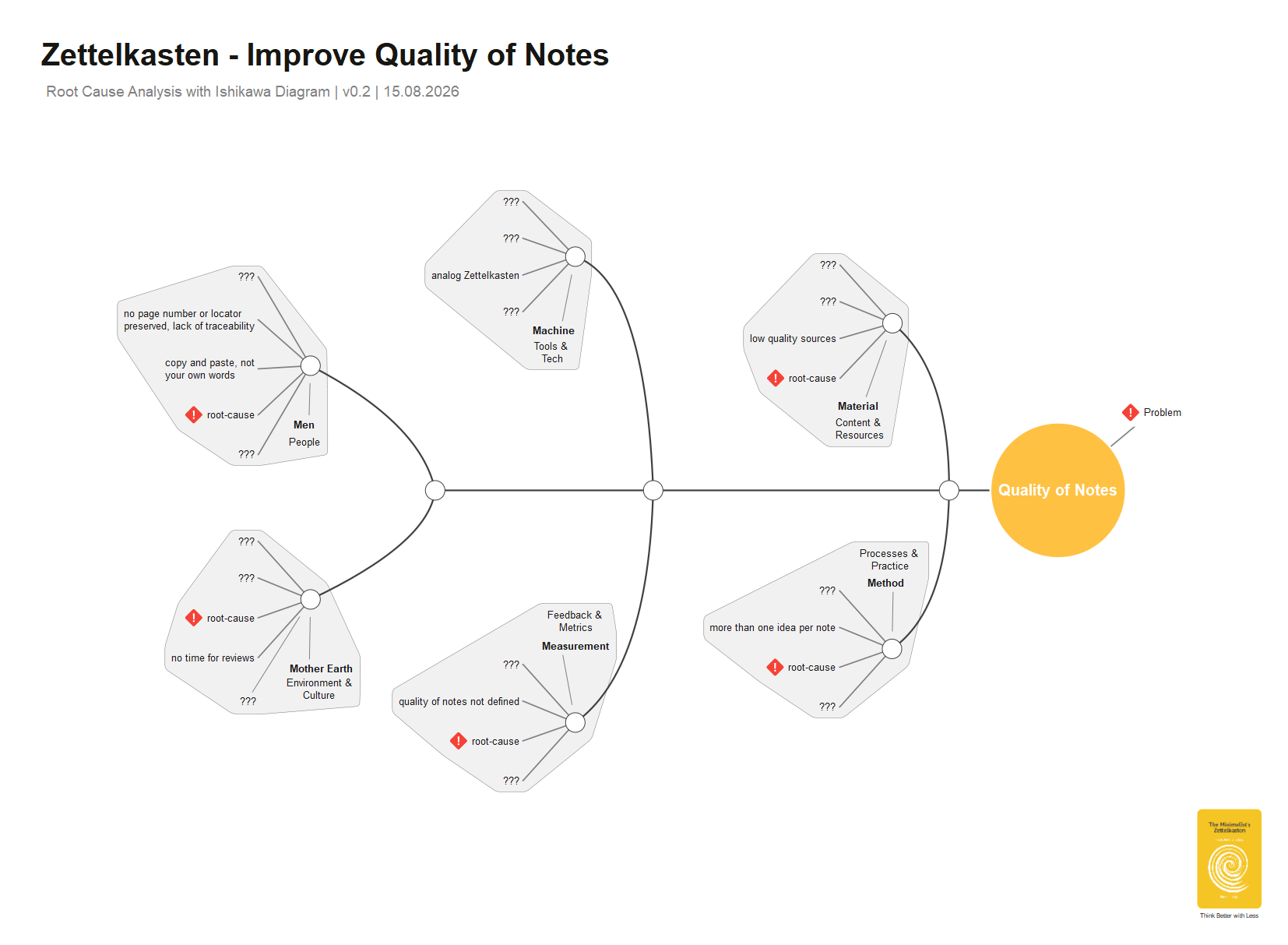
Good questions. Let me improve the problem statement for this example:
I think it works best when the problem statement names the effect we are observing.
Edmund Gröpl — 100% organic thinking. Less than 5% AI-generated ideas.
Good! Getting closer. What did you expect or want from the notes, that isn't happening when you return to them?
First, quality would need to be defined. Or rather, the many qualities.
Each of them could have its own specific paths.
In software development, I believe it even reaches up to 50 dimensions. (I wouldn't want to go that far in this case).
I have always liked the Sascha's Flower Idea Model, even if it does not cover all desirable qualities.
Then there are the "classic" properties like focus, connection, abstraction, and so on, but I would also consider clarity and findability/revisitability, degree of maturity, originality. List can be long.
Personally, I have never consolidated them all into an exhaustive list; I look for what I need in a specific moment based on intuition.
A good software bug report contains enough information to help the readers understand enough to make a start of fixing it. Let's try that out here - this template is a good enough representative of its kind:
For software, one would also want to know what system and version you have. That's probably not quite right here, but please talk about at least the part of the system that is involved when the symptoms happen.
E.g., not
but
The symptoms may not be reproducible. In that case, fixing them will be harder and the apparent trigger may not be what you think.
Here are a few ideas:
Content & Resources
People
Environment & Culture
Feedback & Metrics
Hmmm. None of these criteria work for me.
@Sascha's definition of Good depends on a definition of "proper". Apparently there is an ideal that needs to be matched. What is this ideal? How can we measure how close we came to the ideal? How can we determine that we have achieved this ideal? (Do you want to chime in, @Sascha?)
I think of a good note as a note that captures your thoughts and supports your thinking in a way that is useful for you. If you find it useful to have "proper" notes, I'd recommend clearly stating what makes a note "proper" by your own standards.
Currently, I don't see any difference between improving the idea and improving the note (as long as you aim to capture one idea per note). Nietzsche wrote:
Improving the style is improving the thought.
I say: Improving the idea is improving the note.
This is why I wrote the guide to atomic note-taking (which is a universal skill, independent of the Zettelkasten Method): partially as an introduction to that skill.
I am a Zettler
I like the quote, so I checked the source. This is the German original:1
I find the relationship between writing and thinking fascinating. This quote was missing in my Zettelkasten. Thanks!
Friedrich Nietzsche: Menschliches, Allzumenschliches. http://www.zeno.org/Philosophie/M/Nietzsche,+Friedrich/Menschliches,+Allzumenschliches/Zweiter+Band/Zweite+Abteilung%3A+Der+Wanderer+und+sein+Schatten/131.+Den+Gedanken+verbessern?hl=stil+verbessern ↩︎
In my current internal framework, an idea and a note now almost always coincide by default, but sometimes it is useful to treat them separately.
A note is a physical level, while an idea is a mental level.
Where separating these two levels becomes particularly useful is precisely when discussing properties and qualities.
In my case, for instance, the same property, "future proof" has two different meanings, and therefore requires two different treatments, depending on whether you intend to pursue the physical one or the cognitive one.
I find the relationship between idea and note interesting. What do you all think:
Let’s use my own Zettelkasten. Here’s the systems map:
It's better to have a specific example than a general concept for further discussion.
Edmund Gröpl — 100% organic thinking. Less than 5% AI-generated ideas.
My view on quality:
Principles to improve your Zettelkasten — Zettelkasten Forum
How would you define it?
Edmund Gröpl — 100% organic thinking. Less than 5% AI-generated ideas.
Four questions, four answers:
1. I do not find useful ideas within my Permanent Notes when trying to fill gaps when writing.
2. I search for relevant key terms in my indexes. I narrow the search by using tags. I inspect my ideas network within Obsidian Local Graph. I do not find useful ideas.
3. I expect to find a Permanent Note that helps closing the gap.
4. I took more time for searching. I started to reread sources already mentioned in my Literature Notes. I started research for other sources outside my Zettelkasten. I asked experts for help.
Edmund Gröpl — 100% organic thinking. Less than 5% AI-generated ideas.
This is one of the reasons why writing a Zettel differs significantly from producing a final output; very often, the idea within the Zettel needs to be "rehydrated", provided context enough for comprehension and tailoring writing for the audience.
Another big point, often the author use writing oriented towards future personal reactivation for its Zettelkasten. To ensure it can be conveyed to others, one must cultivate clarity for others.
I think you can create a Zettelkasten that is "usable by others", but you have to build it specifically with that intention, it doesn't happen automatically.
There are things I never considered. The list of potential zettel qualities is like Gremlins :-)
Ok, this is goof, thanks.
Let me make sure I understand you. Do you mean you know there is a card but you can't find it? Or the search doesn't surface one so you are pretty sure there isn't one?
Do you expect to find a card that is almost ready to slot into the writing, or are you hoping to find inspiration?
Ok, none of those in 4) address either case I asked about: no card, or card but can't find it (except maybe asking experts).
Can you show us a representative card you would expect to find, even though it's not right for closing the gap? How were you able to find it - search terms or however you did find it.
If you will indulge me I will write a little about how I worked up the slides for for the presentation version of a paper of mine. Maybe it will give you ideas.
Since the publication version was done. I used that as a guide to the slides. But the slide audience was different - live slide show instead of reading a long paper in a browser, and I had a time limit for presenting it. So I couldn't simply copy the paper. What I have found is that writing for a new audience forced me to make new distinctions and find new ways to clarify and simplify the content. I also got some new ideas as I did that - writing tends to do that for me.
Since some of this material was new or involved new distinctions, although I was able to refer back to the existing notes - which include many I created during writing the paper - there were no notes for some of the new material. When I thought the new work warranted it I created new cards.
I also outlined and expanded much of the material by making new mind maps, and I also looked at mind maps I had made for the paper. One of them made it into the slides.
I put several mind map images and rendered cards up on my second monitor where I could keep looking at them and this was very helpful. Some of these cards were parts of the slides and were never going to become permanent cards. But seeing several of them at a time helped to keep the flow right, and reminded me of what I had written before, or what the outline was.
Working this way was fun and stimulating, and I got too many ideas to fit into the slides, though some became notes. Some went by the wayside and I will probably never remember them.
My pre-existing cards were somewhat familiar because I had used or created them while writing the paper but I needed to remind myself of what they said. Sometimes they would kick off ideas that made their way into paper and sometimes into new notes. Sometimes not. Sometimes I would realize that a card needed updating.
I created a few new citation cards during this process, too as I found some new references.
For me, this dance or continual interaction is what makes things happen. Having the ZK makes them happen faster and better, and is more enjoyable.
Sorry to be so long-winded.
I forgot to say that there was no instance in which text from any card made its way as is into either the paper or slides except for a few quotations, eg., from Luhmann. The cards helped the writing but not by slotting text in.
I have similar questions to @tomp.
Do you mean gaps in your manuscript or gaps in your zettelkasten? Do you have difficulties to find zettels that might be useful, but don't resurface when you need them?
Are those ideas missing in your ZK? In that case you might have to write more zettels. :-)
Do you know that there are useful zettels in your zettelkasten, but you just can't find them?
Are you hoping for some kind of zettelkasten magic, like serendipity or emergence?
Can you give an example of such a gap? When I hear "gap", I think of a gap between (at least) two existing things. What are those?
That's how I find answers to my questions. Hmm. Are you sure that you ask the right questions, when you write zettels or look for zettels?
From that comment:
Each of these criteria are excellent for documentation. They work against what I want in my zettelkasten. If you focus tightly, you won't have notes with general applicability. If you spend a lot of time on accuracy and completeness, you are removing the opportunity for sparking creativity, connecting ideas, letting the cards have semantic value instead of being polished catalogs, of having the cards be valuable across projects.
Naturally we all need reference material of all sorts. But dozens of systems can provide that.
Here is one of my cards. It could seem tiny and
stupid but it inspires me every time I see it again. It gets me thinking about how I can use my own ZK even more effectively, it reminds me how much I value those qualities, and it reminds me of what I was thinking when I was first working out what I think are the important factors underlying successful systems of this sort.
The positioning of this card, at a quick glance, puts me in touch with related cards of all sorts. Here's a part of that neighborhood:
    Zettels aka Z-cards
        Ignition: Effective zettel design
        Scenes and Frames
        Use Cards To Get More Ideas
        About "Quotation" Cards
        Reuse Z-cards In Other Contexts
        A Z-card/Zettel Holds A Flattened Idea
            How can a complex idea be captured in a Zettelkasten?
            There are many kinds of complex ideas
                Trains of thought are one kind of complex idea
                Syllogisms are a kind of complex idea
                Arguments are a kind of complex idea
            Different kinds of complex ideas probably need different ways to capture them
                Mind maps are good for one-thing-leads-to-another
                    Mind Maps are not well suited for ideas with many inputs
    Software
        The Archive
        My Zettelkasten in Sublime
        Eastgate Tinderbox the tool for notes
        Zettels (command line)
        Zkn3
    Note Taking
        How to Take Smart Notes - Chapt 1
    The Zettelkasten as a Topic Map

    A ZK card should be a bundle
    Zettelkasten-Topic Maps Duality
        Can a Topic Map Annotate Parts Of An Occurrence?
    How Zettelkasten Work
-->     The Zettelkasten Triad (Serendipity, Synergy, Syzygy)
    Zettelkasten And Surprise
    Dialogs: Zettelkasten and Others
    Zettelksten Analogies and Metaphors
        How A Zettelkasten Can Stimulate Creativity
        Zettelkasten is Like "The Everlasting Meal"
        Zettelkastek Movie Analogy: Scene Re-inflation
        Zettelkasten- The Card Game
        Zettelkasten As A Game Of Trivial Pursuit

    Luhmann Archives
        Luhmann on Zettelkastens
        Luhman's Folgezettels: On Equality
            6.1 References On Equality
            6.2 Different Senses Of Equality
            6.3  [Equality] Conceptual Basics
                6.3.1 This point of view for comparison is generally
                6.3.2 Point Of View Is A Condition For Comparability
                    6.3.2a [cont'd from 6.3] an aspect like this cannot be compared
I probably don't even agree with each of those cards any more but that's not the point. This kind of neighborhood is even more important when you don't find a card that exactly fits the bill. It's like going into a library and looking through a likely part of the stacks. You are more likely to find something useful, interesting, or wonderful than of you just sent in call numbers and received those particular books.
If I want to refresh myself on how Luhmann used the numbering system as Folgezettel, it's right there. "Can a Topic Map Annotate Parts Of An Occurrence?" - this card reminds me that I still am not sure if I want to or need to use compound metadata, and if yes, how I would do it (the card does not have the answer!).
Simple keywords and tags aren't up to this kind of thing. Local graph views don't answer either, at least they never have for me. Following links from card to card don't give you this neighborhood view that you can scan for reminders and ideas. Well-designed search results are highly effective at building temporary neighborhoods. I have never seen Obsidian so I don't know how that aspect works; I only know about Obsidian and The Archive from what I read here in the Forum. If there isn't a plugin for a really effective search, someone could presumably write one.
[sigh, long-winded again]
Somehow my card got removed. Not sure how that happened. Here it is:
Not all ideas (and the zettel representing them) need to be refined to the highest level of quality in every dimension of it.
It requires too much time and effort, is overly complex, and there are some conflicts between some dimensions, too.
Experience and intuition guide one in setting priorities and determining, on a case-by-case basis, when to stop.
I think a great tool for developing a solid theory of properties is to create a template similar to the one used for Design Patterns.
I tried to draft a template, useful for carrying out a systematic work of identifying, representing and generating ideas about a set of useful elements:
given a property
I had an AI generate and fill out this template by asking it to do so for one of the properties I identified Semantic Stability (I'm too lazy to reapply the scheme to an already taken zettel about, I've already done the work of writing my Semantic Stability).
Here is the result, the scheme and the example
N.B. I won't be doing this kind of work myself.
I've already developed far more than what I need to build a decent Zettelkasten. It's just an interesting theoretical idea :-)
The content in the example is purely demonstrative and generated by AI; it doesn't align perfectly with what I would write in my own personal analysis.
Property Pattern
A Property Pattern is a framework for systematically describing a property of a Knowledge Management System (KMS), and especially how that property interacts with other properties and with the practices used to develop the system.
Identifying a property answers the question:
A Property Pattern allows us to explore a different set of questions:
The model is inspired by design patterns. It is not intended as a mandatory procedure or as a prescription for an optimal value for every property. Rather, it provides a reusable framework for identifying and describing recurring dynamics.
Not every property needs a complete Property Pattern. The schema is a set of dimensions that can be explored whenever they are relevant.
Property
The property being described and its definition.
Benefits
The benefits produced when the property reaches a sufficiently high level.
What value does it add to the KMS?
Enabling Properties
Properties that may facilitate or enable the development of the property being considered.
What properties act as enablers or precursors?
Enabled Properties
Properties that may be facilitated by the property being considered.
What other properties can it contribute to enabling?
Practices
Practices, strategies, or operational choices that can help develop the property.
What can I actually do to develop it?
Tensions / Trade-offs
Properties with which the property may conflict or compete for limited resources such as time, attention, simplicity, or readability.
What other properties may be compromised by developing it?
Balance
The principle or criterion for managing the identified tensions.
What balance should be sought, depending on the purpose and context?
Context
The circumstances in which the property becomes particularly important, or in which it can reasonably be neglected.
When is it worth investing in it?
Scale
The scale at which the property can be observed: a single Point, a group of Points, a cluster, a portion of the network, or the entire KMS.
At what level of the system does it manifest itself?
A model, not a checklist
A Property Pattern does not have to be completed in every respect.
One property may have only one or two relevant relationships, while another may reveal a complex network of precursors, consequences, practices, and trade-offs.
The schema is therefore intended as an exploratory tool rather than a documentation requirement.
Property
Semantic Stability
The ability of a Point to evolve over time while maintaining sufficient semantic continuity to preserve the validity of the relationships within the network in which it is embedded.
The property does not imply immutability. Rather, it concerns the ability to change without losing compatibility with the existing network.
Benefits
Good Semantic Stability:
Enabling Properties
Some properties may facilitate Semantic Stability:
Enabled Properties
Semantic Stability may in turn facilitate:
Practices
Practices that may support Semantic Stability include:
Tensions / Trade-offs
Semantic Stability may come into tension with other properties.
Stability ↔ Evolvability
A Point that is too strongly constrained by the need to preserve its meaning may become difficult to modify. Stability should therefore not turn into rigidity.
Stability ↔ Completeness
Continuously adding qualifications and new aspects may increase the completeness of a Point but, beyond a certain point, may progressively alter its original meaning.
Stability ↔ Atomicity
Frequently separating new concepts into distinct Points may preserve the stability of existing Points, but may also increase the number of components and relationships that need to be managed.
Balance
The property should not be maximized indiscriminately.
The goal is to achieve sufficient semantic continuity to keep relationships valid while leaving the Point free to evolve when new evidence, reflections, or connections require it.
When an evolution substantially changes the meaning of a Point, it may be preferable to create a new Point and establish an explicit relationship between the two rather than forcing the old Point to retain an identity it no longer has.
Context
Semantic Stability becomes particularly important when:
It is less important when a Point is still highly exploratory or when its relationships are provisional.
Scale
Semantic Stability can manifest at different scales:
Point → cluster → portion of network → entire KMS
At the local level, it concerns the semantic compatibility of a Point with its connections. At larger scales, it may concern the ability of an entire structure to evolve without losing the coherence of the relationships connecting it to the rest of the network.
Pattern summary
Atomicity + Sharpness + Cohesion + Modularity
↓
Semantic Stability
↓
Future Proofness + Reusability + Composability + Antifragility
with tensions to be managed with respect to Evolvability, Completeness, and Atomicity.
I like this part:
It has a nice Folgezettel feeling to it. :-)
As it should because I used that sequence to experiment with Folgezettling. It does make for long titles. In return one can get a lot of value by scanning even without examining the cards themselves.
@tomp Do you distinguish between syllogisms and arguments or is the separation an artefact of note creation?
I am a Zettler
Yup, it’s precisely the way I create "my own" Folgezettel. On a plane, the body of a note.
Here is an example to illustrate how a local neighborhood can spark off new ideas or areas to investigate. Let's say I landed here because I ran a search for "syllogism". I wanted to refresh myself on its definition because of my current project. The definition turned out to be in a different neighborhood but this one caught my eye. If I let my mind relax and be more receptive, here are some things that occur to me (I am writing this as it happens):
See what has happened here? Five minutes scanning the fragment of a neighborhood has given me a year's worth of ideas if I followed up on them all.
Or I could just have looked at the card with the definition of "syllogism" and moved on with my project. The ZK cannot provide the ideas and the inspirations all by itself.
A beautiful example! I noticed that you ask many questions. I do this too. I find questions an extremely useful tool for note-writing. They keep the flow going, they spark my curiosity when I'm revisiting a note and they prompt the next todos.