The need for systems for knowledge organization

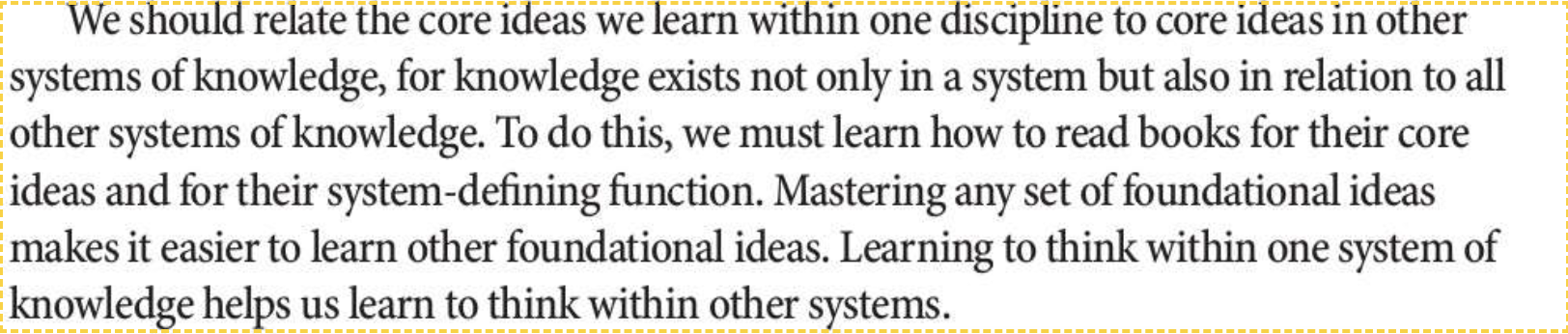
This is an excerpt from the book "How to Read a Paragraph" which highlights that ideas belong to particular systems (domains such as psychology, sociology etc.) and thinking in terms of systems (with a look to big picture at least).
This is something I experience in myself too. Zettelkasten is so atomic note oriented that even though you connect things and only create notes as branches, and not allow any orphans; it becomes messy in my head.
I wonder what you think about such a top-down structure (in our heads or in our systems, doesn't matter). And I wonder your experiences about remembering what's in your ZK. Did you train yourself to think in terms of building blocks? How do you handle not having an anchor in head?
Selen
Howdy, Stranger!
Categories
- 3K All Categories
- 153 Research & Reading
- 702 The Zettelkasten Method
- 12 Knowledge Work
- 101 Writing
- 474 Software & Gadgets
- 158 Workflows
- 733 The Archive
- 15 Plug-In Showcase
- 88 Resolved Issues
- 225 Projects Logs and Journals
- 86 Project: Zettelkasten.de
- 53 Critique my Zettel
- 178 Random
- 375 Introduce Yourselves!
Comments
A quote from an upcoming article on Long Thinking (Cal Newport's term) and the Zettelkasten Method:
The process would be:
In practice, you can't distinguish the two. So, you build a couple of systems, then build the general system, build another specific system and then modify the general system, etc.
I am a Zettler
The article seems interesting, and so does Cal's concept.
Is this podcast episode a right entry point?
It sounds like both a way to structure the Zettelkasten's internal network and a metacognitive process that should run in the mind.
I suggest everyone read "How to Read a Paragraph" to understand your toolbox idea better, by the way. (Though I have a hunch that it's a common reading and I'm behind!)
Selen
To speak of systems implies the existence of subsystems, and so even within one system there are degrees of generality. The trick is to recognize the degree of generality and write your notes to suit.
Knowledge is organized or structured, usually in many ways at once. If your notes do not reflect your own structure to some degree, they won't be congruent to your thinking and understanding. So your notes - let's not get into the meaning of "atomic" for now - will work best if they reflect the level of organization you are thinking about or understand. Of course, when you don't know a field very well you can't do that effectively.
Let's say you are working on history of some kind. You can be interested, say, the life and times of Henry VIII. There are facts about his various marriages. So you write some notes about them. Then you start thinking about how and why marriages have been made in Western European kingdoms and how Henry's marriages do or do not fit some pattern that you have identified. So you find information and write some cards about that.
Then you get an idea about the nature of royal marriages affecting the incidence of warfare and start to look into that. So you write some notes about this larger idea. By this time you will probably have internalized quite a lot of the history you have gotten interested in, and your reading and thinking will have moved into more general regions of historical study. At each stage you are writing notes that fit the degree of generality of your study, and hopefully your links, keywords, outline structure and terms, etc. - whatever methods you use - will come to reflect your broadening understanding.
If you want top-down, go through a library's catalog and see if you can find something you know about. Chances are that you will eventually do so, and you will feel that their cataloging system doesn't seem very natural to you. At a minimum it would take a long time to learn, and it can't adjust as your own understanding develops.
If you can use them effectively, your linking, keywords (especially compound keywords), outline structure if you use one, names of structure cards, all those things will come to form what is called a "subject language", and to quote Svenonius, "the subject language becomes an analog of knowledge itself". That is, knowledge as you understand it, personal to you.
Oh, I don't know that you want to know in my case... I have weak episodic memory and I look to my ZK to help remind me.
This is at least the podcast that I will refer to when I talk about Long Thinking.
I guess you refer to the process of building connected structures for general and specific system. Then yes. I would go as far as saying that almost every specific procedure or pattern for the Zettelkasten is a metacognitive process. Most processes and patterns I come up with are directly based in cognition and metacognition. Consciously.
I didn't know about the book. So, thanks for the recommendation.
I am a Zettler
I found the excerpt on page 3 of Richard Paul's and Linda Elder's How to Read a Paragraph, 2014. Interesting book!
Have you noticed that the book doesn't mention notes in a zettelkasten?
As the book demonstrates, we do not need a zettelkasten for deep reading and thinking. :-)
The book's methodology is close to "How to Read a Book" by Adler, nothing fancy. I am super interested in what is called "Thinking in Built Systems" in The Extended Mind, the passage I pasted, which is the starting point of that idea.
Plus this visual. I was skeptical of hierarchical thinking before reading this book. But I started to think about using books as canvases for different perspectives.
My interest in visual thinking began, and nowadays I focus more on memory and on building a database of ideas.
Eventually, I will probably move towards using Zettels as canvases when I am in the realm of knowledge creation (and long thinking, as I learned above). My Zettelkasten journey is pretty painful, as I am not that good at thinking. But I am pretty satisfied with the level of mental model creation from books. I wrote all this self-reflection to agree on your point. I am more focused on creating canvases and models than a full Zettelkasten.
I wonder what additional abilities a proper Zettelkasten brings. Definitely linking, but I cannot see the point of linking as deeply as I desire. Maybe because of right-brain dominance. I also try to strive towards what is absent in my thinking, which is left-brain organization.
Selen
IMO a Zettelkasten can be use to promote creativity, and broadly speaking in line with what you are interested in. In particular, during an extended period of working on the idea and perspectives, each time one goes away and comes back to the work later, one loses much of the context and details of the ideas. They may have been clear when last you thought about them but now you don't remember much of that.
You can use notes and groups of notes to help bring that context back to mind. In the diagram you showed, if you are thinking about it and were working out how you wanted to extend it, how it didn't quite for your idea, whatever, you could use a note as a hub that connects your ideas with the diagram (by means of a link to open it) together in one place. If it were me, I would have created a mind map on the topic and I would keep a link to that mind map in the hub too.
Such a hub note can serve to bring back into your mind the context of what you were thinking about. This is one way a ZK can be very helpful.