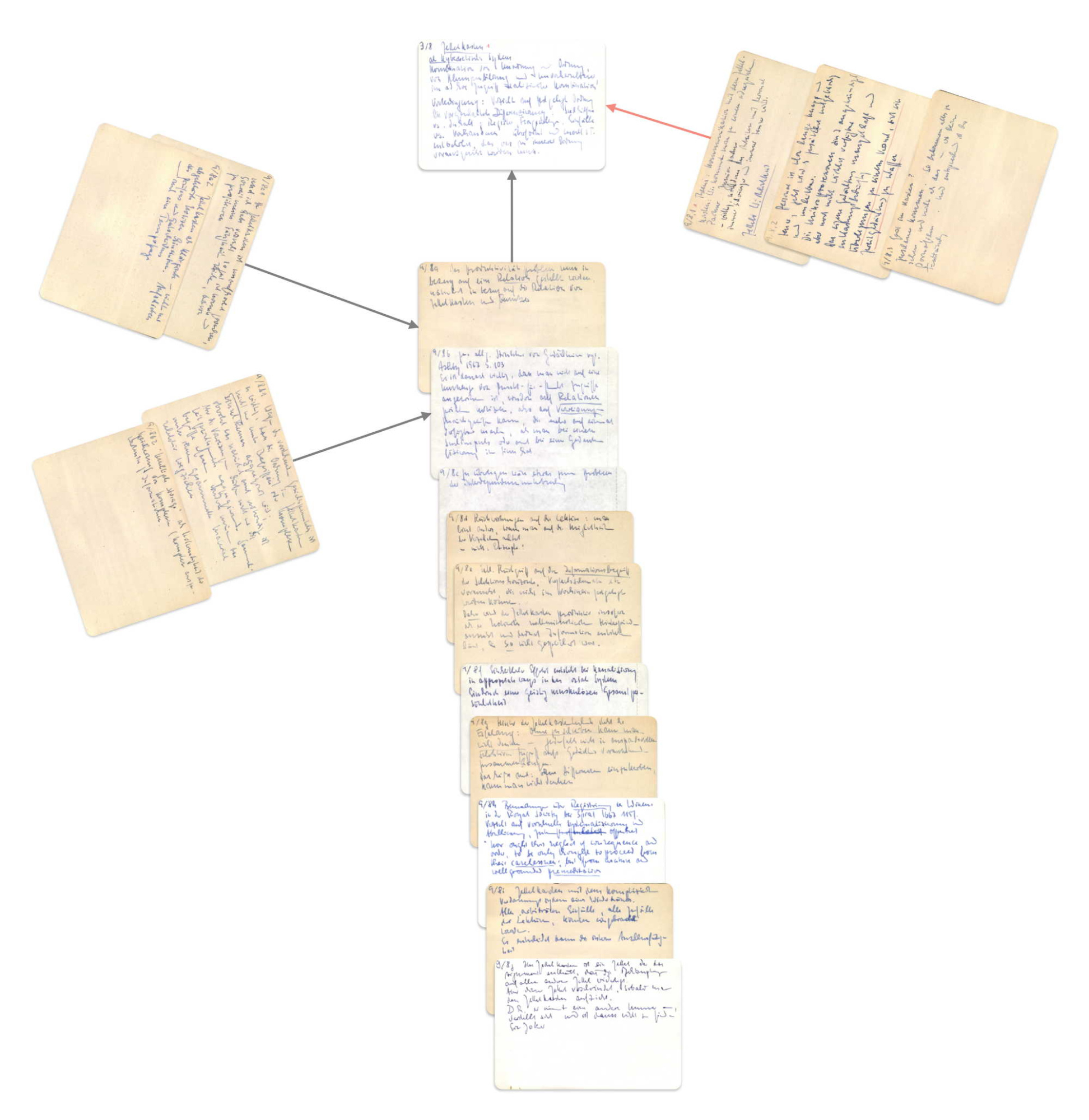
Facsimiles of Luhmann 9/8 zettels laid out on canvas

How does the layout of zettels influence our perception of Luhmann's folgezettel structure?
Here's an experiment that uses facsimiles of all zettels in branch 9/8. Note sequences are indicated by overlapping zettels. The black arrows indicate new note sequences branching off. The red arrow indicates a note sequence attached with a red number.
Howdy, Stranger!
Categories
- 3K All Categories
- 153 Research & Reading
- 703 The Zettelkasten Method
- 12 Knowledge Work
- 102 Writing
- 474 Software & Gadgets
- 158 Workflows
- 733 The Archive
- 15 Plug-In Showcase
- 88 Resolved Issues
- 225 Projects Logs and Journals
- 86 Project: Zettelkasten.de
- 53 Critique my Zettel
- 179 Random
- 375 Introduce Yourselves!
Comments
Ooh, I like this. What a vivid example of how good layout and graphic design can convey more than just text. Your layout is essentially a mind map (in the Tony Buzan usage) of this set of Luhmann's z-cards. Now if only we could hover over a card and get a popup with its text!
Here is the most straightforward representation as a mind map. In this form it is clear how several trains of thought wander off from the original idea. One is invited to continue them or start new ones.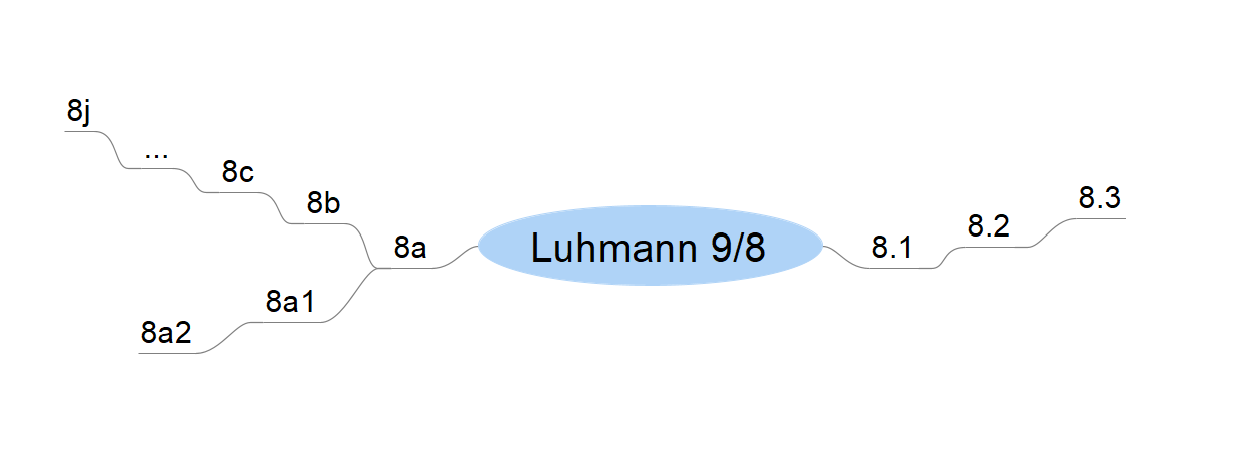
In this particular mind map editor (Freeplane) one can hyperlink a branch to an image file but the image won't show up when hovering over the branch. The branch has to be clicked on to see the image.
(image snipped)
This version is probably more what I had in mind originally. It is linked the same way but the layout is more compact and suitable for using longer titles.
The first image above give me a strong feeling of one thing leading to another. This second one gives me more of a feeling of steps in an argument or items in a checklist.
I hadn't tried mind mapping software before. This is an experiment in SimpleMind.
(snipped image)
It looks very good, all right. Looking at the Simplemind web site, the Pro edition seems to be what I would want and it's price is very acceptable. And it's not online only, a bug plus.
@tomp "a bug plus" - that sounds like a healthy reminder to stay cautious around software recommendations. 😄
What I like about these visualizations is that they make the folgezettel structure feel less like an indexing system and more like a record of thinking in motion. In list form, the branch looks archival; in the mind map, it becomes exploratory. Seeing the same sequence arranged spatially makes me wonder how much of Luhmann's method is hidden in the geometry of the structure rather than in the numbering itself.
It's like working with my analog index cards: in their original order they tell me where a thought came from; spread across a table they suggest where it might go next. When I freely rearrange them, different relationships emerge and entirely different questions come to mind. The cards themselves haven't changed - only their spatial arrangement has.
Same here. There are references, where Luhmann describes the structure geometrically:
Can all be modeled with radial mind maps.
https://niklas-luhmann-archiv.de/bestand/literatur/item/luhmann_2000_IB01 ;↩︎
https://www.researchgate.net/publication/328624186_Where_Does_Niklas_Luhmann's_Card_Index_Come_From ;↩︎
https://niklas-luhmann-archiv.de/bestand/literatur/item/luhmann_1981_AB46 ;↩︎ ↩︎ ↩︎
Luhmann wrote as much himself:
I agree with everything you wrote. I think that for the most part, all these different arrangements for visualizing the cards - mind maps, spatial re-arrangements, applying tags, using an outline, whatever, amount to different projections of the card collection (and I include any explicit or implicit links between cards). Different projections may be better for some purposes. I'm fairly sure there are some useful projections that haven't been devised yet.
The ability to rearrange zettels during the creative process is the main reason why some people prefer paper slips over notebooks or commonplace books.
Beatrice Webb wrote 1926 in her classic text The Art of Note-Taking:
However I don't know if Luhmann ever did work this way.
This is why I have started to emphasize arranging additional windows with notes, images, mindmaps and so on across a second monitor. It may not be as good as small slips on a large desk but if the mechanics are very easy, I'm finding the method pretty useful.
Using an outliner program that lets one rearrange the positions of the cards also allows for some of the flexibility that Webb talks about. If the system also allows for clones, one gets even more flexibility.
The fact that the relative arrangement of z-cards makes a difference shows that the positioning - which is equivalent to unlabeled links - carries important semantic information. That's why I call the various kinds of links, including implied relationships, "Semantic Channels".