On Zettelkasten Productivity

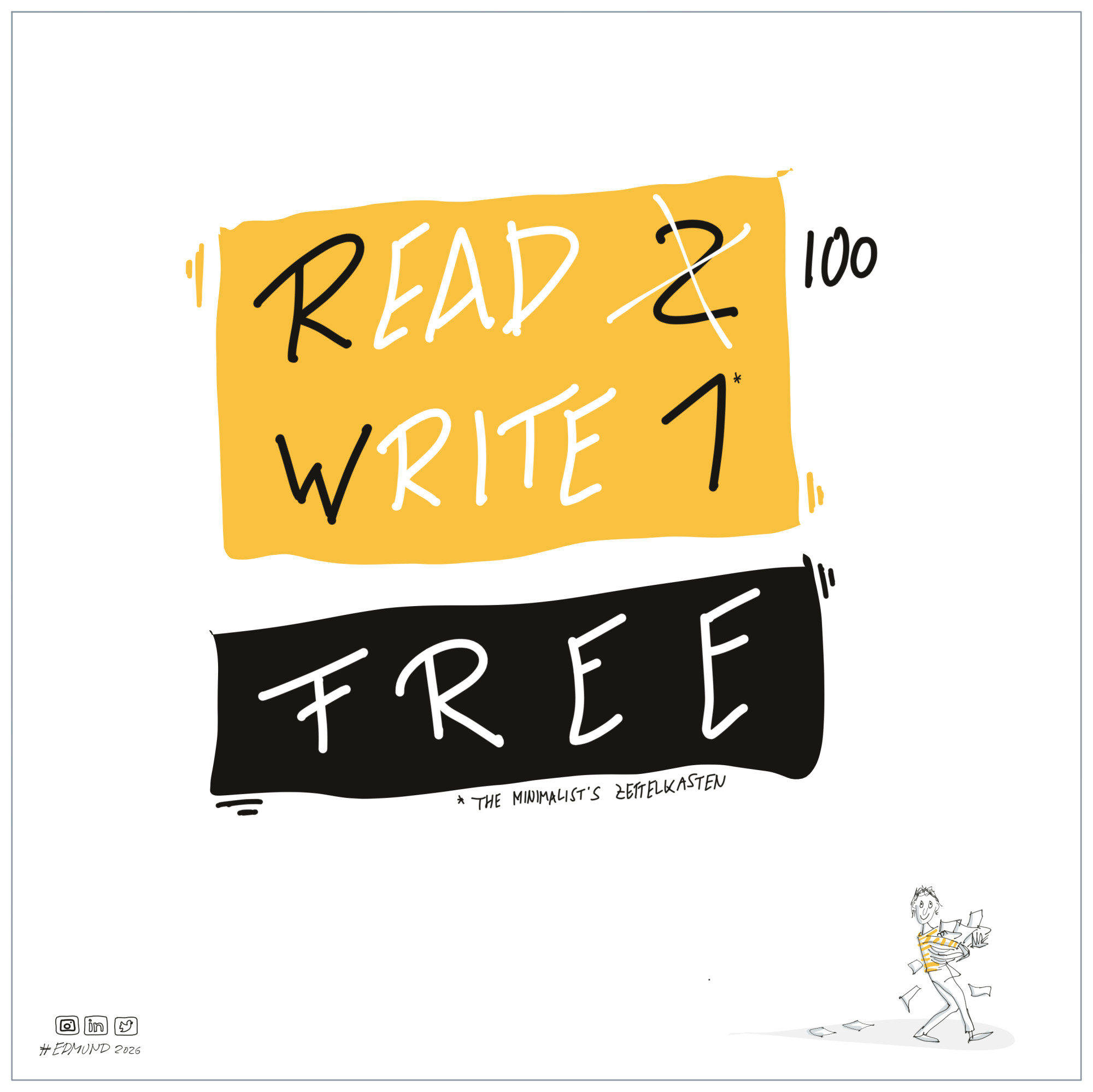
Let's start with some data from reconstructions of Luhmann's second, sociological Zettelkasten:
- Permanent Notes: about 67,000 cards.
- Literature Notes: about 15,000 entries (mostly books and articles).
- Books he authored: a bit over 70.
This means as an estimation, not a directly documented figure:
- For each book or article he read, he only creates on average ≈ 67,000/15,000 ≈ 4.5 Permanent Notes per book or article.
- He processed on the order of 15,000 books and articles in depth, with perhaps roughly half of those being books, so about 7,500 books.
- So the ratio is approximately: books read per book written ≈ 7,500/70 ≈ 100.
- Productivity expressed as output per unit of input: ≈ 70/7,500 ≈ 1 %
The “books read per book written” ratio is a quiet reminder that visible output sits on top of a large, invisible foundation. A writer who publishes one substantial book for every hundred they read is not inefficient; they are distilling, selecting, and discarding far more than they keep.
This flips a common obsession with productivity: instead of asking “How many books have I written?”, one might ask “How many have I truly digested deeply enough that a book could grow out of them?” Measured this way, high productivity is less about speed and more about the density of thought each finished work contains.
Edmund Gröpl — 100% organic thinking. Less than 5% AI-generated ideas.
Howdy, Stranger!
Categories
- 3K All Categories
- 153 Research & Reading
- 704 The Zettelkasten Method
- 12 Knowledge Work
- 102 Writing
- 474 Software & Gadgets
- 158 Workflows
- 733 The Archive
- 15 Plug-In Showcase
- 88 Resolved Issues
- 225 Projects Logs and Journals
- 86 Project: Zettelkasten.de
- 53 Critique my Zettel
- 179 Random
- 375 Introduce Yourselves!
Comments
The I/O ratio of 100 books read per a book published is an interesting heuristic.
There was this very prolific author of science/nonfiction whom I greatly admired (and who passed away relatively recently). His advice to budding authors was similar: you have to read at least 100 books to write one book of some quality.
He was a modern-day polymath, pathologically collecting on the order of 100 thousand books in his personal library. (He bought a 6-story building in Tokyo to keep a faction of his collection.)
Maybe one book written per 100 books read is intuitively what it takes for those people to condense knowledge worthy of output.
Why aren't the articles he wrote included in the count? Is it okay to just calculate the ratio by book to book, article to article?
@zettelsan : Who was this very prolific author of science/nonfiction?
Edmund Gröpl — 100% organic thinking. Less than 5% AI-generated ideas.
@Edmund Wow. I never thought about this that way.
But it truly resembles my own experience: If I regularly schedule time to process sources, I reliably generate genuine insights. Books and articles are literally the fuel for my creative machine.
Phases in which I can't make this happen are surprisingly challenging.
I am a Zettler
The author in question is Takashi Tachibana (立花隆). His rise to fame came from his investigative journalism, which brought down then-Prime Minister Kakuei Tanaka (田中角栄) in the 1970s. But his deepest interest was always science and philosophy, especially the big existential questions. After earning his bachelor’s in French literature and working a few years in journalism, he went back to university to study philosophy.
Tachibana never wrote for readers outside Japan, so his audience remained largely domestic. Yet he had a rare combination of interests and expertise in both science and the humanities, which allowed him to produce several books that read like the very best science nonfiction (think Steven Pinker or Carl Sagan).
The building I mentioned was called “Neko Biru” (猫ビル / “Cat Building”). (He was extremely fond of cats.) Inside, he kept roughly 30,000 to 40,000 books at any given time.
After his passing, there was a photography exhibition showing all his bookshelves, taken over a few years when Tachibana was still alive. You can see a few of them in this magazine article (in Japanese).
https://bunshun.jp/articles/-/53172