Visualizing Luhmann's Folgezettel in Logseq

This is a contribution to The Great Folgezettel Debate. What exactly are those "Folgezettels", that Daniel and Sascha debate? And why do they matter? I think that we need better visualizations of Luhmann's actual zettels to answer those questions.
I suggest an experiment. Explore the online edition of Niklas Luhmann's Zettelkasten. Search for zettels you find interesting. Download those zettels. Print them out and lay them out on a table. Or use a software tool to lay them out digitally. Or use transcriptions of Luhmann's zettels and arrange those.
In this showcase I use Logseq (with some custom CSS) to create an interactive digital version of Luhmann's Zettelkasten.
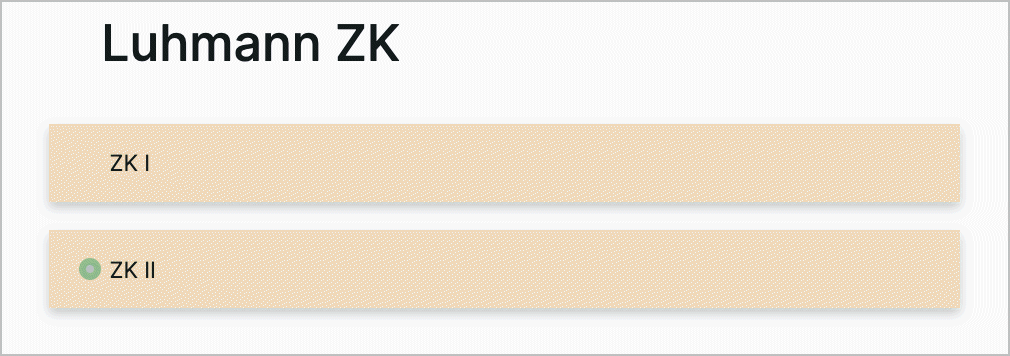
The first screenshot shows the top level view. Luhmann had two Zettelkästen. The older Zettelkasten I and the newer Zettelkasten II. (The green dot indicates in Logseq, that the note contains nested notes.)
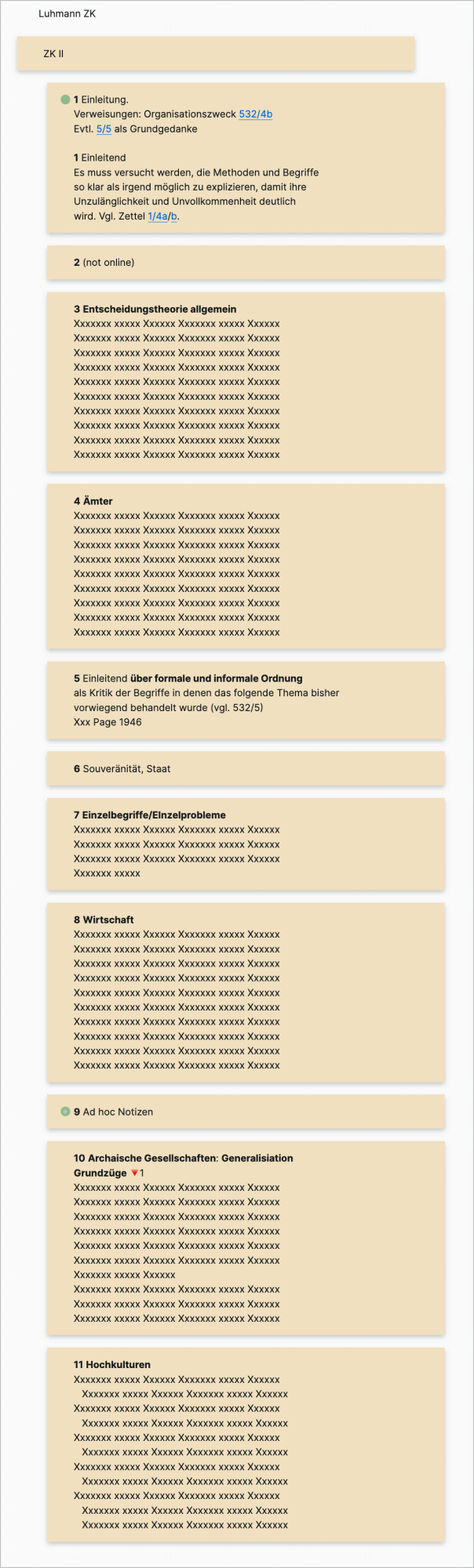
The next screenshot shows ZK II. At the top level there are 12 index cards. (Zettel 1 exists twice. I wrote both zettels in the same node, so that the navigation in Logseq works better.)
Note that the cards contain a lot of text. ("Xxxxx" stands for text that hasn't been transcribed yet. Bold stands for underlined text.)
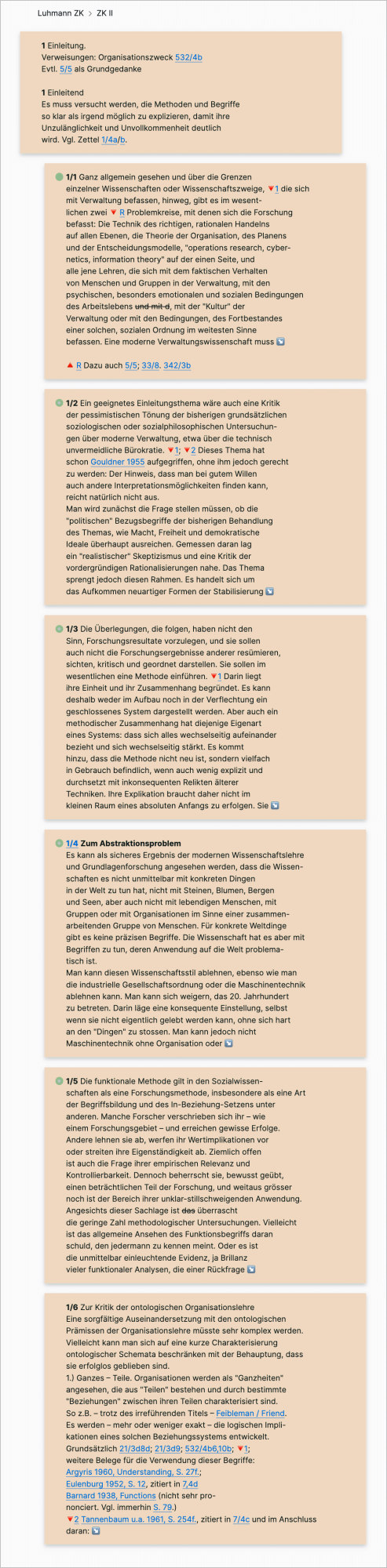
The next screenshot starts with note 1. Note how the text on most zettels ends mid sentence. The symbol (↘️) indicates that the text continues in a separate note sequence. Red numbers are represented with markers in the text (🔻, "Anschlußstelle" in Luhmann's words) and in the corresponding footnotes (🔺). "R" points to the reverse side of the index card. (I added the reverse side to the same card in Logseq for easier navigation.)
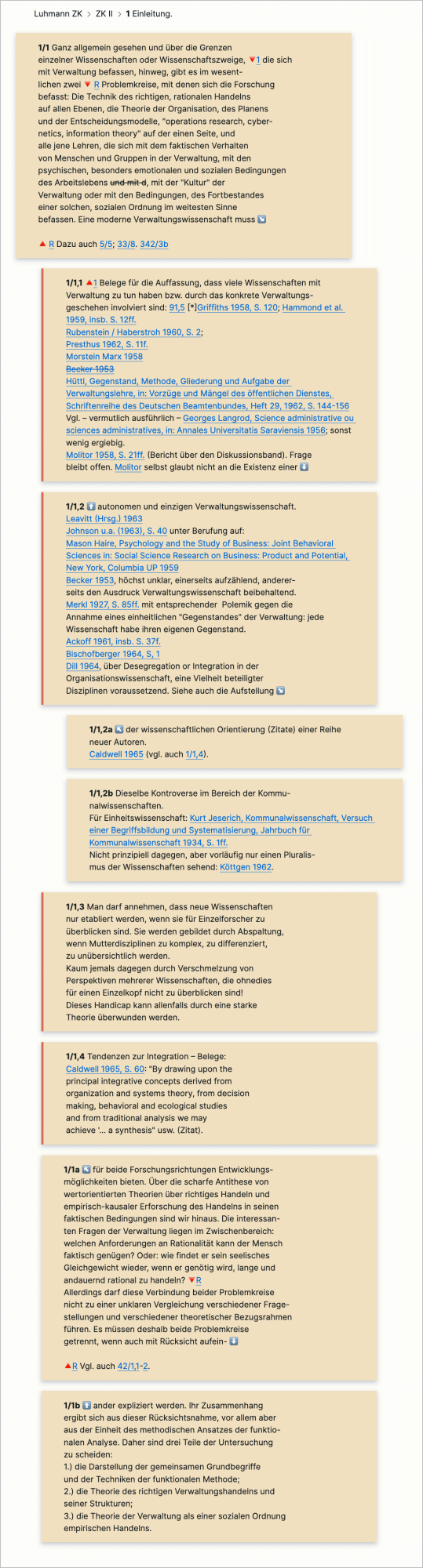
The next screenshot starts with note 1/1. Note that there are two different numbering schemes 1/1,1 to 1/1,4 and 1/1a to 1/1b. The first one (marked with a red border in the screenshots) are more like footnotes. The other is the default "Zettelfolge" (with the typical alternating pattern of letters and numbers).
Zettel 1/1,1 contains footnote 1 (🔺). Zettel 1/1,2 continues the text of the previous zettel (⬇️⬆️).
Zettel 1/1a continues text of zettel 1/1, Zettel 1/1,2a continues text of zettel 1/1,2. Both also branch off a new Zettelfolge (↘️↖️).
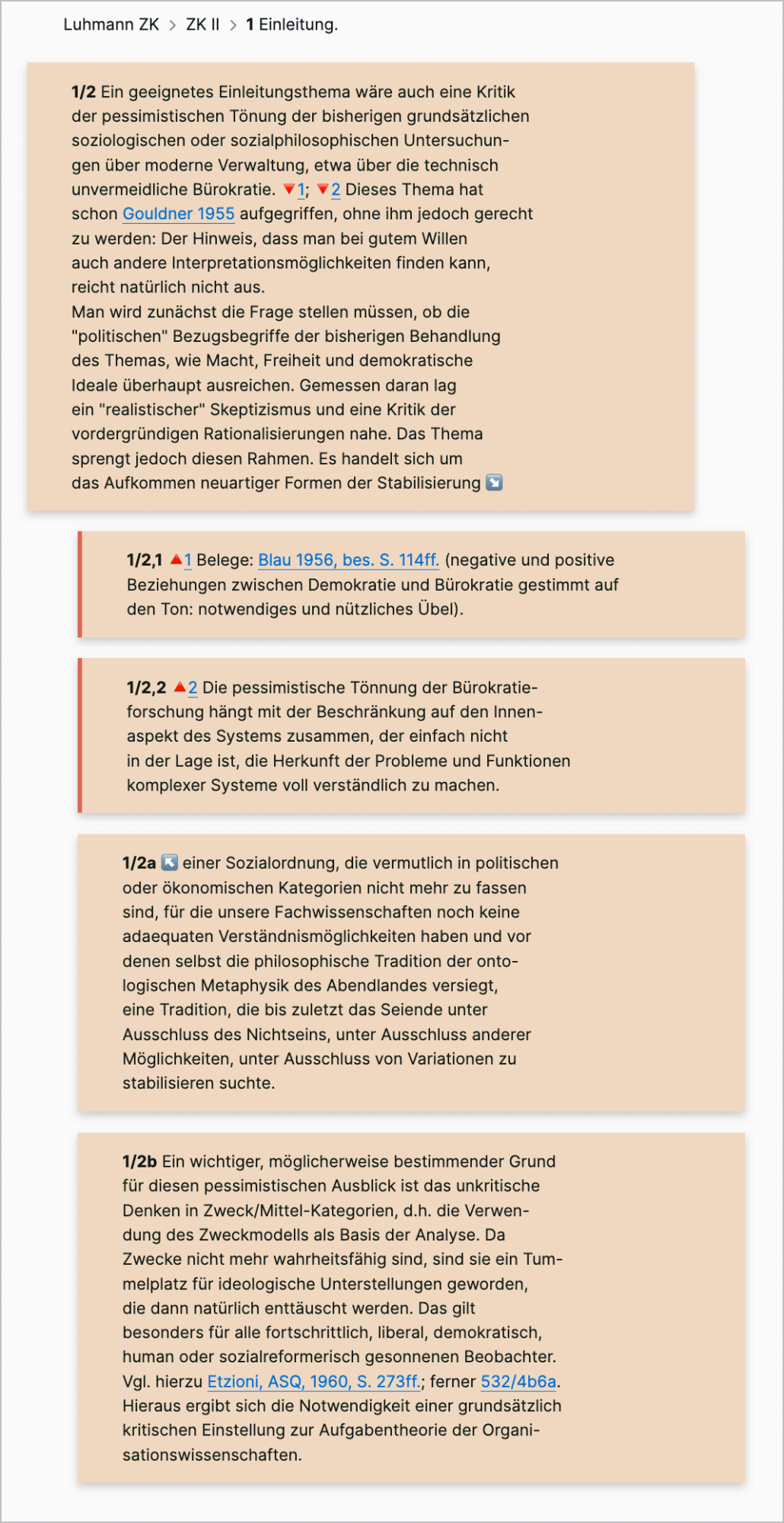
The next screenshot starts with note 1/2. Zettels 1/2,1 and 1/2,2 are footnotes. 1/2a continues 1/2 and branches off a new Zettelfolge. 1/2b adds a new argument.
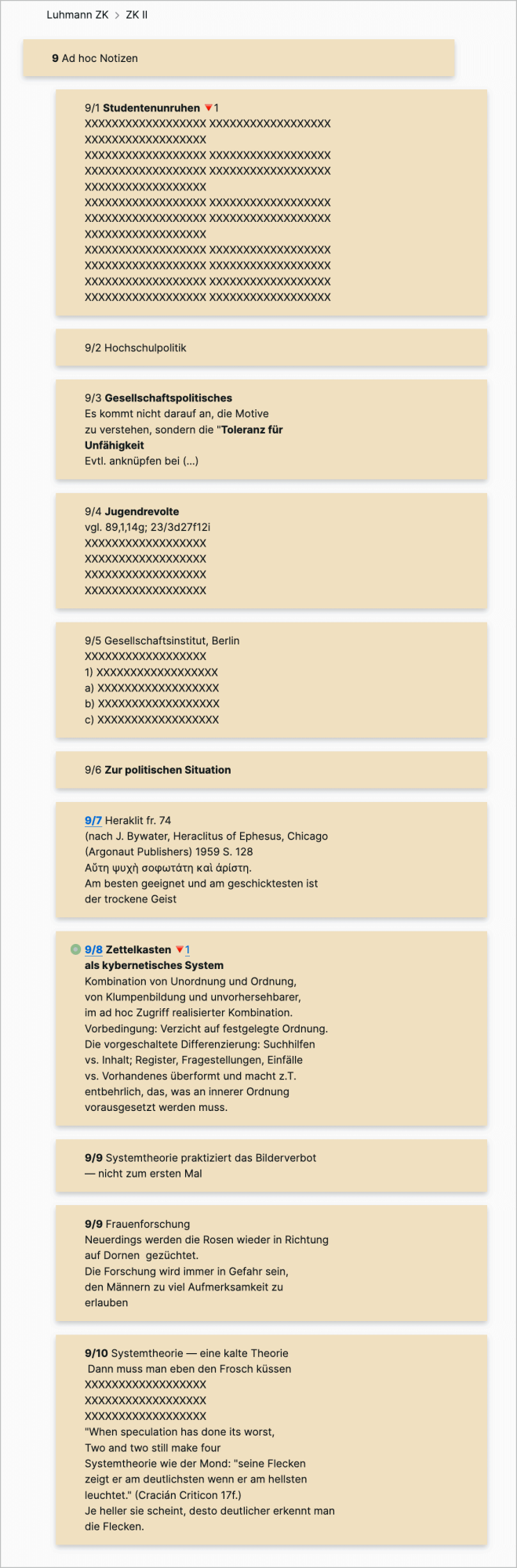
The next screenshot starts with note 9. Again most zettels contain a lot of text.
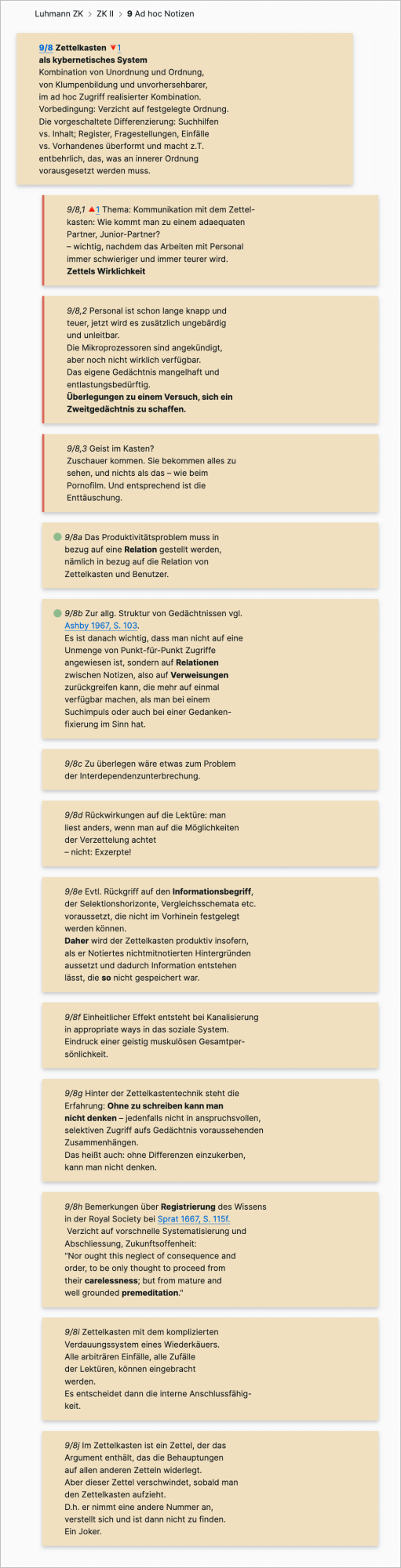
The next screenshot starts with note 9/8. Luhmann used these zettels to prepare the famous article Kommunikation mit Zettelkästen. Some zettels might look familiar. Again two numbering schemes 9/8,1 to 9/8,3 and 9/8a to 9/8j.
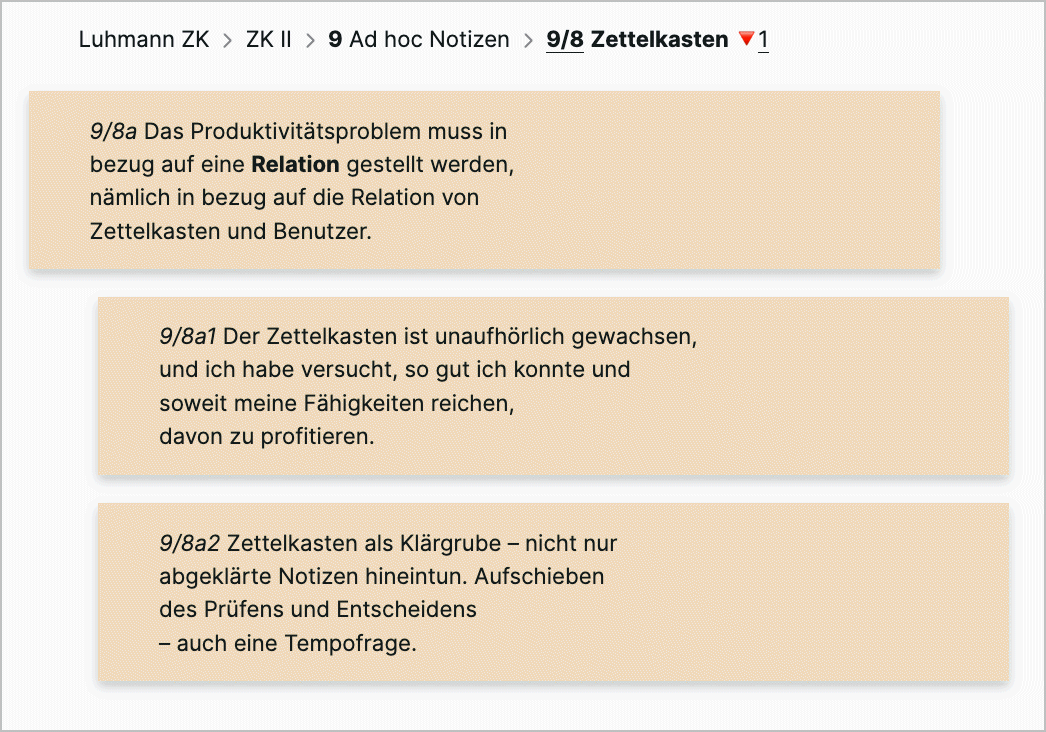
The next screenshot starts with note 9/8a. Topic of this note sequence is the relation between the Zettelkasten and its user.
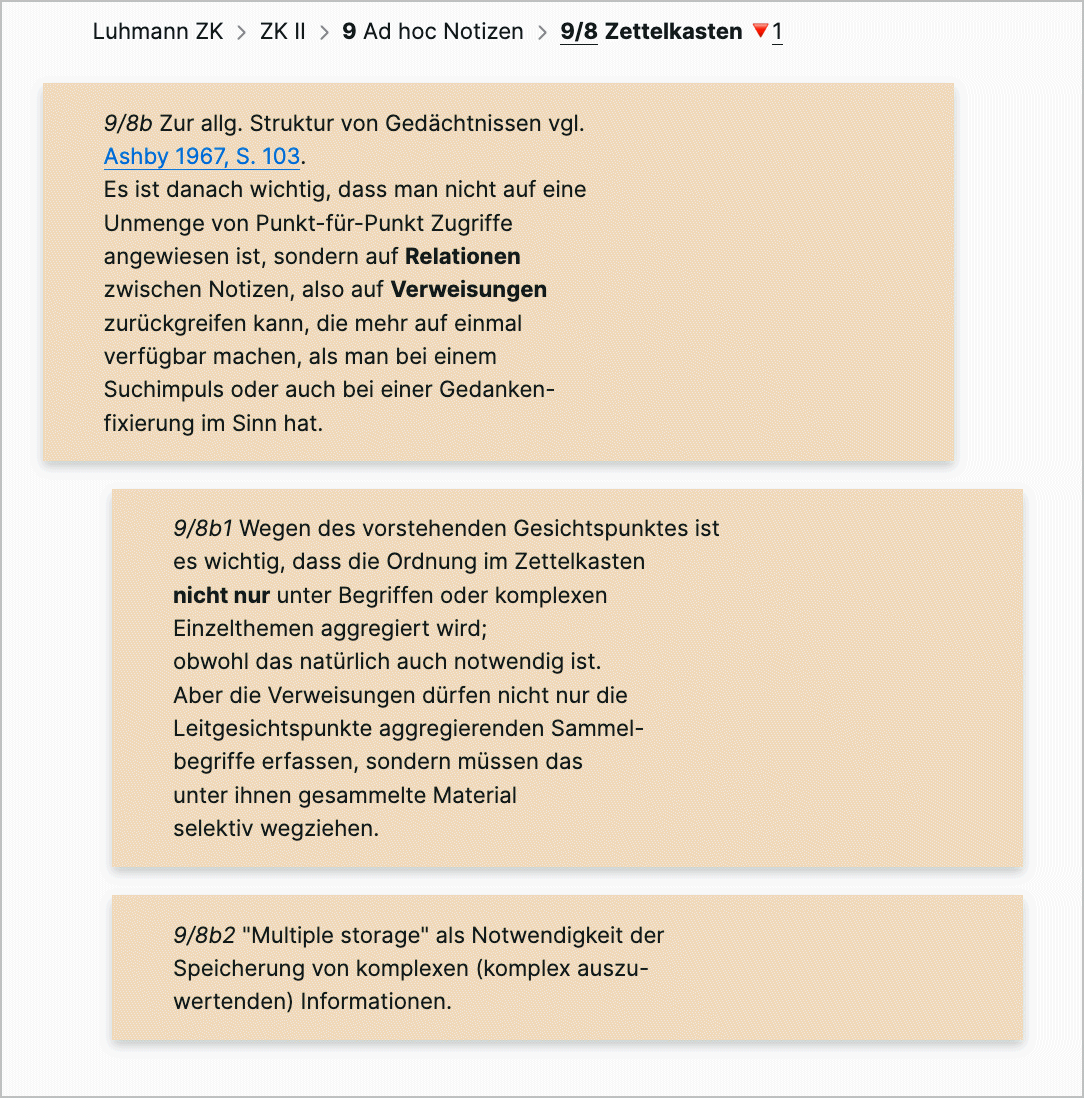
The next screenshot starts with note 9/8b. Topic is the relation between notes in the Zettelkasten.
So what exactly are Folgezettel or Zettelfolgen or note sequences or "strings of thought" (Ahrens 2022)?
Luhmann describes them in Kommunikation mit Zettelkästen as "running text" ("laufenden Text", "fortlaufend"). As you can see in the screenshots, the zettels can be read like continuous text. Several zettel continue text from other zettels. Some make a verbal reference to the previous zettel, eg 9/8b1.
Luhmann also talks about connecting or adding notes to branches ("ergänzt", "angeschlossen"). Most connections are made implicitly by adding a new level to the ID. In the screenshots some connection points are marked with symbols (↘️↖️⬇️⬆️🔻🔺). They continue text from a previous note or are similar to footnotes. Whereas links are just IDs in the text. For example note 1/2b contains a link to 532/4b6a.
I think that Luhmann's zettels and the numbering scheme make much more sense, when you look at the original zettels (or their transcripts) and lay them out as note sequences. It becomes easier to see, how each zettel has a meaningful connection to the previous zettel in the note sequence. This the principle of Folgezettel.
This principle is valuable, because it is not atomic. It's an alternative to atomicity.
In Luhmann's Zettelkasten anything goes, as long as it can be connected. There are zettels with multiple short thoughts. There are long thoughts spanning multiple zettels. There are zettels mixing own thoughts, bibliographies and quotes. Luhmann's system is flexible and scalable. The IDs efficiently create a complex and meaningful structure with index cards. Luhmann added mechanisms like red numbers for connections that go beyond Folgezettel.
TL;DR
Luhmann didn't strive for "atomicity". He didn't use timestamps as IDs.
Luhmann's technique creates strings of thought. It uses a particular numbering scheme to place zettels permanently in a meaningful context.
Logseq is an excellent tool to build a digital version of Luhmann's original Zettelkasten. It helps visualize how Luhmann worked. It helps appreciate the power of Luhmann's numbering scheme, that encodes so much structural information in such a short ID.
Speaking metaphorically, if you only examine individual vertebrae, it's difficult to understand the concept of a backbone. If you only look at individual zettels, it's difficult to see the zettel sequence. With a good visualization you can see the parts and the whole.
Howdy, Stranger!
Categories
- 3K All Categories
- 153 Research & Reading
- 703 The Zettelkasten Method
- 12 Knowledge Work
- 102 Writing
- 474 Software & Gadgets
- 158 Workflows
- 733 The Archive
- 15 Plug-In Showcase
- 88 Resolved Issues
- 225 Projects Logs and Journals
- 86 Project: Zettelkasten.de
- 53 Critique my Zettel
- 179 Random
- 375 Introduce Yourselves!
Comments
Very nice effort. But keep in mind that German speakers are in the absolute minority in this forum.
I am a Zettler
Just out of curiosity, has anyone researched on the maximum number of zettels Luhmann ever connected in one string of thoughts? What I mean is the longest path in a directed (and acyclic) way. This has some implication on Folgezettel in Luhmann's style vs. Bob Doto's style.
Interesting question. I don't know of such an analysis. Some of the longest zettel sequences I found so far:
21/3d8c16c1 to 21/3d8c29
21/3d18a1 to 21/3d18a60
An example of the deepest level I could find is 21/3d5b11w19z6a.
Bob Doto's recommendation is compatible with Luhmann's technique. Doto writes in his 2024 book:
Luhmann seems to prefer counting up within one long sequence (see examples above), whereas Doto tends to branch off new shorter sequences.
In practice, you will amass quite a lot of loose association and not so many trains of thought. Luhmann's ZK is a very good showcase for that.
I am a Zettler
Thank you for the summary. It looks like Luhmann did have fairly long sequence of notes at times. A string of 100 notes seems like a fairly big trunk of thoughts. Unfortunately I cannot read German so don't know the nature of long sequences.
Luhmann's Folgezettel (X in the figure) handles long sequences better, whereas Doto's (Y in the figure) handles branching better:
In fact, I don't think Luhmann's can handle more than two follow-up zettels from a common parent. (I wonder how this was done, as it seems such a common thing to do.) Doto's can have as many follow-up zettels as desired, but supporting a very long string of follow-up zettels would be awkward, since their Folgezettel IDs keep growing in their lengths (and likely with lots of 1's and a's...).
For my personal experiment, I went with Doto's since currently I have a wide-and-shallow zettelkasten for which branches are much more common than long strings of follow-up zettels. But if I were more adept in stringing together related notes, I'd see the merit of Luhmann's Folgezettel.
Doto's numbering scheme is identical with Luhmann's basic numbering scheme. Doto removed exceptions (like the red numbers) and kept the basic principle (alternate numbers and letters). If you understand Doto's numbering scheme, you understand Luhmann's numbering scheme.
The trick is that zettels don't have a simple parent-child-relationship. There are two different kinds of links:
You don't go directly from 1.1a2 to 1.1a2c. You go from 1.1a2 to 1.1a2a by branching off a new sequence. Then you add 1.1a2b as a second note in that sequence. Then you add 1.1a2c as the third.
I made some changes to your Y chart. I x-ed non-existing parent-child links and added the important follow links. ("Folgezettel" literally means "zettel that follows".) The overlaid boxes indicate zettel sequences:
The number of levels remains the same. The chart is still "wide-and-shallow".
Maybe the zettel sequences in Logseq are easier to recognize, when the chart is rotated:
Same chart, same levels, different vertical alignment:
The same structure in Logseq. All zettels:
This is, by the way, the filing order in Luhmann's box.
Logseq make it easy to look only at zettel sequence 1.1a1 to 1.1a2:
Or at zettel sequence 1.1a2a to 1.1a2c:
This is still the same numbering scheme that you use. It's just a different visualization.
You can interpret Doto's Folgezettel IDs that way (they are both alternating alphanumeric sequence, after all), but that's not exactly how Bob explain his usage, though.
From "5 Using Alphanumeric IDs to Identify Your Notes" of A System for Writing, he writes:
Since the notes are directly connected, the "follow-up" note is given a new alphanumeric digit. (Luhmann would increment the least-significant digit here.)
Here, the existing place in digits is incremented for an idea related but not directly connected. Such a note isn't a follow-up note.
Here, for an entirely new topic, the most-significant digit is incremented. (This part is the same for both Luhmann's and Doto's.)
So, I think the ways that IDs grow based on the follow-up behavior are different. And this is the difference I was writing about.
May I point out similarities? Doto writes:
Adding a new level is called branching off.
Consecutive numbers and branching off are different things. (That's the point in my previous post.)
Here's Doto's example rendered in Logseq:
Doto writes:
You connect the note to the branch, where it fits. (However you might determine the fit.)
Connection is a technical thing. 1.4 is connected to 1.3 simply because it is the next number in the sequence. Branching off also creates a connection. 1.2a is connected to 1.2 because it's branched off.
The reason why you choose to connect where is highly subjective. Doto says so himself:
Where do you get the idea from, that Luhmann would do it differently than Doto? Do you have an example or a literary reference?
Just for fun, some other examples from Doto's book. I think the main difference to Luhmann is not the numbering, but the addition of titles and a more "atomic" writing style.
Hmm. I'm still not convinced the branching scheme is identical between Luhmann's and Doto's.
In Bob's example, I can hardly see 1.1 -> 1.2 -> 1.3 -> 1.4 as a train of thoughts. They are loosely related (hence the common most-significant figure), but they are notes which "don't necessarily speak to ones previously captured" in his words. When he is incrementing the least-significant figure for this purpose, why should I think 1.2a -> 1.2b -> 1.2c or 1.2a1 -> 1.2a2 constitutes a train of particular thought? It seems to me that their relations implied by numbering of least-significant figures are parallel, in the same sense 1.1, 1.2, 1.3, and 1.4 are parallel (loosely related but not connected via a train of thought).
(This is another example from Bob's page; a little more extended version to illustrate how Folgezettel structure might grow.)
Bob's note template includes "- previous: <... link item ...>" so that we should be able to identify train of notes as they are meant to be. I wish I could see how the "previous" entries look like for the notes mentioned here.
Again, I do understand that Folgezettel IDs shouldn't be taken as denoting a rigid structure. But the underlying assumption still needs to be understood. (And to me, the biggest issue with Luhmann's Folgezettel is not being able to make a single note a branching point for multiple follow-up notes.)
The relevant section of Bob's book is actually publicly accessible:
https://writing.bobdoto.computer/how-to-use-folgezettel-in-your-zettelkasten-everything-you-need-to-know-to-get-started/
(I don't mean to contaminate the thread with something off-topic though. Please feel free to drop this line of discussion. The topic isn't very important.)
You are facing the problem that you are assuming that there is a set of understandable rules that goes beyond loose association. The examples both by Luhmann and Doto are quite telling that this is a wrong assumption.
I am a Zettler
The question is what you mean by "train of thought".
You are correct, if you mean a sequence of thoughts that supports a particular argument, like in a good essay or speech.
But neither Bob Doto nor Niklas Luhmann promise that kind of train of thought.
Yes, they are only "loosely related". That looseness is an important aspect of the system:
You shouldn't, because it doesn't.
But you should take a closer look at the algorithm. Doto and Luhmann describe the same basic rules. There are strict rules about the numbering, but no rules about the notes' content.
That's an important point!
a) Does the sequence of thoughts imply a sequence of argument?
No. It doesn't. The sequence is not necessarily a "train of thought".
b) Does the sequence of notes always matter?
No. It doesn't. Nobody would notice, if you reordered Doto's apple statements (1.1 … 1.4).
In real examples (see above) I find it interesting that Doto and Luhmann explicitly reference "previous" zettels. They are both aware of the sequence and both reference that sequence.
Sequences don't necessarily encode a logical sequence, but they definitely encode a temporal sequence. Zettel 1.4 was added after zettel 1.3. So the term "previous" implies "previously added" or "at the time of writing already existing".
That's also something Bob Doto and Niklas Luhmann agree on. You don't just assign random numbers. You don't delete numbers. You don't reassign numbers. You follow a strict set of rules.
It helps to use a visualization, where you can see multiple connected (as in formally connected) zettels at the same time. In an earlier post I added branch 7 of Doto's notes (as published in the book). I think you can trace quite well, how he got from 7.1 to 7.27a2.
I don't like the visuals in Doto's book and I wouldn't use the software he uses, because you can't see the bigger picture. But the numbering makes sense.
One underlying assumption is, that you need rigid formal rules to create a stable yet flexible structure, that can support a life time of research. Luhmann succeeded with that goal! He maintained the system for decades.
Another assumption is, that you should be flexible with the content. (Sascha considers this a weakness of the system. He thinks it's "underpowered". I find it a strength, because it allows you to capture thoughts that aren't yet developed. Sascha uses a separate feeder system for those thoughts. Luhmann integrated them in his Zettelkasten. One goal of the original post was to show the messiness of Luhmann's notes. It worked for Luhmann. Others have other priorities.)
Actually you can! Luhmann uses red numbers for that. See zettel 1.2 in the original post. Or check out 21/3d8c with nine red numbers. Number 4 can be found an 21/3d8ce. From there Luhmann branches of to 21/3d8ce1 and so on.
But for most purposes, Doto's simplified version should work just fine.
Remember, that the numbering scheme is only one way to connect notes. It's just the basic structure, that gives notes a fixed place. For additional linking you could use links (see examples in the screenshots above).
Both is incorrect in different ways
Again: Your examples contradict that there is a strict set of rules. Luhmann used a number of methods to lump together notes (I refrain from the term "trains of content", since undeveloped ideas don't form a train of thought that is communicable. The ideas have to be developed, so you establish a train of thought, unless associative babbling qualifies). Doto reduced the number, but equally doesn't adhere to strict rules.
I am a Zettler
The operating word was "capture" thoughts.
I didn't get the "feeder system" from the atomicity guide, but from How to Increase Knowledge Productivity: Combine the Zettelkasten Method and Building a Second Brain (emphasis added):
Maybe I misunderstood your article? My impression was, that you consider some tasks peripheral to or even outside of the scope of your Zettelkasten, that Luhmann handles within his Zettelkasten.
We agree on this one. Everything in one system. No separate feeder.
Of course there are strict rules. How can't you see them?
There are no strict rules for content, but very strict rules for the numbering scheme.
In Luhmann's own words:
The keyword here is "formal". Strict formal rules create an order that can adapt to any kind of content.
It does. See Zettel II 9/8i:
We agree on this one. Folgezettels don't form a train of thought in that sense (see my previous post).
Doto adheres to strict formal rules. I'm not aware of any examples where he took liberties with the numbering scheme.
One could argue, that Doto's rules are even stricter than Luhmann's, because he also considers the content rule of atomicity.
In comparison, Luhmann's zettels look remarkably un-atomic. :-)
Yes. And most of them are boring, because everybody used them. Luhmann didn't invent formal numbering. He didn't invent indexes. He didn't invent references. He didn't invent card indexes. These were well established methods.
Only one method is different — the Folgezettel. Not many people used that method. Most productive researchers and authors at the time, who used index cards successfully, did it without Folgezettel.
So what is it about Folgezettel, that made it so central to Luhmann's personal technique? Why didn't he stick to the same methods as everybody else?
We agree, that Folgezettels don't form "trains of thought" in a coherent communicable sense.
We seem to disagree on the relevance of his sequential writing style. I believe, that Luhmann really cared about continuous text. I believe, that fixed sequentiality was not a bug, but a feature. So here's a new perspective:
What if Luhmann's Zettelkasten isn't a card index at heart, but a notebook? A notebook with branching capability ("Verzweigungsfähigkeit")? Or in today's terminology — an outliner?
While experimenting with Logseq, I was suprised how well it fits Luhmann's Zettelkasten. I've experimented with other visualization techniques and interaction models before. Logseq is the first tool that made it really easy to capture Luhmann's Zettelkasten in great detail, including text continuations and red numbers. Navigating Luhmann's Zettelkasten in Logseq just feels natural.
This is even more surprising, because I don't like Logseq for my own note-making. I prefer personal wikis to outliners. But in this case, an outliner just fits. Maybe this is a clue to better understand Luhmann's technique?
This definitely chimes with my interpretation of it. A hyperlinked notebook where each note fits within a tree hierarchy. You can flip forwards through the notebook by just turning the page, but "forwards" is a depth-first traversal. You can search forwards to find "sibling" notes continuing a conversation by skipping over deeper branches (by checking the numbering).
You can insert new pages but only following certain rules: you can create new branches, but you can't insert a new "older sibling".
This is exactly how my own Zettelkasten works on a Supernote, although without the numbering (I use a different system).
I find Bob Doto's Apple example interesting, because it can be read as a topical hierarchy. Notes 1.1 to 1.4 can be read as exploring apples in general. Notes 1.2a to 1.2c can be read as exploring kinds of apples. Notes 1.2a1 to 1.2a2 can be read as exploring McIntosh apples. Your screenshot from the book shows a nested list of headings, that looks very much like a hierarchy.
Here's a visualization of the same example. It visually distinguishes between branching off (adding a new level, orange) and consecutive numbering (counting up on the same level, blue).
This rendering feels strange. But why? I think because the example is mostly hierarchical. It doesn't explore the non-hierarchical aspect of Luhmann's system. Luhmann allowed to break out of hierarchies at will. However in this example there's no obvious need to break out of the hierarchy.
If I wanted to add a note "The most popular kind of apple for pies is Granny Smith", I might pick the number 1.2d, because it's conceptually close to the thought "1.2 There are many kind of apples" and because the numbers 1.2a to 1.2c are already taken.
Do I have to add the note there? No. Luhmann gives us permission to add it where we want. I could add the thought as zettel 1.4b for example, if that place "speaks to me".
Luhmann's rules limit our options. Within the Apple branch we can only choose between one of the available consecutive numbers (1.5, 1.1b, 1.2d, 1.3b, 1.4b, 1.2a3) or one of the available new branches (1.1a1, 1.2b1, 1.2c1, 1.3a1, 1.4a1, 1.2a1,a, 1.2a2a) or a red number.
But the rules also give us complete freedom within those options. If you prefer 1.2d, because it scratches an hierarchical itch, why not? If you're more into exploring why you eat too many apples, 1.4b or 1.4a1 might be an option. Or you might write:
A less obvious example might be:
Zettel 1.5c1 is completely outside the subject area "apple", but still connected.
In the words of Schmidt (2018):
One might deride this process as "associative babbling". But that is how Luhmann's Folgezettels seem to work.
Not sure, where I'm going here… Maybe it's about conceptual looseness. Luhmann's zettel sequences are neither coherent trains of thought nor are all zettels within the same sequence conceptually direct children of a parent zettel.
Luhmann explains the overall structure of his Zettelkasten:
I called this looseness in an earlier post "messiness". Luhmann's writes:
That "non-arbitrary internal structure" is made up of Folgezettels.
Maybe Folgezettel is about freedom and space. The numbering system with its strict formal rules opens up unlimited space to explore one's thoughts, however arbitrary they might seem at first.
To develop ideas, they have to be captured first.
To make somewhat educated assumptions on how I work (instead of permanently assuming, you could ask), you have to take all of the published material into consideration.
His literature notes (the 15k) are the rough equivalent of the PARA-system I laid out in the article.
The numbering scheme cannot be governed by strict rules if they don't map to the content. If you want to reduce the numbering scheme just to the mere rule how to add another number you lose all meaning and significance. So, I hope you didn't mean to go there.
"formal" doesn't mean strict here. It means "pro forma". This is why he wrote "NUR formal"
Bob can't consider the rule of atomicity, since he never created a proper approach to atomicity and he is in the process of abondoning it.
And as you can see by his own examples: There are now rules if you create a sibling or a child depending on the content which is true to the Folgezettel mechanics. The rule is "it doesn't matter".
I am a Zettler
No. They are an integral part of the permanent record, not some separate "feeder" system. They are stored in the same big wooden boxes.
Why not?
I don't say, that I like it.
But that's how Luhmann seems to have worked.
He didn't assign the numbers completely at random of course. In that case he could have used timestamps instead. He chose very carefully, where he'd connect a new note.
But there's no fixed rule on how to map content to numbers.
You're missing out on valuable insights by not going there.
"Formal" means that the strict rules only apply to outer form.
Can you appreciate it at least as a hint?
Where do you get the idea from that "coherence" mattered to Luhmann?
Thanks for the link. I share Bob Doto's opinion:
If you mean "no rules", I'm happy to see that you understand the examples as intended. There are no content rules, just formal rules for the numbering plus a highly subjective choice of connection points.
(Of course there are some exceptions to the no-rules rule. The top level is chosen by general subject area and ZK II 3 starts with a topical hierarchy. But the general rule gives you the freedom to go anywhere from there.)
All of my stuff is stored on the same hard drive.
QED.
I am a Zettler
I don't get the joke, sorry.
These stills from Beobachter im Krähennest (1989) show Luhmann's writing environment. Red arrow points to the Zettelkasten.
The system boundary between Zettelkasten and everything else is easily recognizable. Some stuff is kept in the Zettelkasten. Other stuff isn't. Some stuff is temporarily taken out of the Zettelkasten. Some stuff has no place in the Zettelkasten. I'm interested in the stuff that goes in the Zettelkasten, not in the other stuff.
Edit: Complete rewrite.
Just because they paper slips are kept in a proximate box of the same built doesn't mean that they are part of the Zettelkasten.
The literature notes don't have an ID, they are sorted alphabetically by author. Schmidt called this "Bibliographischer Apparat" They are kept separate from the actual Zettelkasten.
In his central article Communication with Zettelkastens, the bibliographical apparatus is not even mentioned. For a good reason: The bibliographical apparatus is external to his actual Zettelkasten.
=========================================================================
Look. I wouldn't mind sorting this out if you were just a beginner who is trying to figure out how Luhmann worked and set up his system.
But you present yourself with such a lack of humbleness and stating basic errors with the confidence of 1.5 Kanye Wests that it is super annoying to hash these things out.
If you don't care about your social conduct, perhaps, you think strategically. Behaving like a bull in a china shop won't get you a serious exchange of ideas. I am half-assing my comments (which is an additional annoyance) because you are not a beginner with a beginner's mindset, you don't now the basics either.
Currently, my main motivation is to reply to most of your posts to make sure that they don't stand alone, because in the internet nobody knows you're a dog. Too many people would be misled by the confidence of your presentation.
So, I feel forced to reply because I am responsible for this community.
I see your high effort in your posts and I really respect this. But there is a mismatch, outlined above, that is preventing your efforts to shine.
=========================================================================
On another note: We reduced the time window for editing because of you. If you completely edit and change the original post 2 hours after you published it, you are obscuring and distorting the record of the exchange which is quite impolite.
I am a Zettler
Hello everyone! I've been watching this forum for quite some time now but the post above is the reason I decided to register today. To introduce myself: I'm Russian and I've spent about a year looking through Luhmann's online archive to figure out how his Zettelkasten worked. I believe that I actually did figure it out and I also wrote its detailed description in Russian which I believe to be the most accurate description to date. If you can read Russian or want to use some automatic translation tool to read it, you can find the pdf here: [Link edited. This is the first post of an account that was created today. You may write a PM if you want this link]
That being said, I want to compliment @harr's efforts because I see a genuine wish to figure everything out and some of the conclusions match my conclusions as well.
Now to answer the post above:
If the lack of ID means they are not a part of the "actual Zettelkasten", then keyword index isn't a part of it as well. Why can't Zettelkasten have a few distinct parts? And how would you then explain that there are links on Luhmann's bibliographic notes that connect them to the main part of the Zettelkasten? Also, he used short versions of bibliographical references (autor and year) in the main part to reference the bibliographical data in the bibliography section. How is it not a part of the system when it obviously is?
This is just plain wrong. Open the original article, page 225, lines 5-8:
Your translation:
Luhmann literally says "bibliographical apparatus" and adds that bibliographic notes are stored inside the Zettelkasten. How can you not know this when you have translated the article into English? This is beyond my comprehension.
And after making so blatant mistakes you go on to say:
I only emphasize with bold three places in this quote, but really could emphasize the whole thing. I think the one who should care about humbleness and social conduct more is definitely not @harr. Reread your own words, can't you see the arrogance in them?
Yes, the key word index is an auxiliary tool distinct to the core, the Zettelkasten.
In Luhmann's communication theory terms, these links a structural coupling ("Strukturelle Kopplungen") (No English Wiki article, the German is here)
Imagine a politician talking to an industrialist. This is no evidence that the political system and the economic system are just one system.
To argue that they are parts of the same system, you need inclusion criteria. Establishing a connection is not sufficient. The connection must be made, and it must be established that the connection is essential.
A structural coupling is an indicator of two separate systems.
A system is operationally closed ("Operationale Schließung. This could be roughly translated to "a system speaks follows its own logic" (this a bad translation).
So, bringing everything together:
The Zettelkasten and the bibliographical apparatus are operationally closed separate systems, but structurally coupled.
The explanation establishes that there are specific connections that are a strong indicator of them being separate systems.
I used the wikipedia links to provide you an entry to Luhmann's thinking. I can base this on the primary literature of Luhmann if you have reasonable objections.
The system is not identical with the Zettelkasten. In the very section you quoted, Luhmann says "paralleles Hilfsmittel" which implies not identical with the Zettelkasten.
See the above explanation for the reasoning in Luhmannian terms.
You are very correct in correcting me. The bibliographical apparatus is indeed mentioned in his article.
However, the bibliographical notes here are not the notes as in slips of papers. The term is underdetermined and can mean both bibliographical data or just notes based on readings. The so-called literature notes are stored in a separate box and is operationally closed which makes it a separate system.
The very practice of Luhmann shows that the bibliographical notes go in a separate system:
I see sloppiness and annoyance. Different vices, but viciousness nevertheless.
You are factually correct here to point this out. But as a Russian you should know:
Я человек грешный, но ты мой гость.
(I am a Russia German for context.)
This is your first post, and you didn't even take the courtesy to introduce yourself in the respective category. So, we will not discuss this topic.
I am a Zettler
Since the link was deleted from my first post: yes, I really do have a pdf (84 pages) that accurately describes (in Russian) how Luhmann's Zettelkasten worked and I will gladly send it to anyone interested if you ask for it in a direct message. I promise there is nothing malicious about that file, I just wrote the thing in Microsoft Word and then used "Save as" to make a pdf out of it. There are also pictures of Luhmann's cards, lots of them. Perhaps I will share some of what's written there in English if I'll feel like writing other things on this forum. We'll see how it goes.
Okay, I see that you understand the word "system" very differently from how I use it and, seemingly, how @harr used it in the previous posts. I only ever had interest in Luhmann's Zettelkasten and not in sociology and his sociological theory, so I won't get into all this. What I and presumably @harr wanted to say is that you can't easily imagine or use the Luhmannian Zettelkasten without the bibliography, or keyword index for that matter, regardless of whether you consider them "technically one system" or not. Luhmann's bibliographic notes have the same format (A6), are stored in the same wooden boxes, have links to the main part of the Zettelkasten, are frequently referenced in the main part of the Zettelkasten, are mentioned and briefly discussed in Luhmann's article on Zettelkasten, and are generally considered to be a part of the Zettelkasten. Luhmann also mentioned how he read differently because of the connection of these notes with the main part of the Zettelkasten. All of this is enough for me and many other people to call the index, the "main part" and the bibliography parts of the same system (in our sense of the word). We see them as a single thing. Even if bibliography and keyword index are distinct from the main part of the Zettelkasten, this is definitely not similar to just being "stored on the same hard drive". I guess this is something to keep in mind: other people usually do not understand words as terms of some specific theory.
The word "parallel" in that section most likely means "parallel with the keyword index" since that is the topic of that paragraph. Also, at the end of the same paragraph Luhmann says that memory works with names of authors and with keywords at the same time, which is likely the reason for bibliography and index being called "parallel". My comment about bibliographic notes being stored "inside the Zettelkasten" based on the same paragraph also stays.
I am aware that bibliographical notes likely don't mean slips of paper here. It doesn't change my point. I don't know what "operationally closed" means exactly but what I do know is that Luhmann wrote his bibliographic notes with the intention of making notes in the main part of the Zettelkasten. He also referenced them from the main part of his Zettelkasten which isn't exactly making a new note based on them in my book. Again, this and everything outlined above says to me that they are not a "separate system" in my sense of the word.
I'm fine with not dwelling on this further. Although this is actually the first time I see this expression.
Oh, this explains your first name. I was wondering what the story behind it was.
Thanks @Zettelkasten101 for fact-checking!
What is the forum's policy on ad hominems?
No. I don't edit posts that have a reply. If I did, it was by mistake. Do you have an example, where I edited a post after it had a reply? That shouldn't have happened.
I'm sorry, if my editing behavior violates a forum policy. I'm trying to provide content that enriches the discussion. And I'm trying to provide a clear train of thought within my posts. Unfortunately I notice some stuff only after posting, that should have been noticed while drafting. I believe that it is in the readers' interest to clarify those thoughts, before someone replies. If this forum has a different policy, I respect that policy.
Where did I claim that Luhmann assigned a Folgezettel ID or any other ID to bibliographical notes?
Yes.
I checked your video reference. Starting at 9:35 Schmidt describes the content of Luhmann's Zettelkasten ("Der Inhalt des Zettelkastens"). Here's a screenshot for your convenience:
The slide describes the bibliographical apparatus as part of the Zettelkasten. A more accessible source is Johannes Schmidt is The Fabrication of Serendipity. He describes elements of the Zettelkasten (emphasis mine):
Schmidt makes sense to me. The entirety of the Zettelkasten is the Zettelkasten. The Zettelkasten has a physical structure: there are multiple wooden boxes with multiple drawers. The Zettelkasten has an internal structure: there are multiple sections and collections. Some of them are organized as Folgezettels and others by other principles.
Luhmann kept the bibliographical apparatus separate from Folgezettels, but within the Zettelkasten.
At 41:19 Schmidt talks about the importance of the keyword index for Luhmann's paper-based technique (emphasis mine):
Does your concept of the "actual Zettelkasten" include or exclude the keyword index?
Yeah, fact-checking can be annoying.
But with the help of transcription and translation tools, even a 47min non-english video can be processed quickly. In this case I learned something new, so it was rewarding. And maybe there's something new for the readers as well.
@harr, your analysis of Luhmann’s sequencing here are, as always, extremely helpful and, in my opinion, among the most accurate depictions of how Luhmann actually sequenced his cards. I always learn something new from your forum posts here, or fix gaps in my own understanding. Thank you for continuing sharing your insights and analysis. I wish you maintained a separate blog where you could publish these analyses without the distractions that often appear in threads here from a few self-appointed know-it-alls, who seem to always butt in themselves into every discussion, as if each post must requires their approval and validation.
I’ve been a member of this forum for about two years now and visit regularly, but avoid posting replies or sharing my own conclusions here. It's a scary place here. I mainly come to learn from few people whom I believe truly understand the topic. I will also register a domain name related to Zettelkasten, host a forum platform, and become an expert. 😊
Thank you very much!
I was considering it. I like the place here, because of the variety of view points found in the comments. And I do appreciate critical feedback, because it keeps me sharp. There's always something to learn, even from rude comments.
This thread started with an experiment. There are so many unfounded claims floating around, that I needed to look at the real thing with my own eyes. The experiment worked well with Folgezettels, because the Luhmann Archive has published so many of them.
We know surprisingly little about Luhmann's bibliographical notes. During my research I found only very few facsimiles of bibliographical notes. I can't remember having seen images, that show where Luhmann filed these notes.
Does anybody knows where to find pictures of Luhmann's bibliographical notes? Please share!
In the meantime I rely on researchers like Johannes Schmidt, who have access to Luhmann's original Zettelkasten (see above), and on Luhmann's own words. For example the talk, that Chris Aldrich mentioned in Niklas Luhmann's Zettelkasten Method "One Pager" (1968)) (emphasis mine):
I find it interesting, how Luhmann teaches his own method.
(1) I used the terms that Luhmann used as is thinking framework and (2) both his line of thinking and the article's title "Communication with Zettelkastens" are strongly indicating that his article is written based on his systems theory. Therefore, not going into all of this means that you don't engage with the very thinking that you are trying to understand.
If you completely rewrite your post hours after your original reply, the situation arises that people read your post postpone the answer for an hour, start to right the answer only to find that they are reacting to something that isn't there.
You didn't violate any forum policies. So, no worries about that.
(Annoying me is also not violating any forum rules for the record)
So, in this slide there is his first Zettelkasten and his second Zettelkasten as a title. According to your reasoning, both are just one Zettelkasten.
Schmidt says that he started his second Zettelkasten after the first one and gave reasons for it.
So, is Schmidt wrong stating that Luhmann started a second Zettelkasten and he should've correctly said that he continued his original Zettelkasten in another wooden box? Or is his title wrongly claiming that everything is part of his Zettelkasten?
Currently, you pulled evidence for the actual use of the word Zettelkasten. This means that you try to base a technical definition on empirical evidence for how the word is actually used in an informal setting.
Luhmann himself is using the term here non-technical in the lecture notes. So, if he'd put a gummy bear in his Zettelkasten, he could say "Oh, there is a gummy bear *in my Zettelkasten.", but at the same time say "This gummy bear isn't part of my Zettelkasten."
The gap here in your reasoning is that you miss establishing inclusion criteria and establishing that they are essential and not just accidental.
I provided my exclusion criteria in this thread: Structural coupling implies separate systems, operational closedness implies exclusion of other entities being part of the system.
==========================================================================
I forgot: I think that you are correct in drawing the connection outlining. I'd use Bike App for that.
==========================================================================
We are derailing your thread here. If you want the thread to be separated, point to the first post of the new thread I will split from here.
I am a Zettler
Not necessarily. Luhmann's article deals with a very tangible thing, especially tangible for us now through the online archive. If my goal is to understand how it worked, I can have a theory separate from Luhmann's theory that only deals with what I directly see there (in the archive), and Luhmann's thoughts in the article can still provide some useful clues because they still deal with this very thing.
For example (this example is present in my description of his Zettelkasten), when Luhmann enumerates the advantages of his system, he discusses red numbers and letters in the first paragraph which deals with his branching technique while the links between notes are discussed in the second paragraph. This allowed me to support my conclusion that red footnotes (as I call them) aren't links at all but a part of the branching technique since Luhmann himself (contrary to Schmidt, for example) saw them this way.
Does this count as "engaging with the thinking"? I think so. And I believe it is quite possible to engage with what Luhmann thought of his Zettelkasten without going into the depths of his sociological theory. Honestly, I think some things he wrote in his article are very confusing, the most prominent example being the claim that communication is only possible where two partners can surprise each other. I do get how he himself could be surprised, but not the Zettelkasten. Perhaps it is explained in his theory, perhaps it isn't. I really don't strive to learn Luhmman-theory-speak, so even if I will learn that those confusing things are a result of some different word meanings because of his theory, I will still use my own language to describe all things Zettelkasten, and in my language inanimate things can't be surprised.
Yes, they are partially digitized.
The only bibliography of ZK I is here (fully digitized): https://niklas-luhmann-archiv.de/bestand/zettelkasten/zettel/ZK_2_BG1_001_V
The first bibliography of ZK II is here (fully digitized): https://niklas-luhmann-archiv.de/bestand/zettelkasten/zettel/ZK_2_BG2a_134_V
The second and most interesting bibliography of ZK II is here: https://niklas-luhmann-archiv.de/bestand/zettelkasten/zettel/ZK_2_BG2b_00001_V
Unfortunately, it is only digitized partially (they say there are 3 more boxes of cards not present there) and they didn't yet add any transcriptions for these.
By the way, all these bibliographies and other parts of both Zettelkastens are accessible from here: https://niklas-luhmann-archiv.de/bestand/zettelkasten/inhaltsuebersicht