Optimal Concentration: Dedicated Sessions Are Your Success Recipe • Zettelkasten Method

 Optimal Concentration: Dedicated Sessions Are Your Success Receipe • Zettelkasten Method
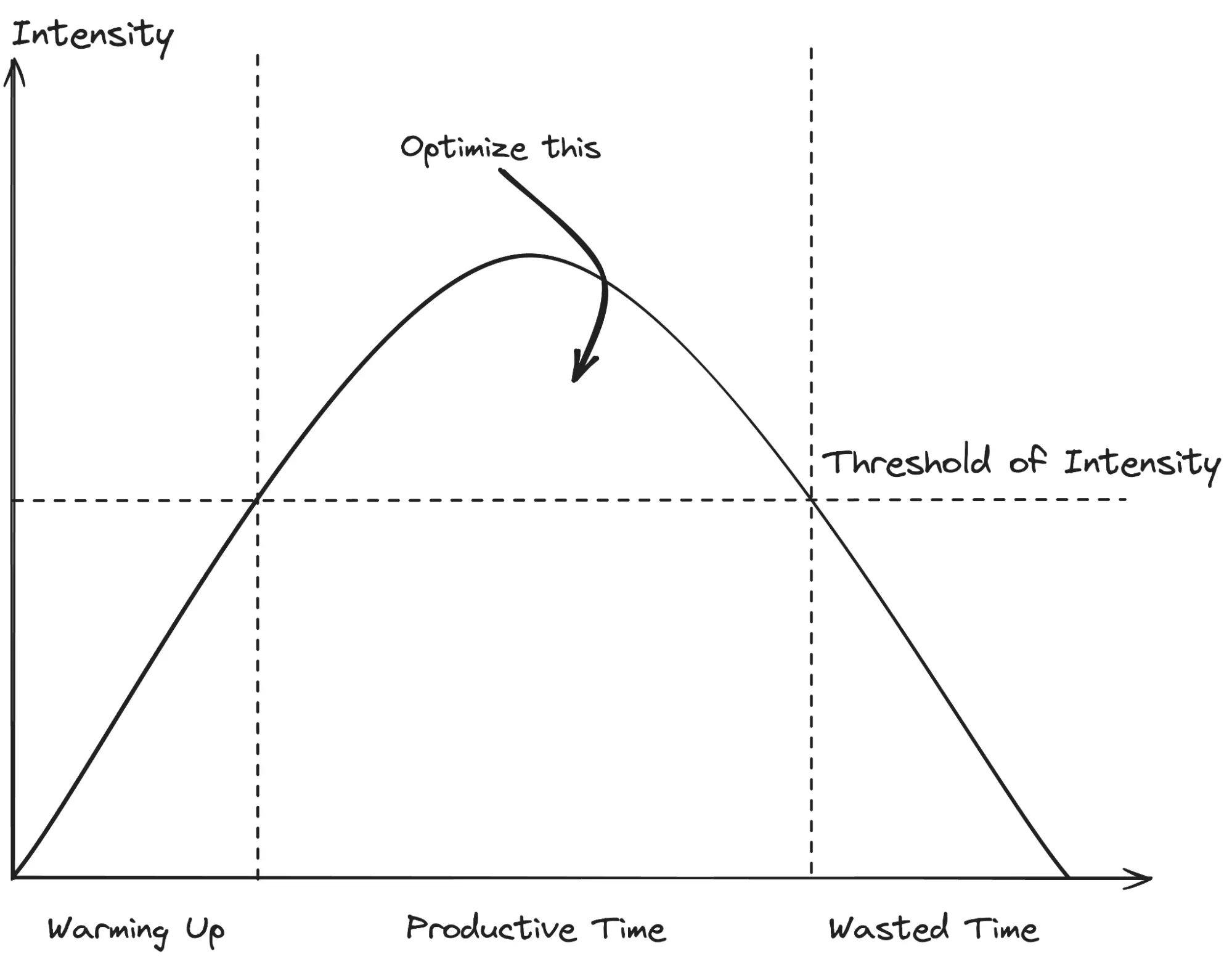
How to design a deep knowledge work session with your Zettelkasten. The goal is to maximize the time spend in deep focus.
Post edited by ctietze on
Howdy, Stranger!
Categories
- 3K All Categories
- 153 Research & Reading
- 703 The Zettelkasten Method
- 12 Knowledge Work
- 102 Writing
- 474 Software & Gadgets
- 158 Workflows
- 733 The Archive
- 15 Plug-In Showcase
- 88 Resolved Issues
- 225 Projects Logs and Journals
- 86 Project: Zettelkasten.de
- 53 Critique my Zettel
- 179 Random
- 375 Introduce Yourselves!
Comments
If we are to prioritize time spent in deep concentration, should we invest in shallower academic work (like listening to a podcast in your field) at all, or is the mental opportunity cost too high? What kinds of leisure would not be considered distractions?
Deep work requires high-concentration sessions. However, this doesn’t mean you should reach the maximum concentration possible. In fact, doing so is counterproductive.
Too much concentration makes you more fragile. A small disturbance (a noise, a mistake, an interruption, etc.) can easily turn into a major annoyance that prevents you from working.
It also reduces your cognitive flexibility. Flexibility is a fundamental skill for doing creative work and solving problems. But an excess of concentration, at least in my case, usually turns into rigidity and obsession rather than productive focus.
So the goal is to optimize (not maximize) concentration. I don’t remember exactly when it was, but it was Sascha who recommended that I avoid falling into this excess of concentration and instead keep myself in the soft zone (from The Art of Learning by Josh Waitzkin). Thanks to that, I can now work for much longer sessions without suffering the negative effects of over-concentration.
Creative work doesn’t play by conventional rules
I don't know this question. However, in athletics you mix both high- and low-intensity sessions. Based on this, I think there is a good point in shallower (~less intense) work.
But for me, I max out at ~8-10 hours of reasonable intensive work per day over the long-term. So, I chose silent walks often over adding more input.
@FernandoNobel
Good addition. I guess the western over-the-top mindset warrants a balancing addition like yours. (Though, I don't envy the schedule and intensity of many Asian cultures!)
There is a similar pattern between the western school of powerlifting and the eastern school. The western school is all about performing epic workouts that leave you exhausted and in need of a lot of recovery. The eastern school treats training as physical labour. Calm, high volume, medium intensity, focused. I train in eastern style for a long time, and it fits me a lot more.
However, I really enjoy the over the top intense sessions both physically and mentally. When the time comes, I hope finding some research on chess players, how they react to games.
I am a Zettler
Thanks! :-)
I think there’s a direct connection here with wu wei (or acting according to nature, as the Stoics would say). Sometimes the right action is to do, and other times it’s to not do. The key is being able to tell the difference.
Should I let myself be carried by this dangerous river because it might carry me out of the situation effortlessly? Or is this the moment when I need to give it everything I’ve got, because not acting would actually be the risky choice?
I would love to know more about how chess players handle this :-)
Creative work doesn’t play by conventional rules
Funnily, I published a podcast yesterday about different types of training plans. There are two types that are of relevance here:
Applying this to intellectual work, the volume plan is obviously what is sane and is the most appropriate platform to success. However, the Meat Grinder is quite promising. A lot of the geniuses follow such a schedule and I wonder if being able to stay in the meat grinder is part of super high achievement.
I lived a meat grinder life (for spiritual reasons) for a long time and I got a lot out of it. One of the benefits is that it raises your work capacity as long as you are willing to change yourself. Wu Wei applies somewhat: You create the meat grinder. But then you let your mind and soul change with it.
There is a qualitative difference between just enduring the meat grinder and letting it restructure your self. I even wrote a short essay trying to explore this topic called "On bending and breaking". If you just bend, you will snap to your older self. If you let something in yourself break, then you make a leap in development.
I think that the biggest problem here is that you have the shouting of lunatics like David Goggins who try to explore such a process. An interesting direction is the concept of post traumatic growth.
I got a little bit offtopic...
I am a Zettler
In my experience, I've gone through many Meat Grinder situations, both in creative work and in my personal life (though probably not to the extreme you describe in your own experiences, haha).
I usually approached them from Uri Alon's perspective of "the cloud". When doing science it's common to hit a block where your realize that initial plan of going from point A to point B is impossible. The way out usually involves breaking your basic assumptions, reconstructing them, letting go of goal B, and finding a new path C. In other words, you escape the cloud by accepting the impossibility of the situation and letting it fundamentally reshape you (new assumptions, new goals, etc).
Then, if you are a really good scientist, the final step is publishing your results as if you’d always intended to go from A to C in the first place :^)
So I think the Meat Grinder Plan has its place in creative work, and may even be inevitable once you've exhausted the Volume Plan without getting results.
Creative work doesn’t play by conventional rules
Started to listen to this Ted Talk by him, and he started by saying, "I stopped shaving." Lol. Then I am in the cloud since I am 17.
I think for many people, the meat grinder is a dumb idea, period.
Many conditions have to come together for the meat grinder to benefit you both in the short and long term.
I, for example, took very intensive care about the meaning structure of my life, so that I could restructure my psyche properly and adapt. Without such measures, you might just get burned out, which means that you get short-term results with long-term costs.
I am a Zettler
Then, you had a really rough life :-)
I agree that without the conditions you mention, the meat grinder is devastating in the long run. However, it's also a situation that you often drift into, or sometimes simply can't avoid.
For example, I took part as a student in the iGEM competition (the largest synthetic biology competition), and I can assure you: it was a true meat grinder. The stakes were extremely high, and so was the level of competition.
For me, it was an experience of extremes (moments of great happiness mixed with a lot of stress). In other words, both the intensity and the volume were very high. I spent the entire summer working every single day, all day long, with the team (I took less than a week off). I even remember that the only moment of personal reflection I had was the twenty minutes it took me to fall asleep at night. Everything else was thinking about the competition.
In later editions, I participated as an advisor or judge, and I've seen the same pattern repeat. The meat grinder is always there.
In my case, I now actively try to avoid falling into a meat grinder situation whenever possible. So implementing a "Meat Grinder plan" isn't something I have in mind (I don't want to do that to myself). Still, I believe it's an aspect of creative work that sometimes simply can't be avoided. In that sense, maybe what's really useful is a "Meat Grinder rescue plan".
Creative work doesn’t play by conventional rules