
Howdy, Stranger!
Categories
- 3K All Categories
- 153 Research & Reading
- 707 The Zettelkasten Method
- 12 Knowledge Work
- 102 Writing
- 474 Software & Gadgets
- 159 Workflows
- 733 The Archive
- 15 Plug-In Showcase
- 88 Resolved Issues
- 225 Projects Logs and Journals
- 86 Project: Zettelkasten.de
- 53 Critique my Zettel
- 179 Random
- 375 Introduce Yourselves!
Comments
Thanks for the recommendation. I really like the simplicity of this workflow :-)
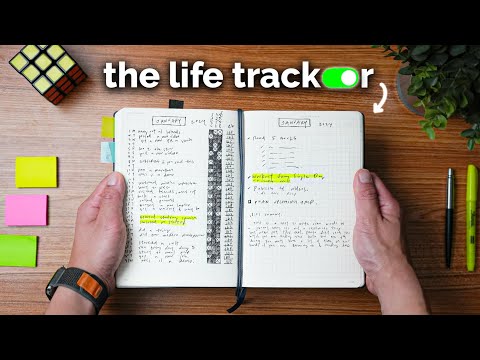
I think the video's workflow can easily be adapted to a digital journal (even a digital journal within a Zettelkasten). But, doing this has some costs:
On the one hand, we lose the ease of being able to draw whatever we want/need.
On the other hand, writing in a physical journal can be more convenient in many situations, e.g. writing your journal before going to sleep.
Creative work doesn’t play by conventional rules
I kept a Bullet Journal for a few years - this is very similar. I liked keeping a paper Bullet journal but eventually migrated to digital, using NotePlan. One area that is worth including that wasn't specifically mentioned is to write down one thing you are grateful for each day.
I like this to be a communal thing. To me, this elevates the experience to a great extend.
I am a Zettler
Yes, I agree. My oldest daughter gets her family together before bed and they go around the circle, from youngest to oldest, sharing their favourite part of the day and something they are grateful for. It creates a good feeling amongst the group.
I've been tempted a few times by the 'quantified self' approach to life; tracking habits, weight, fitness and other metrics. Overall I feel like it puts too much pressure on one's self to constantly be critical of progress in any domain. It can very easily become a distraction from being present as much as possible in each moment, which brings a stronger feeling of quality to my life as it moves on.
It also takes a lot of time an energy to keep track of.
That being said, if someone has a specific goal they want to achieve (weight loss or better sleep), it's of course a great idea. As progress can be easily overlooked if you're feeling not so great over a course of some days.
@tjex
The quantified self approach has similar traits to veganism. One of the traits is that it almost cancer-like in its effect on one's way of living, pretending that it can provide the answer to all questions that life asks from us.
So, your experience is pretty natural.
Btw. The Lucifer-Effect by Zimbardo explains imho much of the problem.
I don't think that it's the pressure that creates the negative effect, but the single-mindedness that it creates. (another book: The Master and His Emissary)
(Anticipating @Andy to throw in some other books that I will put on my list... )
)
I am a Zettler
I have been summoned by @Sascha in response to this issue raised by @tjex...
I haven't heard much about Quantified Self in the past few years (I heard more about it around 10 years ago), but I admit that I am sympathetic to it, not as a panacea that "can provide the answer to all questions" and not as "a distraction from being present as much as possible in each moment", but merely as a hobby driven by curiosity (or by any other motive) that may or may not have utility.
In "For some, self-tracking means more than self-help" (2019), Joseph Reagle said:
This "compulsion" or "curiosity" (they are not the same—choose whichever one seems most relevant to a particular case) generates information, but the information itself does not tell you what to do, how to act. The presenter that Reagle mentioned had a ton of information but seemingly wasn't sure about how to make sense of it.
To make sense of self-tracking data for changing your life, you still have to go through the same process of reflection that anyone else has to do when thinking about their life. Perhaps it's possible to aim for a happy middle between pure information and pure reflection?
In "How to use data-driven insights to accomplish 'the Informed Self'" (2016), Francis Wade (in my interpretation of him) called this happy middle "the Informed Self" (instead of the Quantified Self):
Of course, this is just another way of saying what @tjex already said above: "That being said, if someone has a specific goal they want to achieve (weight loss or better sleep), it's of course a great idea."
But having said that, I still want to defend those people who want to collect data just because they are curious. It is possible to do this in a way that does not distract from the present moment (because it is automated) and does not pretend to be a panacea for all problems. Personally, I track most of my time use. All that data is also transferred into a calendar where I can see exactly what I did at any time in the past. Sometimes this data is useful for troubleshooting and for giving me a more precise understanding of time, but it's also just a little hobby that generates data that I think is cool and interesting but that other people may think is weird. There is nothing wrong with this, but there will always be haters.
Further reading:
Do you also use data from Zettelkasten for your ‘quantify self’ approach? Time spent? Insights per year? Or other collectable data?
Edmund Gröpl — 100% organic thinking. Less than 5% AI-generated ideas.
@Edmund said:
No, I don't quantify my Zettelkasten nearly as much as other people in this forum do. I have a set of annual smart folders in DevonThink (one of the apps I use) that shows how many Zettels I've created per year since 2008. And I have time-use data recorded back that far, so I could filter the time-use data for
note*, sum the hours per year, and divide by the number of notes per year, but I doubt that would be a meaningful number, and it would badly overestimate because I often combine note-writing with other related activities within a recorded time block.That's practically the BuJo method, particularly the Monthly collection. I do this every month, and I track daily by hand the habits or stuff that I need to improve on. It's pretty good!
My Zettelkasten is a Bullet Journal and my Bullet Journal is a Zettelkasten.
Edmund Gröpl — 100% organic thinking. Less than 5% AI-generated ideas.