Think-Draw-Wait: Three Steps for a Visual Zettelkasten.

It takes time to wait. Today, I created a sequence diagram to reveal one of my 'secret Zettelkasten workflows':
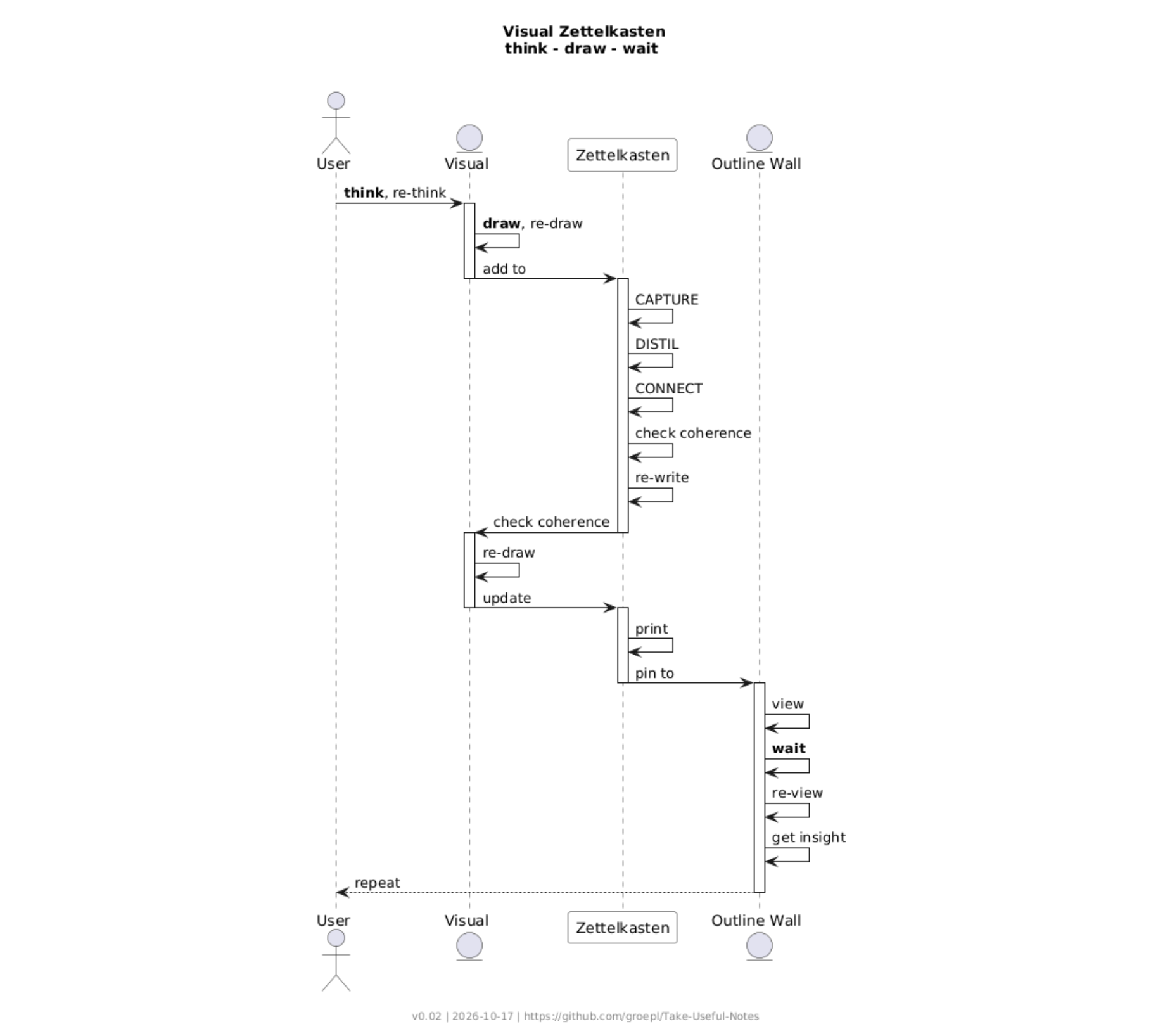
My Zettelkasten reminded me of an old idea from 2023 published on the Obsidian forum. To create the diagram today I used the PlantUML plugin for Obsidan.
More about: https://plantuml.com/en/
Post edited by Edmund on
Edmund Gröpl — 100% organic thinking. Less than 5% AI-generated ideas.
Howdy, Stranger!
Categories
- 3K All Categories
- 153 Research & Reading
- 708 The Zettelkasten Method
- 12 Knowledge Work
- 102 Writing
- 475 Software & Gadgets
- 161 Workflows
- 734 The Archive
- 16 Plug-In Showcase
- 88 Resolved Issues
- 225 Projects Logs and Journals
- 86 Project: Zettelkasten.de
- 53 Critique my Zettel
- 181 Random
- 376 Introduce Yourselves!
Comments
@Edmund You must be the Master of using diagrams to map various Zettelkasten processes (and other processes, for that matter). Do you find using this approach clarifies your thinking?
I've used mind maps in a limited way to document engineering design processes and find, even if I think I know the entire process, that the mind map helps to clarify certain aspects of a process. And sometimes, I discover a few additional elements or flow paths.
I'm curious: What is the "Outline Wall"?
The Outline Wall is a technique used by historian Robert Caro [1], to organize and make sense of large amounts of information. He would create an outline of the main ideas and concepts of a historical event or period and post it on a wall. Then, he would add all the research materials he gathered, such as documents, images, and notes, and pin them around the outline.
The idea behind it is that by visually organizing the information and seeing it in front of him, he can easily identify patterns and connections between the different pieces of information. The outline serves as a structure, helping him to see the big picture and understand how all the pieces fit together, also allowing him to change the structure as he gathers new information. This way, he can think more clearly and make connections between different pieces of information.
References
[1] Paul, Annie Murphy. The Extended Mind - The Power of Thinking Outside the Brain. Mariner Books, 2022. https://openlibrary.org/books/OL35293012M/The_Extended_Mind., p.144
[2] https://medium.com/@groepl/take-useful-notes-use-an-outline-wall-65752cb0d3ae
Edmund Gröpl — 100% organic thinking. Less than 5% AI-generated ideas.
Yes, absolutely. I always start with a sketch. I love the refinement that comes with many iterations.
Edmund Gröpl — 100% organic thinking. Less than 5% AI-generated ideas.
Thanks! Here's a picture of Caro and his coarkboard: https://cspancollections.gmu.edu/s/Home/item/5966