Howdy, Stranger!
Categories
- 3K All Categories
- 153 Research & Reading
- 706 The Zettelkasten Method
- 12 Knowledge Work
- 102 Writing
- 474 Software & Gadgets
- 159 Workflows
- 733 The Archive
- 15 Plug-In Showcase
- 88 Resolved Issues
- 225 Projects Logs and Journals
- 86 Project: Zettelkasten.de
- 53 Critique my Zettel
- 179 Random
- 375 Introduce Yourselves!
Comments
Franky, I'm not sure, and I'm not sure I even care at this level. At the time I wrote that note I felt a liking for the word ("syllogism") mostly because I liked the sound of it. I did look up the definition but I haven't really internalized it yet. So I'm using it in a sloppy way and maybe I'll revisit those cards someday. What I am actively thinking about is the difference between a proof and an argument, "proof" meaning in the logical or mathematical (is there even a difference?) deductive sense.
[snip]
Luhmann wrote this well-known snippet:
"...[communication with the slip box] becomes productive only at the moment of evaluation, and is thus bound to a certain time and is to a high degree accidental"
My example (previous comment) is a living embodiment of it. There are other ways for a ZK to evoke creativity and productivity. I don't know if Luhmann ever experienced this kind of associative cascade. I hope he did.
I think he did. Kommunikation mit Zettelkästen contains another clue (emphasis added):1
My image is that he's browsing the Zettelkasten, flipping through cards in the order as they are filed, occassionaly looking up links, finding interesting stuff and having innnovative thoughts. :-)
https://web.archive.org/web/20240629071815/https://luhmann.surge.sh/communicating-with-slip-boxes
German original: "Jedenfalls gewinnt die Kommunikation an Fruchtbarkeit, wenn es gelingt, aus Anlaß von Eintragungen oder von Abfragen das interne Verweisungsnetz in Betrieb zu setzen. (…) Auf diese Weise wird — durchaus punktuell, in diesem Moment, aus Anlaß eines Suchimpulses — mehr an Information verfügbar, als man bei der Anfrage im Sinne hatte; und vor allem mehr an Information, als jemals in der Form von Notizen gespeichert worden war. Der Zettelkasten gibt aus gegebenen Anlässen kombinatorische Möglichkeiten her, die so nie geplant, nie vorgedacht, nie konzipiert worden waren. Dieser Innovationseffekt beruht einerseits darauf, daß die Anfrage Relationierungsmöglichkeiten provozieren kann, die noch gar nicht traciert waren; zum anderen aber auch darauf, daß sie auf interne Selektionshorizonte und Vergleichsmöglichkeiten trifft, die mit ihrem eigenen Suchschema nicht identisch sind." ↩︎
I do know that passage. I have a slightly different picture of how it may have worked for him. Of course, we can't really know.
Luhmann is working on some thoughts for an essay on equality. He is working from cards in Case I. section 6.3. In one card about Ideology and Equality he sees a link to a card with more about that area, card 45,8a52ai1. He realizes that this topic should be touched upon in the essay. Then he remembers that he had made a connection to Equality and Justice and decides he should add a section on that to his to his essay too. He knows he put a link to a card in the Justice area so he paws through his cards in section 6.3 until he finds the link. The group of cards at that link provide just the material he needs.
This is a way in which he could have gotten serious productivity boosts without experiencing an associative cascade.
Yeah, that's another possibility. I can imagine both. BTW, in my imagination, if he had a thought like
he'd immediately write it on a zettel and insert it into the box.
Your thoughts made it into my zettelkasten, @tomp. Those questions helped a lot!
My note "train of thought" now includes a reference to Hobbes, who coined the term almost 200 years before the first railroad. According to a dictionary, "train" has also the older meaning of people or animals following each other, eg a camel train. The metapher "caravans of thought" is surprisingly accurate. It changes the imagery in my head. When I now think of "train of thought" I have images of a camel train, caravan or convoy in my head. Unlike the tightly coupled wagons of a railroad train, the animals or people walk with a certain distance from each other. This is a moving image.
The word "trail" seems to refer more commonly to the path created by people walking it. A trailblazer is the first person to walk a new path. When I now think of "trail", I think of animal trails or hiking paths in the forest. This is a static image. I think of Bush's trailblazer as someone who prepares a new path in the forest by selecting vistas, so that other hikers can later walk the same path and enjoy the same vistas.
However, there's also the verb "to trail". One could argue that people in a train trail each other. And there's the "trailer" that is attached to a truck. If you add several of them, you get the road train. Hmm.
With the new images in my head, "train" doesn't work for Folgezettel anymore, because a train moves, but zettel structure is static. :-( My notes lead me to "branch", which feels organic but too heavy, not like individual cards. "Building blocks" feel to hard and massive, because I'm not stacking them like a brick wall. "String" or "thread" feel lighter. Maybe not a "web", but an inka khipu?
Can we improve the quality of our notes by choosing better metaphors?
Glad to be of help. Composing my responses also helped me understand some things that I knew but hadn't articulated as well.
Cool. You got a stronger Caravan image than I did. I will mull it over and see if I might want to adopt it too.
I have no doubt. Much of our thinking is metaphorical anyway. I know I get a flash of satisfaction when I hit on a good metaphor. That reaction will pay off later in the ZK.
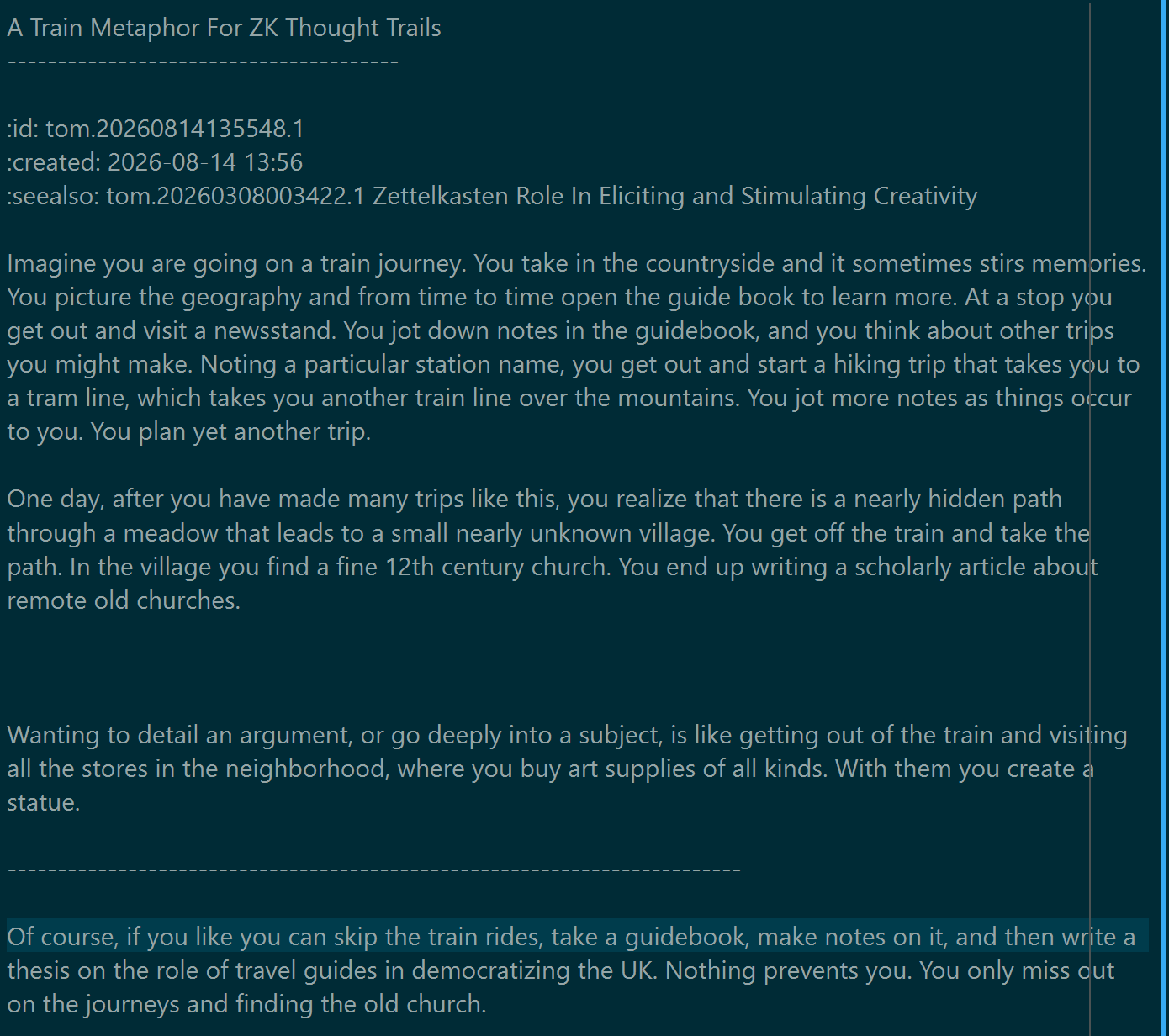
I had forgotten I have this card on the train metaphor, though it morphed into a journey metaphor as I wrote the card. I'm posting it as an image to avoid having the forum software make changes.
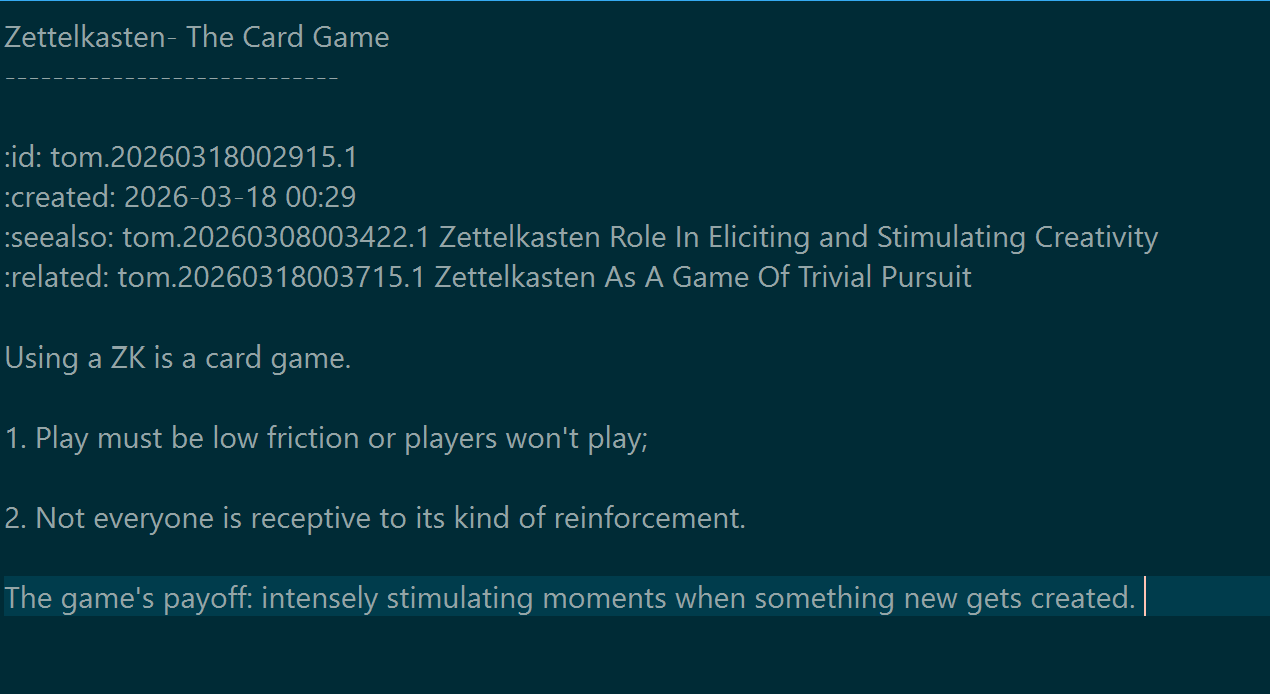
Here's another of my metaphor cards:
Wow! What a great discussion! Thank you all.
I have now used your feedback to update the Root Cause Analysis:
The green flags have already been reviewed and revised. At least one of the yellow flags should indicate the root cause of the given problem statement. As we can see, most of the proposed potential causes fall within the categories of Men, Material and Method.
I feel much better now. The only thing left to do is to focus on finding and eliminating the main root cause.
Edmund Gröpl — 100% organic thinking. Less than 5% AI-generated ideas.
Before you spend any more effort in that direction, would you please read the part of another thread starting with this contribution of mine. It may give you some more ideas -
https://forum.zettelkasten.de/discussion/comment/26149/#Comment_26149
All right, now that you've looked at the other thread, (or not), I have noticed a few things about your chart. I hope you won't mind me sharing my thoughts. The chart hasn't narrowed things down very effectively. Instead, it has expanded into a range of possible causes. This makes me wonder if you may have a number of notes that "fail" in different ways. There would be no single "root cause". Is this so, and can you group them into similar groups? Could you share a few notes that "failed"?
Another thing I noticed is that this kind of chart is used in production processes, where the need is to ensure that the produced widgets, whatever they are, stay within tolerances (often on a lot-by-lot basis) and the need is to quickly and reliably pinpoint the problem so it can be addressed (I used to work in manufacturing businesses).
But you are not, I suppose, producing lot-size quantities of identical note-widgets. You have no way to define acceptable tolerances. You do not have precise and standard ways of determining failure. You don't have precise and standard ways to remedy the cause. This approach is probably not too applicable to, say, a football team, and it certainly isn't going to help an individual player out of a slump. For that he relies on individualized coaches (Hi, Sasha!), time, and practice.
Let me offer a different way of approaching your problem with notes. You said, I think, that notes weren't happen when you wanted to write something. I assume that you already have a project but that you get stuck somewhere, nothing coming to mind. If that's right, please correct me.
Imagine, or actually do, sitting down with your notes. You are going to work on some section. You go to pull out a note. Why?
You know what you want to write about but the words won't come. Maybe a note will kick-start something?
You do find notes but they are all off-topic.
You find notes that seem to be on topic but they feel flat and you can't connect with them any more.
-What, you didn't feel any enthusiasm back then? Then why were you spending cognitive effort on these notes? Life is short, enjoy the work.
I have written in terms of individual note, but groups or sequences of notes need to work together. Everything I wrote above applies to groups of notes.
Grrr, how the heck do you edit a reply once it's posted? People say the do but I don't know how.
I think you get an hour to edit your post, I guess with the assumption (which is true for me) that you notice some errors only after posting a reply.
If you look immediately above your post, to the right, you will see the time of the post and the word "Flag". You will also see a gear symbol (you might have to right click on the time to see the gear). If you see and click on the gear, you can still edit your post.
Thank you. I've seen that symbol, I think.
Yes, I think this is the first step in using the Ishikawa method.
My Zettelkasten is also part of my production process. My aim is to produce high-quality books, blog posts, and so on.
I'm not stuck, but I have to do some more of my "homework". Here is my latests version from root cause analysis:
My resulting actions:
I'm look for a good place to save this diagrams in my Zettelkasten. Are they Structure Notes like Maps of Content, Context Notes which are reusable for different Permanent Notes (Zettel) or just Project Notes?
See also: Understand Zettelkasten Essentials — Zettelkasten Forum to improve "Reviews & Habits".
Edmund Gröpl — 100% organic thinking. Less than 5% AI-generated ideas.
You are working against a strong headwind - you are trying to diagnose your own process. On top of that, in this particular case it is very hard to run diagnoses and to establish criteria with which to evaluate them.
I offer the following as an example. A student tries to find the root cause as to why he keeps getting bad marks on his essays. First comes the student's attempt to troubleshoot, next the teacher's perspective.
Why do I keep getting bad marks for my essays?
Student's root cause breakdown -
Not legible enough
teacher does not understand what I say
Teacher: actual problems -
This student will never find a usable root cause by using his chart.
What might be effective or at least a good start would be for the student to have a dialog with the teacher. Of course here there is no teacher to dialog with. Let's imagine one and see how it goes:
S: You keep giving me bad grades. Why?
T: You don't explain concepts clearly, and you don't seem to grasp the concepts in the assigned materials.
S: I don't know what you mean by the concepts in the materials.
T: The concepts are the main ideas in a work. It sounds like you don't know how to look for them when you read. Let's work out a plan to help you learn to spot them.
S: OK. What else?
T: You don't seem to understand what these essay assignments ask for. Maybe learning to spot the concepts in the reading materials will help with this, too.
...
You might try writing a dialog like this, see where it goes. Otherwise, each branch of your chart that leads to a "maybe it's this" should lead to a dialog about it. The trouble is that it's hard to see one's own blind spots.
I see two areas missing from your chart, and I think they are important if you are going to continue to keep using that approach.
Here's my concept of what my Zettelkasten system is all about -
Basically, a Zettelkasten-like note collection is not a machine that pops out ideas when you turn the crank. It's not like a player piano. It's there to support creative thinking, including writing. I think of it as a cognitive instrument. I can play it to refine my understanding of particular passages, and sometimes I get inspired with new ideas while I'm playing it. Sometimes I play it with hopes of getting inspired.
If the diagram is worth saving, that might be because it's an example of this kind of approach. Otherwise it's specific to this one analysis and probably not ZK fodder.
If it's worth saving as an example, then that's the subject of a note - it's about troubleshooting. The note can link to the diagram. Perhaps this note could be a seed that grows into an entire new area in your ZK.
Maybe use these diagrams as attachments to an atomic note?
The atomic note would be "Permanent Notes often fail to be useful when I return to them for writing". Or maybe an open question: "Why are my zettels less useful than expected?"
The attached charts could be a starting point for further zettels. Look at each branch and try to turn each branch in a separate note.
A disclaimer: I am referring to my own system and my own notes. I am pessimistic about improving the quality of my notes because I am up against diminishing returns. I don't see the utility in doing more than
1. standardizing the format, which I have done in the Zettel repository;
2. following Ahrens's advice to read with a pen and notebook;
3. adding source references to a reference manager (Zotero) before using them.
My workflow frequently goes from projects to the notes in the Zettelkasten, as opposed to the other way around, which may be why I don't run into the problem described here.
Zettel GitHub. Zettel Wiki Erdős #2. Problems worthy of attack prove their worth by hitting back. -- Piet Hein. PROBLEMS. Grooks, 1966. CC BY-SA 4.0.