A tiny experiment with note types

Last week, I started a small experiment involving three different types of notes (Permanent Notes). My Zettelkasten analysis showed the following numbers:
- #type/proposition = 68,5%
- #type/question = 31%
- #type/observation = 0,5%
Just an observation. I hope to discover some related and useful propositions and questions within the next few weeks.
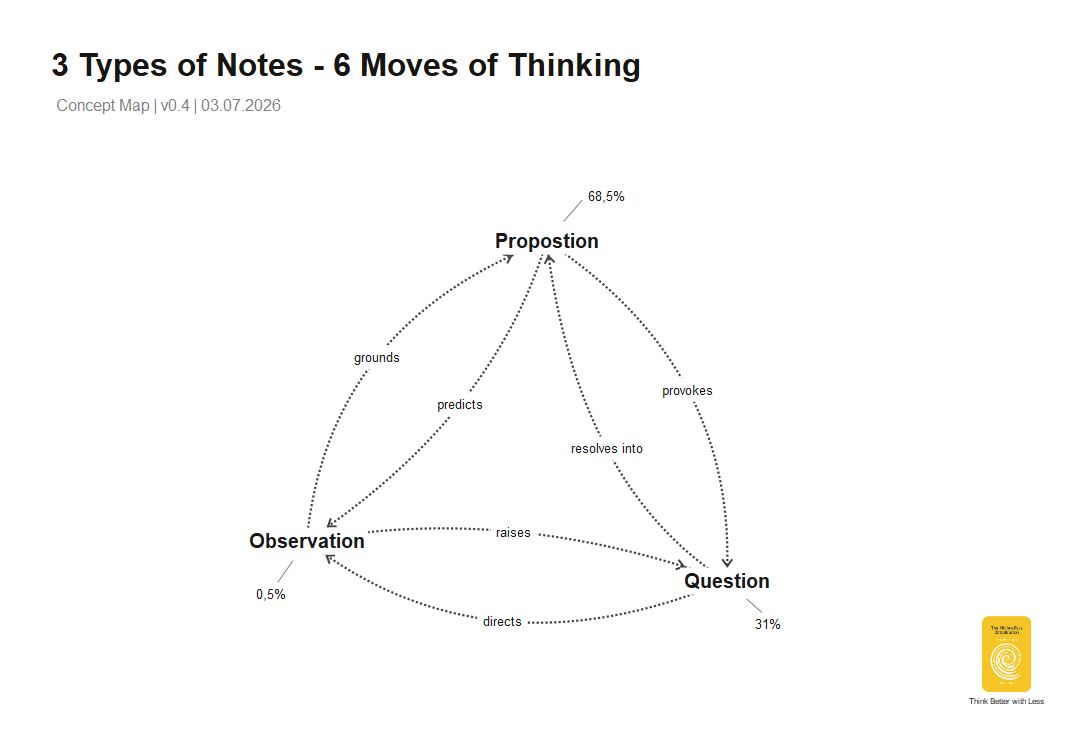
What have your experiences been like when trying out structural experiments with your Zettelkasten?
More about:
Edmund Gröpl — 100% organic thinking. Less than 5% AI-generated ideas.
Howdy, Stranger!
Categories
- 3K All Categories
- 153 Research & Reading
- 706 The Zettelkasten Method
- 12 Knowledge Work
- 102 Writing
- 474 Software & Gadgets
- 159 Workflows
- 733 The Archive
- 15 Plug-In Showcase
- 88 Resolved Issues
- 225 Projects Logs and Journals
- 86 Project: Zettelkasten.de
- 53 Critique my Zettel
- 179 Random
- 375 Introduce Yourselves!
Comments
I've ran several experiments with structure, but in the end I always come back to the same conclusion, which is to keep it simple. I always regret it and reverse it when I make anything more complicated than it needs to be.
The experiments I end up keeping are the ones that work across my entire Zettelkasten in a consistent way. If an experiment only seems to work for a particular set of notes, then it makes me think that those notes will become isolated and lose the benefits of connection to the whole.
I'll keep experimenting, but will always ask how this experiment fits into the entire process and helps with my overall goals.
If I were to run your experiment on my notes, I'd probably have way more observations, so it's interesting how your percentages turned out. Maybe that's just because of the particular set of notes you applied it to.
I've experimented with type and scope annotations but so far haven't gotten much value out of them. That could change in the future, perhaps.
I have an experimental script that returns a "Concise Bounded Description" (CBD) of a z-card. This shows all cards that have links to the selected card, and then all cards that have links to them. One could extend the CBD beyond two tiers, but the extra levels would produce many more results whose connections would be increasingly diffuse so I haven't tried more tiers so far. This can sometimes be helpful. The script produces clickable links for each hit so navigating to any of them is easy.
I have tried creating temporary and provisional sections and I've found them to be very useful.
The model is very interesting. Thinking about it, it partially reflects what I do, but with a probably fundamental difference: I don’t make those type of notes explicit (they are all "permanent notes"), they behave in a certain way only because of their placement within the note that contains them.
If an observation is strictly specific to a proposition, I integrate it directly into the note it supports; if it can support multiple notes or has relevance independent of the others, I create a dedicated note and I make use of links. In any case, I don’t have explicit types, as already stated. A text is an observation if it behaves like an observation when contained within a note or linked within a note.
I could consider this a kind of “duck property” of my notes: if it works like… then it is…
I obviously can’t measure percentages, because since the notes aren’t typed, I wouldn’t know how to count the different kinds of notes 🙂
I try out new ideas with a few notes to see if the idea works at all.
Small scale experiments make it easy to explore many variants.
Experiments with real data help weed out ideas that looked promising in theory, but fail to produce the desired effects in practice or even introduce undesirable side effects.
Yes, that's a useful threshold.
When I make structural changes, I apply them to the whole ZK. A consistent ZK is easier to update.
Yes!
The 0.5% is the most interesting number in there. A category that thin usually is not a rare phenomenon, it is a category that is not earning its keep: either observations are not being captured at all, or they are being absorbed into the proposition they support at the moment of writing, which is exactly the placement-based approach described further up the thread.
That points at a test for whether any structural experiment is worth keeping: does the type change what you DO with the note later? If it changes what you review, what you link, or what resurfaces, it is structure. If it changes nothing downstream, it is bookkeeping, and bookkeeping quietly stops being maintained. I think that is the mechanical reason the keep-it-simple instinct keeps winning here. A half-maintained taxonomy is worse than no taxonomy, because now you cannot trust the absence of a tag to mean anything.
The other filter I have found useful: only make explicit what you cannot recover later. If you can tell a question from its text, because it is phrased as an open problem and ends in a question mark, then the tag is redundant, and redundancy is what rots first. The annotations that tend to survive are not categories at all, they are STATES: open versus answered, provisional versus settled, still-current versus superseded. Type is usually recoverable from the note itself. State usually is not, because it was true at a particular moment and the prose does not record that moment.
So my honest guess about the three types: proposition and question will drift toward something you could have inferred anyway, and the thing you will actually end up wanting is a status on the questions. That is the annotation that carries information the text cannot give back to you.
Admittedly, 0.5% is a low figure. However, I have only just started using the '#type/observation' tag. My Zettelkasten, on the other hand, is more than four years old.
From Austin Govella I've learnt that "Tags provide architecture, not content." I use this tag for filtering. It shows an entry point for a "7-step Zettelkasten Cycle". See: https://forum.zettelkasten.de/discussion/comment/24119/#Comment_24119
Thank you! That will give me food for thought.
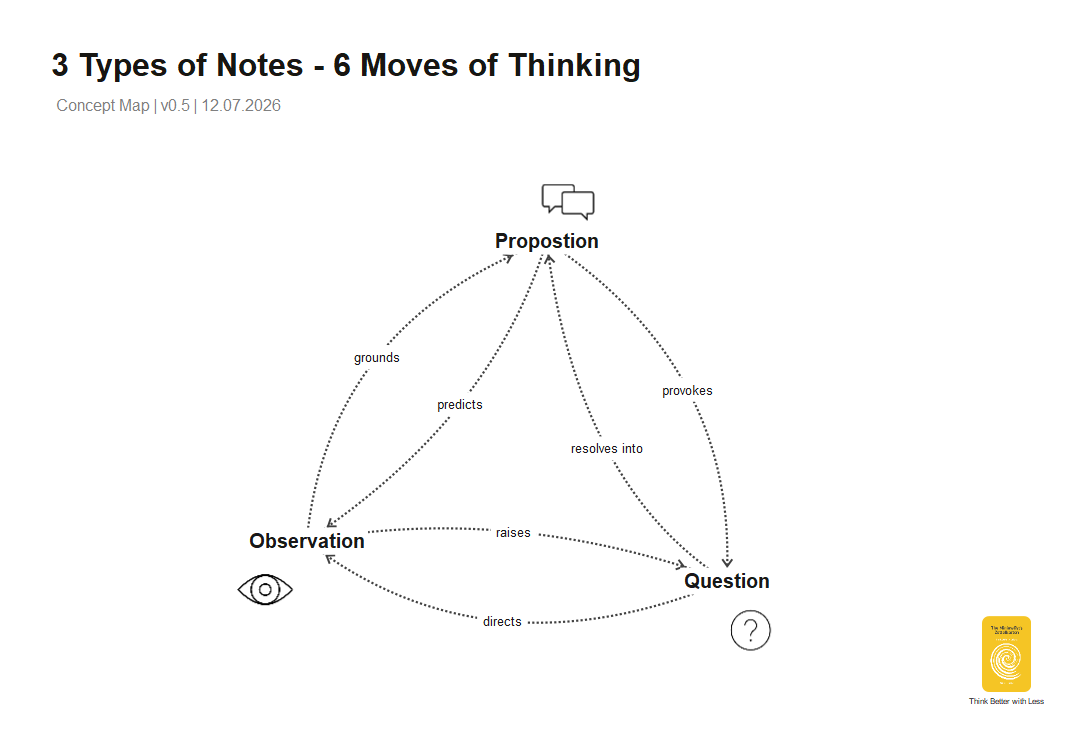
My visual update:
Edmund Gröpl — 100% organic thinking. Less than 5% AI-generated ideas.
Right - tags are equivalent to organizing points in an outline, so "architecture" is a reasonable term.
Interesting. I don't think of tags in terms of an outline.
I like to compare their basic functionality with indexes. On paper you'd write a list of page numbers or IDs next to a keyword. In a digital tool you can add the keywords as tags to the locations you want to find and use search to list those locations.
Yes. And also a simple tag is equivalent to a top level heading in an outline. A compound tag (A.B.C) is equivalent to a heading several levels down. You can picture all cards with a particular tag as being direct children of that heading node.
The reason I say this is that any compound string can be translated into an indented list, which is in essence an outline. For example, "A.B.C" becomes
A
  B
    C
The reverse is also true.
When a card has more than one tag, from an outline point of view that card has clones under each of the headings.
"the locations" would translate to "heading nodes" in an outline. The search is basically a search for headings that contain the search terms. A different kind of search looks for hits on card titles. It's very useful to do both in the same search routine.
The card search routine can display the hits grouped under their header node titles, which really works well. The headings search can show just the heading titles. Navigating to one of those headings will show all the cards under it.
That's how I use them as well. Make sure my tags are unique enough that they are not attached to more than about 5 (max 10) notes. Then a list of your tags becomes a great index.
I found the quote in a Medium article: How to approach tags in your personal knowledge management (PKM) system. Govella also says: "Tags are ad hoc, of the moment, tools." And: "Knowledge is messy." I agree. :-)
Need an account to read more than the lead-in. unfortunately.