Zettelkasten as a Productivity System

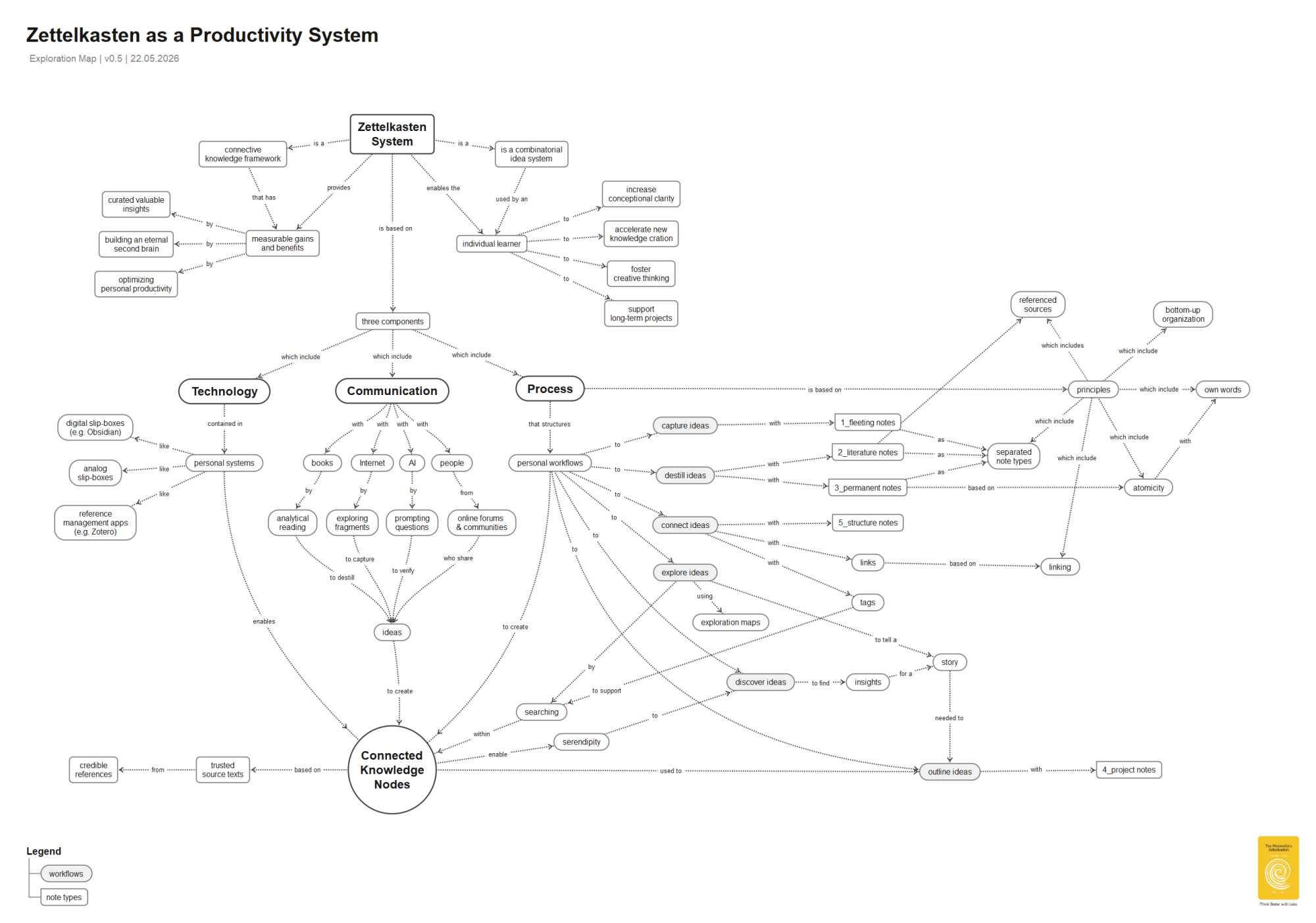
Some visual aids are designed to simplify specific elements of a system, thereby improving our understanding. They look very simple.
Exploration maps like this help us to understand the connections between existing concepts. At first glance, they may seem very complicated. However, they can help us discover hidden insights.
Edmund Gröpl — 100% organic thinking. Less than 5% AI-generated ideas.
Howdy, Stranger!
Categories
- 3K All Categories
- 153 Research & Reading
- 708 The Zettelkasten Method
- 12 Knowledge Work
- 102 Writing
- 474 Software & Gadgets
- 161 Workflows
- 734 The Archive
- 16 Plug-In Showcase
- 88 Resolved Issues
- 225 Projects Logs and Journals
- 86 Project: Zettelkasten.de
- 53 Critique my Zettel
- 179 Random
- 375 Introduce Yourselves!
Comments
That's a very well done diagram. I especially like that the edges are labeled, and that the two kinds of nodes are shown with distinctly different visual appearances.
Thank you! I tried to keep it simple and structured — happy it works.
This is a diagram showing my own Zettelkasten system. Looking at yours, are there any additional elements or principles that you prefer?
Edmund Gröpl — 100% organic thinking. Less than 5% AI-generated ideas.
As it happens I have created a mind map of my own. It has a different thrust than yours: mine is about the principles that I have tried to apply to my own implementation and practice. I'd be happy to discuss any of the parts that aren't fairly obvious.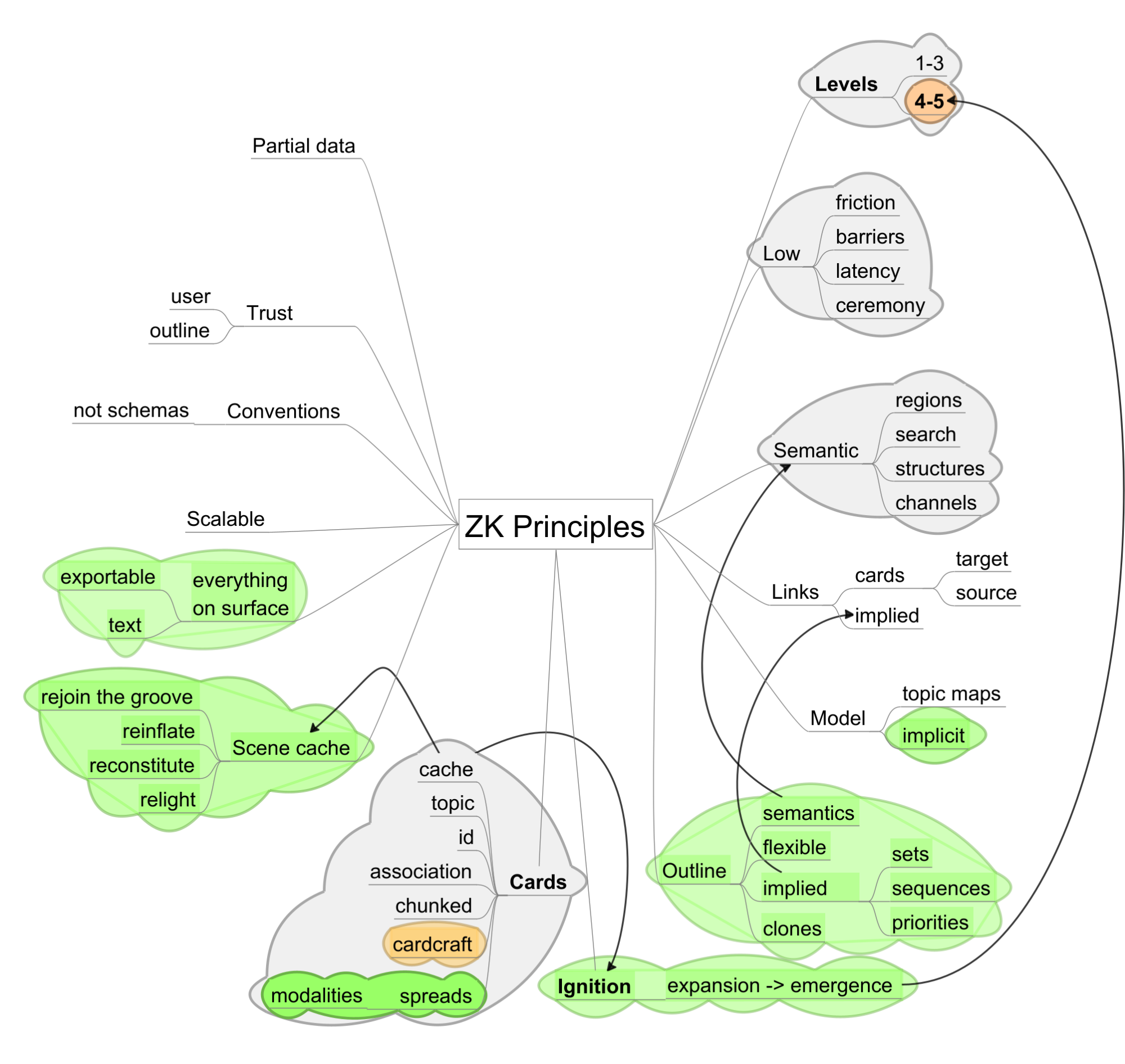
Thank you! It's a great set of principles. They demonstrate a highly personalised adaptation of Luhmann's Zettelkasten method to your own practice. Let me start with one question: What is a 'scene cache'? How do you use it? An example would help me to understand better.
Edmund Gröpl — 100% organic thinking. Less than 5% AI-generated ideas.
By "scene" I mean the mental or conceptual context that goes along with the note you are writing. It refers to all those things that didn't make it into the note. After all, a note can only be a flattened, compressed version of the rich picture in your mind. You can hope that reading the note later will bring it all back.
While a movie is being made, a scene that isn't finished will have to be picked up at a later time. To make that work, the director, cast, and crew uses devices such as storyboards, continuity notes, notes on scripts, actor's marks, camera blocking, lighting diagrams, rushes (unedited footage from previous takes), and so on to try to make sure that the scene has continuity with what went before.
A good card can play this role. Maybe not perfectly but we can try!
Of course it depends on what kind of card it is. A card that shows the syntax for a particular computer command doesn't need to do all that. The card is valuable anyway, when you happen to need to use the command.
But consider, let's say, a card that captures a quote from a book. Why did you want to save the quote? You had something in mind. Maybe you wanted to illustrate a principle. Maybe you admired the language. Maybe you thought it would become a building block in an argument you were constructing. Maybe you had an opinion about it.
The card will be more effective if it helps the surrounding context, what I am calling the "scene", come back into your mind. It "caches" the scene, to use a term from software design, meaning to save for restoration later.
I have a card for this concept (or principle). It's still preliminary and I may come back to it sometime. Here it is:
[The markdown preview is boldfacing some words but that's not in the actual card.]
Thank you for this great explanation. Your concept of a scene seems to be one of the more sophisticated Zettelkasten principles. Where does it stem from?
Edmund Gröpl — 100% organic thinking. Less than 5% AI-generated ideas.
@Edmund said:
What @tomp described seems to me to be similar to what is called the subjective context principle in Ofer Bergman & Steve Whittaker's book The Science of Managing Our Digital Stuff (MIT Press, 2016), though that principle is about the importance of designing your information system in such a way that the relevant surrounding context can easily be regenerated.
I can tell you exactly, though I only recently realized that one can apply the principles to z-cards. I learned to take meeting notes using mind maps and found they were very effective. One day I went looking through a box of old papers, to see what I could get rid of. I found an old mind map of meeting notes from a meeting five years earlier.
Out of curiosity I went over the mind map and within about five minutes, most of the meeting came back to mind, almost as if it had happened only a few days before. I've had a similar experience several times since.
I also used mind maps when a colleague asked me to teach a few sessions of a graduate level course on software engineering for him. I got a pad of large (size D IIRC) newsprint sheets and planned out the course with about half a dozen mind maps per session using big markers and highlighters. With these I could give an entire 3-hour session without needing more detailed notes. The branches helped bring back to mind everything I wanted to talk about. The large, bold format let me read the mind maps from a distance so I could move around and take quick glances without have to peer at notes in my hand.
Much later, I started thinking about how a Zettelksten can support a person's thinking, puzzled about how mind maps fit in (since I was using them for writing), how to promote creativity, and it all came together.
That is the back story. Everyone's brain works differently and I don't say that everyone should use mind maps. Use whatever modalities work best for you. If I could create good cartoons I would definitely use them with my z-cards, just as one example. Even sticking with text alone there is plenty that can be done to help a card refresh one's mind.
I haven't read that book (perhaps I should, thanks for the reference), but it sounds like it's closely related. I wrote about a single card recreating the mental context, and naturally the next step would be making more than one card cooperate for the same purpose.
Making the card a hub that can summon other related assets would be a part of it.
Here‘s a link: https://books.google.de/books?id=Ds1uDQAAQBAJ&printsec=copyright&redir_esc=y#v=onepage&q&f=false
"the subjective context principle"? Do I need it? I only keep a link to the source and some links to a few related ideas. All other context is lost. I do not use my Zettelkasten as an archive. An archive retrieves what you put in. A communication partner returns something you didn't.
Edmund Gröpl — 100% organic thinking. Less than 5% AI-generated ideas.
That's so if you put in unlinked and unrelated facts. Luhmann talks about exactly that: how much more arises from the collection than was explicitly put into it. In my view, part of that extra value (if we can call it that) comes from the semantics of the indexing and links, which is usually more inarticulate than reasoned. Part of it comes from the semantic drift that happens because the user's concepts drift over time faster than the collection's does. This can give rise to the dissonance or surprise that Luhmann wrote about as leading to creative discovery.
You only keep a link to the source and to a few related ideas? That's just what a browser bookmarks manager does, or should do. My relationship with bookmarks managers goes back a long way and I know what you mean.
These days I want more from my system. I want it to help me restore context so I can pick up where I left off. This doesn't prevent me from building up other ideas and contexts, nor from making unexpected connections, so it's not working as a jail.
An option to integrate Zettelkasten and the "Subjective Context Principle":
Edmund Gröpl — 100% organic thinking. Less than 5% AI-generated ideas.
I have some fairly fundamental disagreements with many of the ideas on your diagram.
I fully agree with the idea that we want to avoid being locked into a rigid system of thought but I don't agree with the way you have interpreted that distinction.
This, to me, is where lot of the value of a ZK comes from. Finding things other than exactly what I was looking for... is what leads to connections I otherwise might not have thought of. That's when I understand something better or get a new idea, and that's what makes a ZK so valuable to me.
You're right that Luhmann's numbering system assigned positional context — "Context is emergent rather than pre-assigned." would be more precise than "Context not given." The diagram overstates that opposition.
Where I'd push back: the distinction I'm drawing is about how meaning is generated, not how things are found. Findability is a separate problem, and collapsing the two loses something important.
Here's my update:
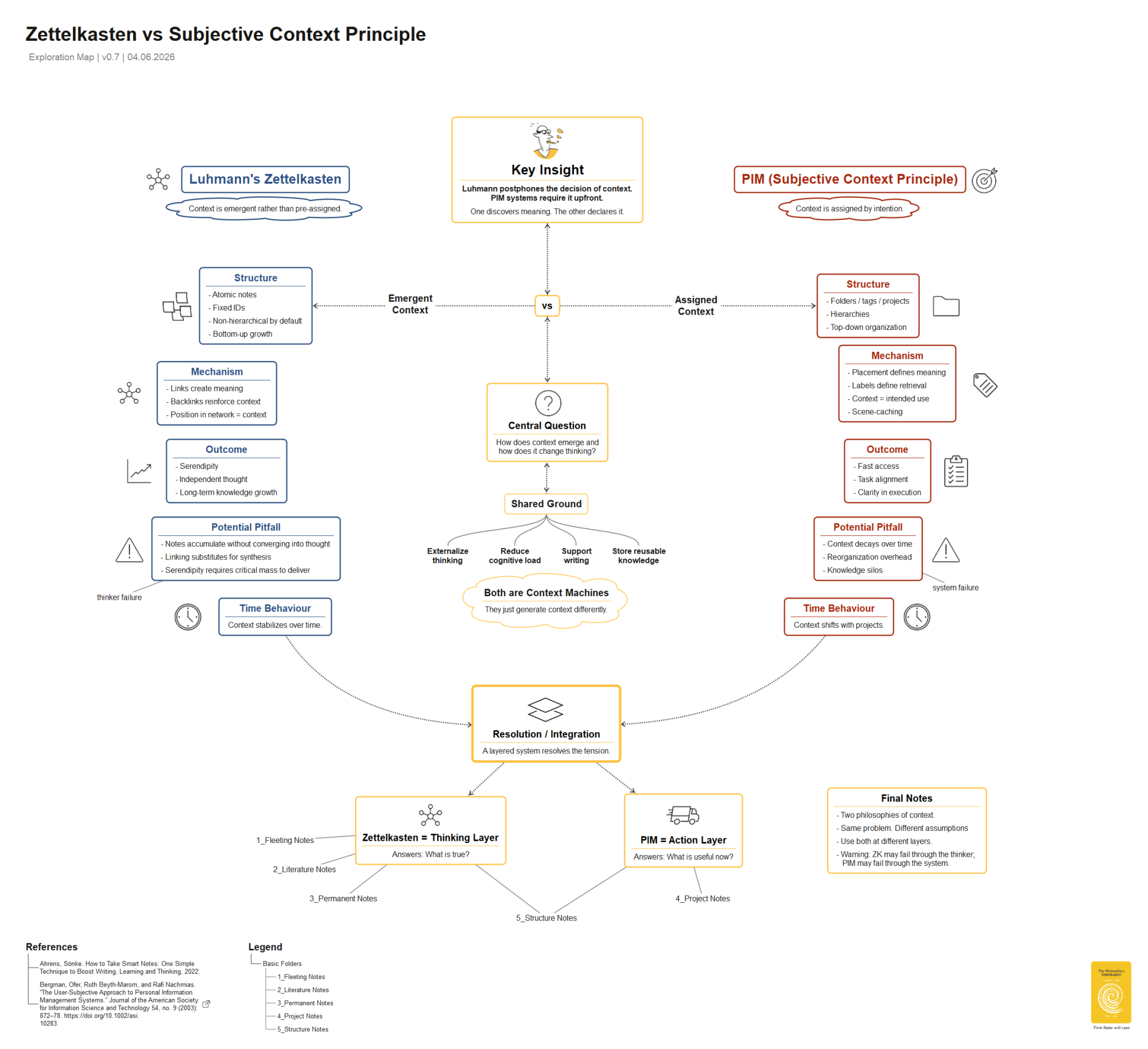
Note: The added five basic folders (1_Fleeting Notes, ...) are essential for my own Zettelkasten. They combine Zettelkasten an PIM elements as well.
The following is my perspective on Zettelkasten and PIM, as demonstrated in an Object-Oriented Model: https://forum.zettelkasten.de/discussion/comment/23124/#Comment_23124 with a PDF zu zoom-in.
Edmund Gröpl — 100% organic thinking. Less than 5% AI-generated ideas.
I differ in several ways, among them:
If you take Luhman's numbering system and lay it out as an indented list, and then label top-level nodes with their labels from his high-level index (or with the main idea of a major subsection, e.g., "Equality and Identity"), IMO those labels constitute a precoordinate compound subject language, which is a perspective structure often used in library science. There is a lot of semantic knowledge associated with that structure, and that emergent semantic knowledge contributes to the ability of the ZK to surprise the practitioner and contribute to creatively forming new ideas.
You could try to argue that Luhmann's numbers, like say "6.3", were abstract numbers and didn't make an ontological commitment; well, I say that after some time working with his system Luhmann knew perfectly well what those major (and sometimes minor) divisions were. I bet he even had the feel of them in muscle memory. The mere fact of sequencing in those numbers establishes relationships between them.
The perspective hierarchy point is the most interesting thing in this exchange. If Luhmann's numbering emerged through use into something hierarchy-like rather than being imposed upfront, that supports rather than undermines the diagram: context emergent rather than pre-assigned, even when it eventually stabilises into recognisable structure. The muscle memory observation extends this nicely — a mature ZK becomes partly embodied, which no diagram can capture.
On findability and meaning: I'd still hold them apart analytically while agreeing they're entangled in practice.
Edmund Gröpl — 100% organic thinking. Less than 5% AI-generated ideas.
Right, and one advantage we can have with an electronic-based system that Luhmann could not is that we can rearrange the structure if it seems to be getting out of date, or we have learned some new distinctions. So an emergent, personal, flexible structure, carrying substantial semantics - that's a good way to think of it. The next step would be to think about what design features would make good use of these characteristics.
Nicely put.
@Edmund, I'm sorry, I may have caused some confusion by not specifying precisely enough the exact concept that I had in mind that I thought was related to @tomp's scene. I mentioned the subjective context principle from Bergman & Whittaker (2016) but I was thinking of a more specific concept or attribute within that principle that they call internal context (p. 212):
Internal context seems most similar to what @tomp called the scene, although the scene could include the other three attributes. I think of these as important metadata for an information item or note, not specific to PIM as opposed to Zettelkasten.
I think we are looking at things the same way here. I'm not as sure what "should" go into an information item in a PIM, but since I see a Zettelkasten as being a superset of a PIM, I think about the content of metadata of a PIM-level note in much the same way: why do I want this note, what is it about, what do I expect to get out of it later, how much effort is it worth just now, will I be able to find it again?
The usual moving target.
So true.
Edmund Gröpl — 100% organic thinking. Less than 5% AI-generated ideas.