Begginer Choices and Doubts

I’m a beginner with Zettelkasten and I’d like to know if these choices make sense or are at least acceptable for someone starting out.
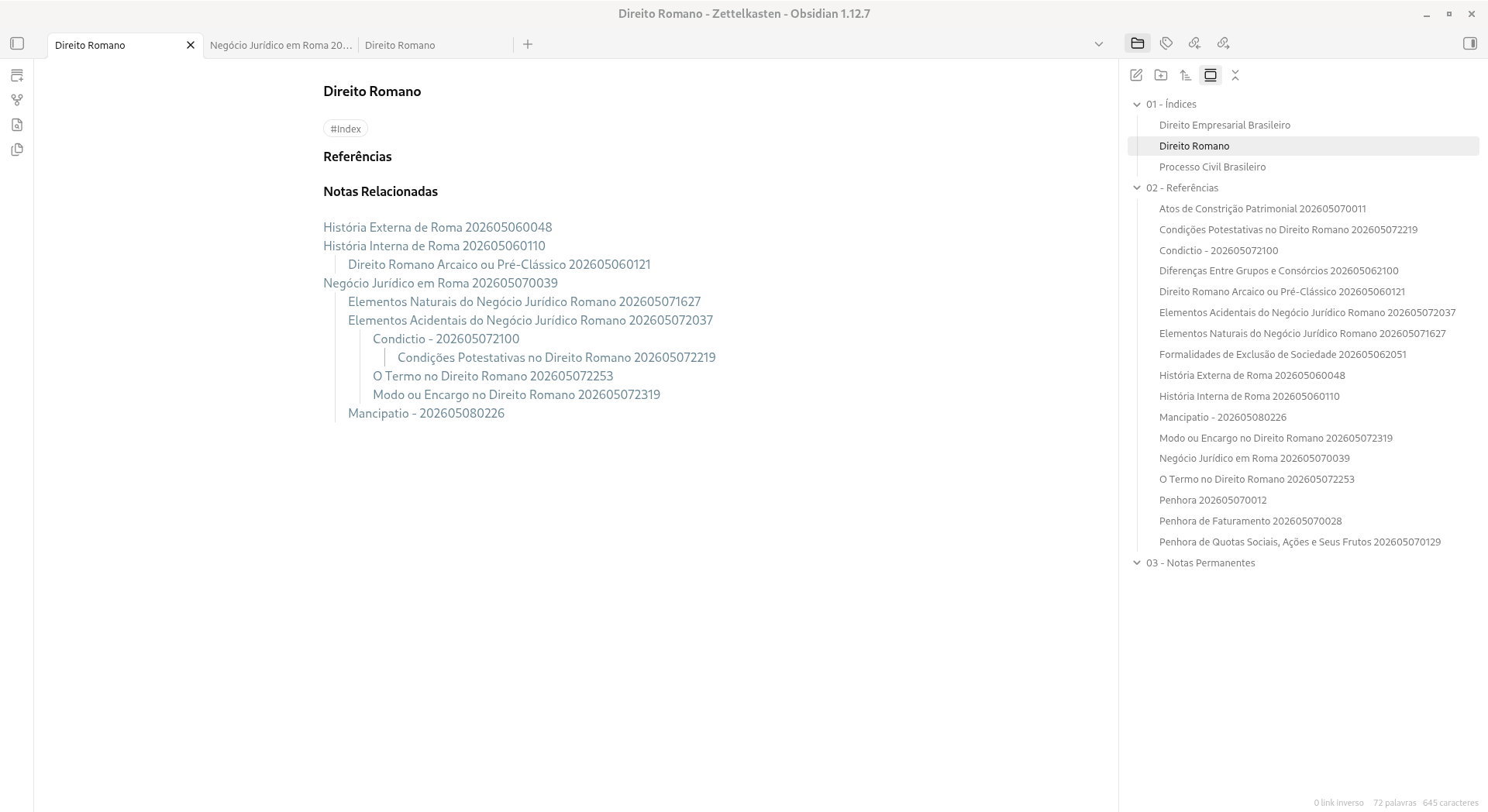
- Is it okay to avoid very long titles? For example, I’m studying Roman Law, and many of my notes naturally want to become something like: “something something… Roman Law” or “legal transaction… in Rome.” It’s not a huge problem, but I feel my titles are becoming repetitive and unnecessarily long.
Should I try any technique to avoid this issue?
I’m also trying to avoid excessive hierarchies and overly remote links because I don’t want to turn my Zettelkasten into an overengineered system that becomes impractical for daily use. For example, “condictio” is technically related to “accidental elements of Roman legal transactions,” but instead of linking it directly to a broad note like “Roman legal transactions,” I’m linking it only to the more immediate conceptual note. I’m doing this to avoid obsessing over connections and spending more time engineering the system than actually studying. Does this approach make sense?
I’m not using numeric hierarchies or Folgezettel. I looked into it, but it feels somewhat impractical for modern digital workflows. Instead, I’m organizing things mainly through index notes.
Does this sound reasonable for a beginner, or am I building bad habits early on?
Howdy, Stranger!
Categories
- 3K All Categories
- 153 Research & Reading
- 703 The Zettelkasten Method
- 12 Knowledge Work
- 102 Writing
- 474 Software & Gadgets
- 158 Workflows
- 733 The Archive
- 15 Plug-In Showcase
- 88 Resolved Issues
- 225 Projects Logs and Journals
- 86 Project: Zettelkasten.de
- 53 Critique my Zettel
- 179 Random
- 375 Introduce Yourselves!
Comments
Welcome to the wonderful world of digital note making! It seems that you are facing classic design decisions.
Yes. The purpose of a title is that you see at one glance what a note is about. The titles help you identify your notes and keep them apart. So it's ok to abbreviate or to use some personal codes.
There's nothing wrong with deep hierarchies and remote links, even if some people have strong opinions on the subject. :-)
The issue usually comes up when newbies are trying to build the ultimate encyclopedia of their area of interest. Many people start by building a topical hierarchy of their area of interest. They start with broad topics and break them down into ever smaller subtopics. They realize that many things are related to many other things. Then they try to model all those relationships. Then they get lost. This is a very common beginner's mistake.
The recommendation is to have a clear focus for your notetaking and to be very selective about your notes. There's no need to re-create Wikipedia or a textbook or an online course or a legal database, because those tools already exist and because it would take more than a lifetime to re-create them.
Your personal notes should be optimized for your personal needs. So the big question is: What do you want to achieve with your notes?
Good choice. Powerful apps like Obsidian have more flexible options. With a smart combination of properties, bases, backlinks and plugins you can navigate tens of thousands of notes instantly in Obsidian.
But in order to set up a useful system, you need to be clear about your usage. Why use Obsidian and not, let's say, a good textbook and Anki?
@rogerleiro
Welcome to the forum!
I agree with @harr 's comment about title length - use a short, medium or long title, it's up to you. It should be sufficiently and specifically descriptive so that you know what the note is about, but there is no rule on length.
In regards to built-in hierarchies, there are pros and cons and various opinions expressed in the forum regarding the amount of hierarchy to build into your Zettelkasten up front. I favour not much, but it depends on the topic as well.
My practice is to build specific connections between notes (ones that make sense), in a bottom up manner, and I use tags a lot (not in a general way, but again, very specific tags). The way I use tags, the list of tags becomes an index to what is in my ZK. I'll try to find a link to that discussion and post it here, although it came from me commenting on other people's posts and I'm not sure how to effectively search in the forum for that combination.
Sometimes, it becomes clear that a specific topic deserves its own structure note and occasionally I will start with a structure note, but this is not my common practice.
Don't worry too much about trying to get the 'right system' in place in advance. Whatever you start with now, it will evolve over time, so let yourself run with it and adapt as you go along.
You can learn from what the others on this forum do, but in the end everyone comes up with their own system, which is right for them.
Welcome and good luck!
Thank you all for the help. I found the comments excellent, and I’m really glad I can rely on a community like this while learning.
The main difficulty I’m having with more “remote” links is that the link section can start to feel polluted, or I can end up spending too much time reflecting on possible connections.
At the beginning, I almost treated links as something ontological — as if they defined the very “being” of the note subjetct and of the Zettelkasten itself. But over time, I started to feel that this “being” is constantly changing and somewhat indeterminate, which makes me think I need to approach note-taking in a more practical way.
A very concrete example from Roman Law:
“Legal Transactions” (Zettel 1) could contain “Accidental Elements” (Zettel 1a), meaning elements that would only exist if expressly established by the parties. The accidental elements most commonly discussed by Roman jurists were “Condictio” (Zettel 1a1), “Term” (Zettel 1a2), and “Mode or Burden” (Zettel 1a3).
Now, “Mode or Burden” (1a3) connects to “Condictio”, because it's to establish it's differences, and certainly to “Accidental Elements” (1a), since it is directly under that conceptual branch.
However, I hesitate to also create a more distant “grandparent” relationship by linking “Mode or Burden” (1a3) directly back to “Legal Transactions” (Zettel 1), because there is already an intermediary note connecting them. I’m afraid that once I start creating these broader and more remote links, the whole system may become an endless note-engineering exercise.
For example: should I individually directly link every Roman Law note to a general “Roman Law” note?
If I try to maintain that level of systemic completeness, I suspect I’ll spend more time managing links than actually studying.
Ironically, the Romans themselves would probably dislike that approach, considering how practical they were in the way they viewed both law and life
If you want to declutter the main area of your note, you could move some links to YAML frontmatter. For example, when you have a parent-child relationship, you could add a parent property. Or you could add links for subject matters:
If you think of your notes as a system, then it would make sense. Personally I see a value in linking empty notes. But… I know exactly why I'm linking notes, when I'm linking notes. Those links solve a well-defined practical problem.
It helps to label your links. That's one reason, why I like YAML frontmatter. The name of the property defines the kind of link. It answers the Why.
You could als provide the context as a paragraph of text:
What do you mean by"contain" and "conceptual branch"? What kind of relationship does it define? It might be too unspecific to be useful.
As an experiment you could draw concept maps that contain all the relationships you care about.
You could, see the "subject matters" example above. Or you could use tags instead. Or plain text for full text search. …
Yes. The trick is to be selective.
Yeah, they were excellent engineers. :-)
....
Here is a link to a discussion on the use of tags; near the beginning, I have two comments, the second of which provides more detail on how I use multi-level tags.