Self-directed Learning with Zettelkasten

There are six books on the desk in front of me. Books on the subject of the Zettelkasten system.
My idea is rereading all of them. Mortimer Adler called it 'syntopical reading' in his book 'How to read a book'.
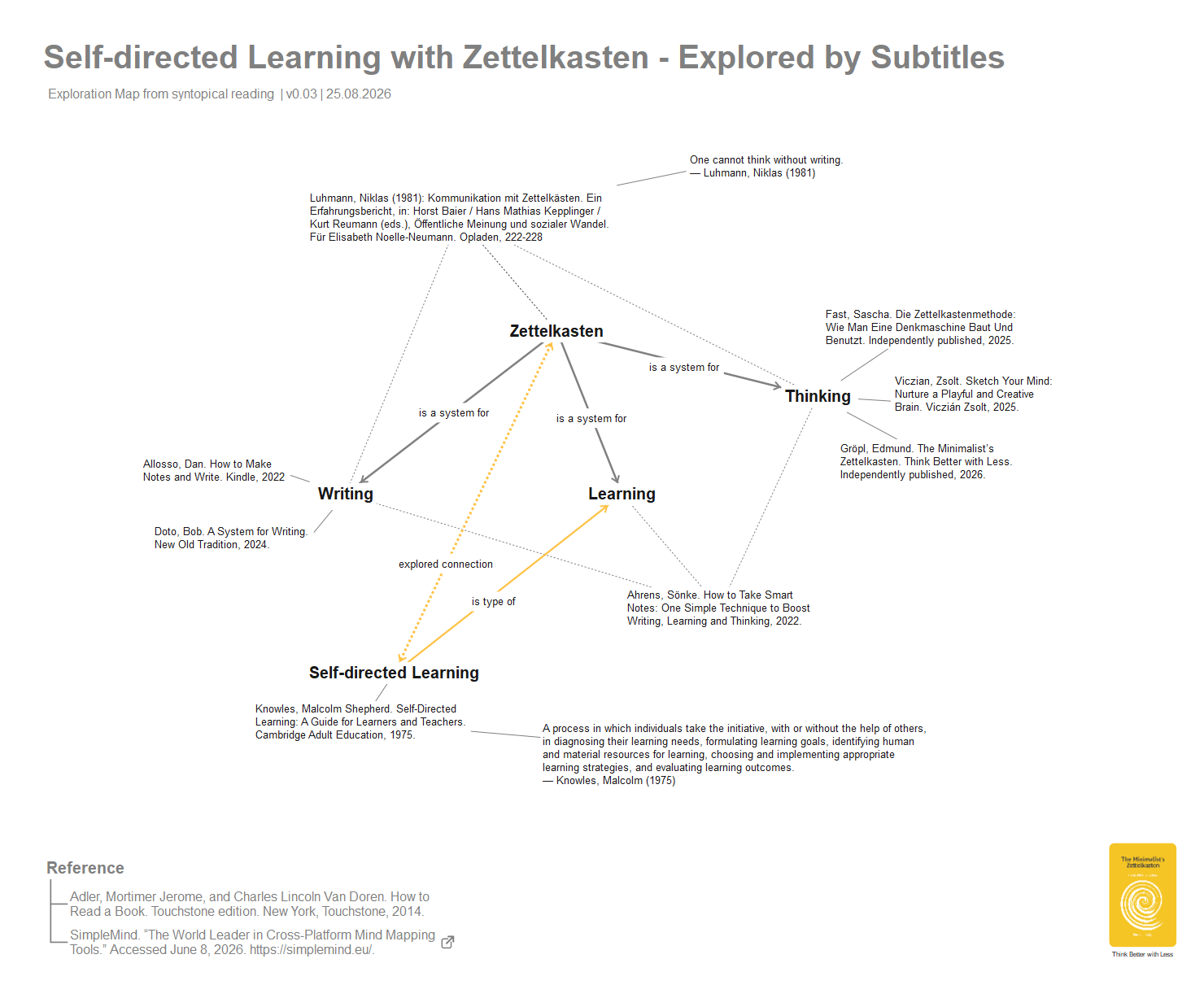
But where should I begin? I shifted one book from left to right, one from right to left. I read the titles and the subtitles. Two of the books are about writing, three are about thinking. My favourite book by Sönke Ahrens is about writing, thinking and 'learning'. Yes, about 'learning'! Only one author mentioned 'learning'.
I should mention that 'learning' is one of my favourite topics in my Zettelkasten. My current area of interest is 'self-directed learning'. To cut a long story short, here is a context map:
Edmund Gröpl — 100% organic thinking. Less than 5% AI-generated ideas.
Howdy, Stranger!
Categories
- 3K All Categories
- 153 Research & Reading
- 703 The Zettelkasten Method
- 12 Knowledge Work
- 102 Writing
- 474 Software & Gadgets
- 158 Workflows
- 733 The Archive
- 15 Plug-In Showcase
- 88 Resolved Issues
- 225 Projects Logs and Journals
- 86 Project: Zettelkasten.de
- 53 Critique my Zettel
- 179 Random
- 375 Introduce Yourselves!
Comments
We can see 'Zettelkasten' and 'self-directed learning' as related key terms. We can also view them as related concepts. The former would result in a link from A to B, while the latter could be used to create a set of concept maps.
Now let's take a look at 'self-directed learning' and its inherent elements:
A 'Zettelkasten' within a concept map could be reduced to its five basic note types:
Edmund Gröpl — 100% organic thinking. Less than 5% AI-generated ideas.
Both concepts can be seen as modules from which a larger system can be constructed:
That's the first example of modular thinking being implemented in my Zettelkasten. It is implemented using four structure notes, each containing one concept map.
References
Edmund Gröpl — 100% organic thinking. Less than 5% AI-generated ideas.
Here is my high level starting point for a Zettelkasten.
Related indeed: When we turn to our zettelkasten because we choose to (no one tells us to), condense something we read, read something for a set of new zettels filling a gap, browse along trains of zettels to discover new knowledge emerging - that would meet the definition of 'self-directed learning' for me. Or is anything crucial missing?
Nice perspective at any rate: Turning to my zettelkasten now has an even better flavor.
How to zettel for stellar revelations? What a fantastic journey!
It has always been important to me to make the learning function of the Zettelkasten explicit, so I think it is absolutely right that it has been highlighted here.
I would go one step further, though: I think the possible outcomes of a Zettelkasten are much broader than writing , and even broader than learning itself.
Any product, service, skill, decision, or form of agency that is significantly influenced by the ideas and knowledge developed through the Zettelkasten can become an outcome of the system.
In other words, writing is just one possible way in which the knowledge developed in a Zettelkasten can become useful in the world.
For a personal example, my Zettelkasten has become a tool for running better. I use it to develop and refine my understanding of training, understand my own physiology, having with input not only running theory but my training sessions analysis itself, and that knowledge subsequently directly affects how I actually train.
It also affects much less formal things: it has become a tool for having better conversations, building an opinion, both about important subjects and about seemingly unimportant ones.
So I tend to see the Zettelkasten less as a writing system and more as a knowledge-development system whose effects can propagate into whatever activities are influenced by that knowledge.
Writing is a particularly important and visible outcome, but it is only one possible destination.
I don't know if there can be a single general term that can substitute the word "writing" for all of these things. Maybe "Application", or simply "Outcome".
Yes!
I call it a "cognitive instrument". Not too graceful (in English, anyway) but it evokes a flavor of "musical instrument".
Ahmad calls it "payoff"
How to zettel for stellar revelations? What a fantastic journey!
For Ahmat the payoff is writing:1
"The slip box's ultimate purpose is not to store ideas — it is to produce finished thinking. Essays, articles, reports, arguments, books. The system earns its maintenance cost when it starts generating output that you could not have produced without it."
I find this input-output thinking too narrow. I find the maintenance itself rewarding. I don't think of it as maintenance. I think of it as learning.
Same here. Writing is only a part of the voyage. I don't just travel to arrive at a destination. I also enjoy the voyage itself.
I like the verb and noun benefit. I benefit in many ways from working with my ZK. I wouldn't even know where to start listing the many benefits of a ZK. I find various kinds of interaction with my ZK beneficial.
Chapter 17 of https://www.amazon.com/Zettelkasten-Obsidian-Notebook-Practical-Organize-ebook/dp/B0GPQKJLS9 ↩︎
It may still be worthwhile trying. Let me give it a first shot from my perspective:
(to be contd)
How to zettel for stellar revelations? What a fantastic journey!