Read, Think, Write — A Concept Map of World Models

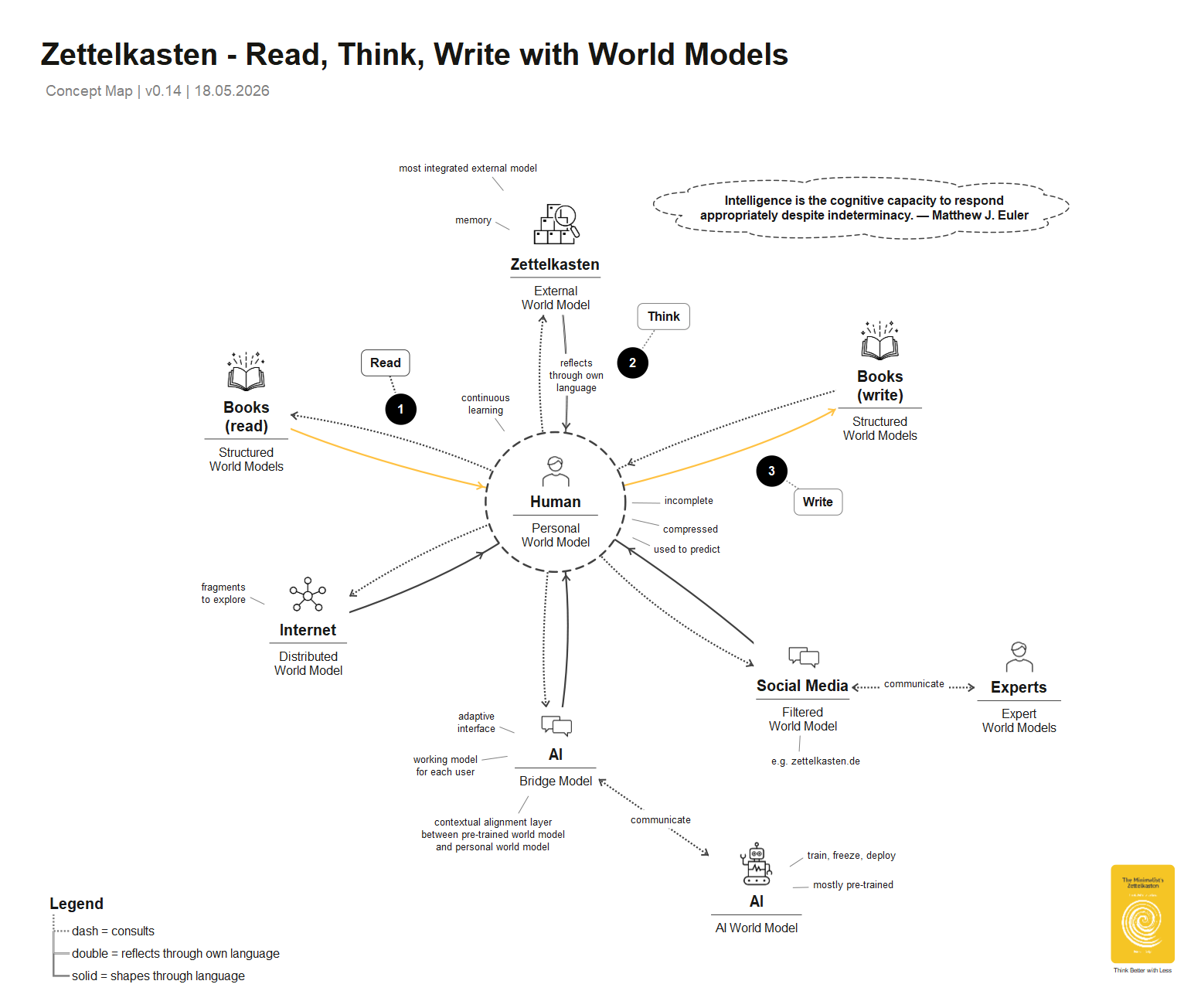
How does a Zettelkasten fit into the larger landscape of knowledge sources that shape how we think and write?
I have been working on a concept map [1] that tries to answer that question. Now starting from Euler's definition [2] — intelligence as the cognitive capacity to respond appropriately despite indeterminacy — the map places the human author at the center, surrounded by six external world models: Books, the Zettelkasten, Social Media, the Internet, Experts, and AI.
The central distinction the map tries to make visible is between consulting a world model (deliberate, active, voluntary) and being shaped through language by one (ambient, often involuntary). Most external models do both. The Zettelkasten is the exception: its inward arrow is labelled "reflects through own language" — which is the argument for why it occupies a different position from the others.
The map also embeds a simple workflow: ① Read, ② Think, ③ Write. The Zettelkasten sits at the hinge between all three.
This is v0.14 of an iterative process. I would be curious whether the consults / shapes distinction resonates with how people here experience their own practice — and whether anything important is missing from the map.
Reference
[1] Obsidian Forum. “Select Tools for Zettelkasten. But How? - Knowledge Management.” September 5, 2023. https://forum.obsidian.md/t/select-tools-for-zettelkasten-but-how/66067/4?u=edmund.
[2] Euler, Matthew J. “Intelligence and Uncertainty: Implications of Hierarchical Predictive Processing for the Neuroscience of Cognitive Ability.” Neuroscience & Biobehavioral Reviews 94 (November 2018): 93–112.
Edmund Gröpl — 100% organic thinking. Less than 5% AI-generated ideas.
Howdy, Stranger!
Categories
- 3K All Categories
- 153 Research & Reading
- 703 The Zettelkasten Method
- 12 Knowledge Work
- 102 Writing
- 474 Software & Gadgets
- 158 Workflows
- 733 The Archive
- 15 Plug-In Showcase
- 88 Resolved Issues
- 225 Projects Logs and Journals
- 86 Project: Zettelkasten.de
- 53 Critique my Zettel
- 179 Random
- 375 Introduce Yourselves!