Howdy, Stranger!
Categories
- 3K All Categories
- 153 Research & Reading
- 702 The Zettelkasten Method
- 12 Knowledge Work
- 101 Writing
- 472 Software & Gadgets
- 156 Workflows
- 733 The Archive
- 15 Plug-In Showcase
- 88 Resolved Issues
- 225 Projects Logs and Journals
- 86 Project: Zettelkasten.de
- 53 Critique my Zettel
- 177 Random
- 375 Introduce Yourselves!
Comments
The different users in your use-case model remind me of Doron Mayer's "inner workflow team" (Wayback Machine link) that I mentioned previously, where the different users are different roles that we play in a creative workflow. In other words, the creative professional, student, and project manager in your diagram are not necessarily different people!
@Andy: Thank you for sharing this link. It's a good overview. Yes, the model uses roles. One person may have different roles when using Zettelkasten. Not every role needs all use cases.
Edmund Gröpl — 100% organic thinking. Less than 5% AI-generated ideas.
A Zettelkasten can be defined within it's generalisation-specialisation structure (
A is a B) and it's whole-part structure (A is part of B). Here's a new Zettelkasten model:Zettelkasten - An Object-Oriented Model.
Zoom in and you can see the differences in detail:
We may use it to compare different classes and objects like a Zettelkasten and a Personal Wiki.
In this example the model shows:
More about: Reddit
Edmund Gröpl — 100% organic thinking. Less than 5% AI-generated ideas.
@Edmund Category theory diagram next, please
Author at Zettelkasten.de • https://christiantietze.de/
Great idea. 👍
But here is the answer from my Zettelkasten:
😉
Edmund Gröpl — 100% organic thinking. Less than 5% AI-generated ideas.
What is the minimum set of atomic notes required to explain a Zettelkasten? - I'd say it's 48. What's your number?
Here's my start with seven initial notes:
One restrictive rule: Only use notes from your existing Zettelkasten.
Edmund Gröpl — 100% organic thinking. Less than 5% AI-generated ideas.
A Zettelkasten Metaphorical Model.
In this model we understand Zettelkasten through the use of metaphors and analogies. Changing the metaphor changes the way we think. I started my Zettelkasten using Luhmann's metaphor: "A Zettelkasten is a communication partner."
Today, however, I see the Zettelkasten community as my preferred communication partner. Why not change the metaphor? My latest idea: My Zettelkasten is a gym for my brain. Let's see what happens.
Also see: https://forum.zettelkasten.de/discussion/comment/23036/#Comment_23036
Edmund Gröpl — 100% organic thinking. Less than 5% AI-generated ideas.
@Edmund said:
Here's an obligatory link to an earlier discussion that @Edmund started: "What is your preferred metaphor for Zettelkasten? And why?" (April 2022)
Tiago Forte's blog post "What do you call your second brain?" (August 2022) has some good ones too, but it's worth noting that they tend to be mind/head/brain-centered.
The gym metaphor may be more likely to lead you in a new direction if you omit the "for my brain" part, because that part makes it very similar to all the other mind/head/brain-centered metaphors, whereas if you think of it more broadly as relating to the whole body like a physical gym, then the gym metaphor could reveal something new that the other metaphors lack, perhaps.
EDIT: For example, if I call my Zettelkasten a "gym for my heart", it has different conceptual associations than "gym for my brain", and could lead to different emphases and outcomes. In terms of the MBTI model that you posted earlier in this discussion, the brain-versus-heart distinction is T versus F. Perhaps it's no surprise that someone who scores as "INFJ" (me) would point out the F alternative, as much as I aspire to apply my T skills in knowledge work.
After further consideration, I admit that calling a Zettelkasten a "gym for my heart" may sound quite ridiculous. But I submit for consideration that calling it a "gym for my brain" is equally as ridiculous, given the first lesson in Lisa Feldman Barrett's book Seven and a Half Lessons About the Brain (2020): "Your brain is not for thinking."
Thank you for reminding me at our amazing metaphor discussion three years ago.
Great link. :-)
I started with the gym metaphor as an "experiment". The experience I've gained at a physical gym can easily be transferred to a mental one. However, I have no idea where this will lead.
What I learned from the metaphors in the model above:
Here is an updated version of the Zettelkasten Metaphorical Model:
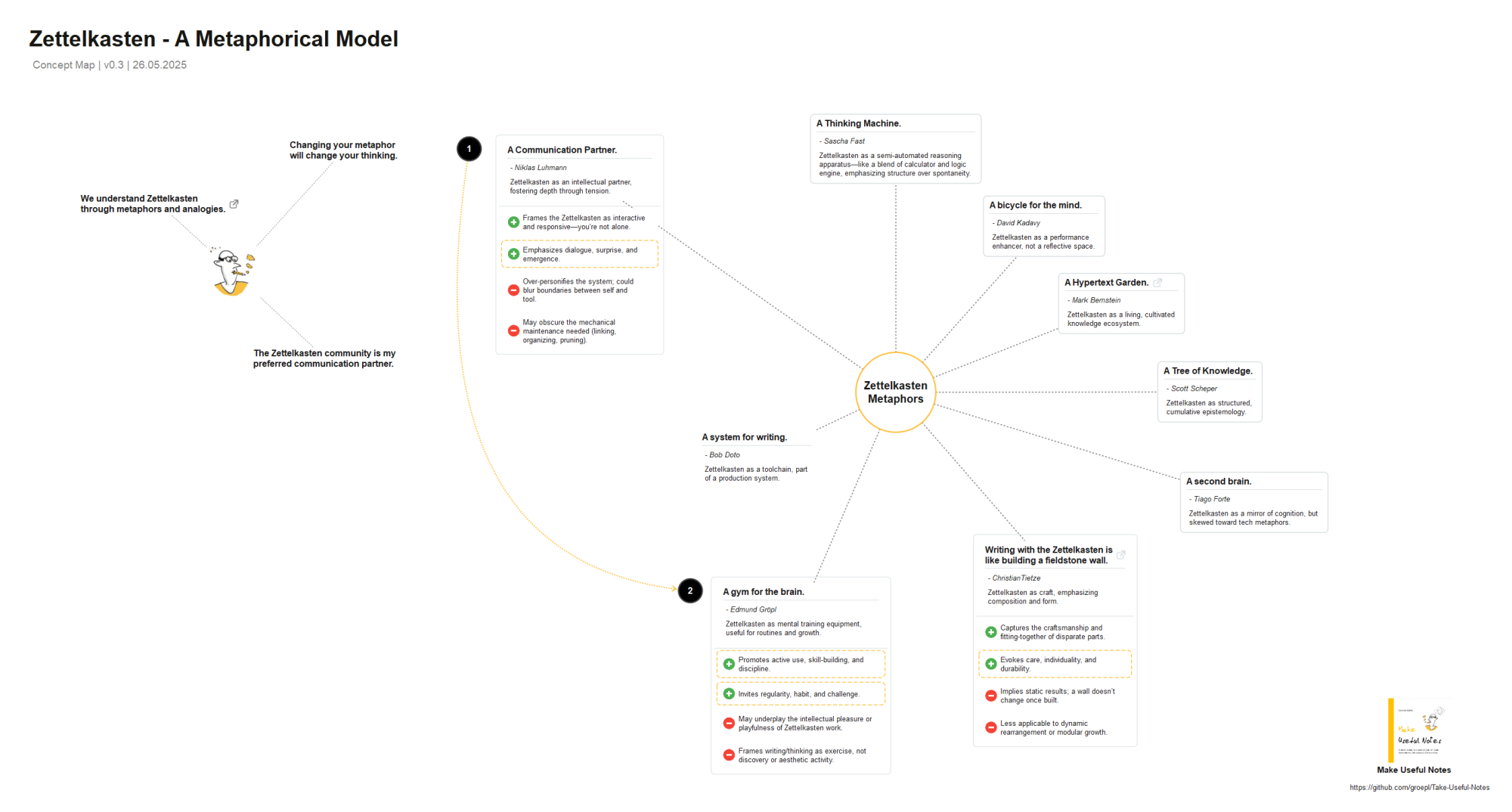
We see that metaphors are double-edged: they reveal by mapping one domain onto another—but they also obscure by ignoring what doesn't fit the mapping.
Edmund Gröpl — 100% organic thinking. Less than 5% AI-generated ideas.
Yes, it is. For me, though, it's part of a mental experiment. There's no fact behind it. There's no deeper meaning. But it's a chance to produce new insights. A tool to enable creativity.
Edmund Gröpl — 100% organic thinking. Less than 5% AI-generated ideas.
Zettelkasten - A Mental Training Model
The model is based on the metaphor "Zettelkasten is a gym for my brain". Here are some of the exercises I use to improve serendipitous discovery in my Zettelkasten:
Edmund Gröpl — 100% organic thinking. Less than 5% AI-generated ideas.
Edmund, as always your diagrams are splendid and very interesting. I was wondering: are they part of an ebook you have yet to publish?
I'm sure they will be included in the book. But not all of them. Only the best ones.
Edmund Gröpl — 100% organic thinking. Less than 5% AI-generated ideas.
I have a note dedicated to collecting analogies for a zettelkasten, these are the ones I have so far:
What's your favorite?
I'm still active with my "Mental Gym Model":
Here is a first prototype for printing on cards:
Edmund Gröpl — 100% organic thinking. Less than 5% AI-generated ideas.
We are still having an ongoing discussion about the definition of Zettelkasten: https://forum.zettelkasten.de/discussion/3286/my-current-definition-of-the-zettelkasten-method
I believe that there is no such thing as a perfect definition. Setting a proficiency level for Zettelkasten, like CIFRZ, may help to find a definition that might be useful for the related users:
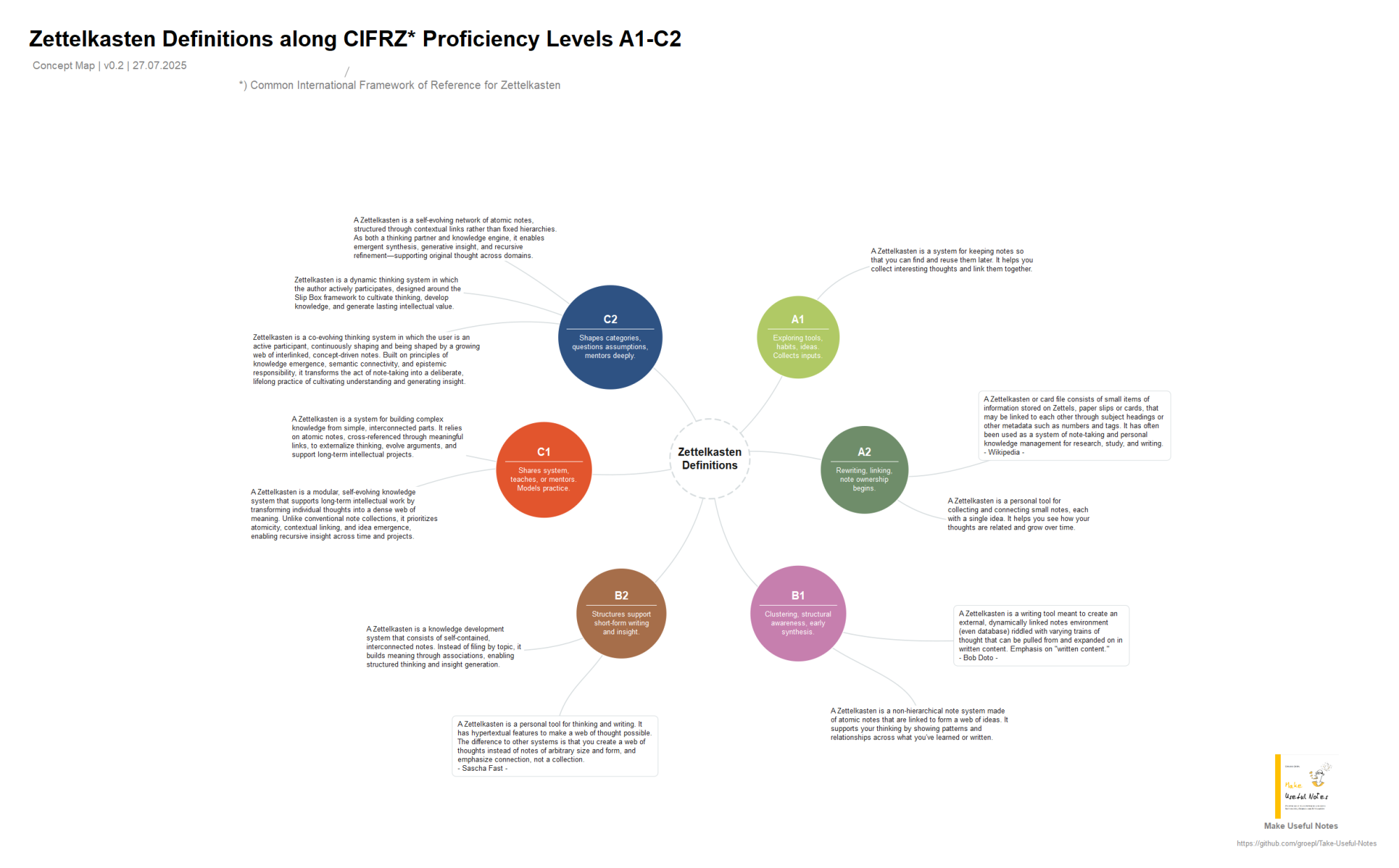
However, we need to consult our users as started by @Sascha . And we need to ask users at different levels.
Edmund Gröpl — 100% organic thinking. Less than 5% AI-generated ideas.
The Minimalist's Zettelkasten Definition
See also:
Edmund Gröpl — 100% organic thinking. Less than 5% AI-generated ideas.
Zettelkasten Ecosystem Model
According to the Merriam-Webster Dictionary, an ecosystem is a system made up of an ecological community of living things interacting with their environment, especially under natural conditions.
I think tool and method in a Zettelkasten are less like software and workflow, and more like two organisms in a symbiotic relationship. Seeing Zettelkasten tools and methods as “living things” leads to a concept map with major interactions as named connections:
The related view: A Zettelkasten is a thinking ecosystem in which a method and a medium continuously shape each other.
For me an interesting question now is:
Edmund Gröpl — 100% organic thinking. Less than 5% AI-generated ideas.
I find the same questions involving the author even more interesting :-)
In my practice I've seen relevant long term effects to my mind, besides the well know dynamics such conversational effects between zettels and author and reactivations of ideas into the brain from zettels.
I've seen my mind changed by zettelkasten.
Whenever I read "ecosystem" for "digital system," I want to know who the top and bottom feeders are.
Zettel GitHub. Zettel Wiki Erdős #2. Problems worthy of attack prove their worth by hitting back. -- Piet Hein. PROBLEMS. Grooks, 1966. CC BY-SA 4.0.
I have to think of stories where the author appear in the story. What do the "tool" and the "method" think about the "person"? Do they perceive the human as a god-like force that can create and destroy their ecosystem at will? And what happens, when a "person" leaves their zettelkasten for good? Are "tool" and "method" still alive?
Speaking of narratives in which the author appears in the story, there is the divine narrative:
Zettel GitHub. Zettel Wiki Erdős #2. Problems worthy of attack prove their worth by hitting back. -- Piet Hein. PROBLEMS. Grooks, 1966. CC BY-SA 4.0.
That's what I've noticed, too.
And I got one new entry to my list of open questions: “How does Zettelkasten change my thinking?”
It’s directly related to: “How does AI change my thinking?”
Edmund Gröpl — 100% organic thinking. Less than 5% AI-generated ideas.
Apologies for this. While the definition seems right I'm not endorsing the conclusion. My Bayesian prior assigns 50% odds.
Zettel GitHub. Zettel Wiki Erdős #2. Problems worthy of attack prove their worth by hitting back. -- Piet Hein. PROBLEMS. Grooks, 1966. CC BY-SA 4.0.
I think the text works well, even if one doesn't share the conclusion, because it's not really a defense of atheism. The author describes belief in God as an experience: "Believing in God is experiencing the world as a divine story in which I am a character."
I don't think that the absence of that experience proves the absence of God. Neither does the presence of the experience prove God's existence. Yet the experience matters, when people talk about their beliefs. Believers tend to experience God as a force that guides their lives.
I'm wondering if entities like a "tool" or a "method" can have such experiences. :-)
Zettelkasten family resemblance: Exploring visual similarities in basic models.
In evolutionary biology, family resemblance describes how groups of organisms or genes share overlapping similarities through common ancestry and intermediate relatives without needing a single, universal defining feature. We have already discussed the concept of shared traits in an attempt to improve our understanding of Zettelkasten without strict rules:
and:
One of our first attempts to identify structural similarities between our various Zettelkasten approaches using visual representations can be found here: What is going on in a Zettelkasten visually by @Annabella . Now let's have a second one. As you know, I love visual representations. So, my question is: can the similarities between different Zettelkasten models be illustrated visually?
1. Luhmann's Zettelkasten
Let us start with my basic model of Luhmann's analog Zettelkasten system. It consists of two slip-boxes, a main slip-box and a bibliographical slip-box, each of which is focused on different types of notes. All in all, I've found five types of notes in the shown reference.
As we know, Luhmann's Zettel form the core of the Zettelkasten system. Three types of structure notes are added here to enable an easy access.
2. Ahrens' Zettelkasten
The famous "Smart Notes" system based on the initial Zettelkasten from Luhmann:
The core is the same, but two types of notes are added: Fleeting Notes and Project Notes. Both are analog notes. Fleeting Notes are written with pen on paper, Project Notes are kept in physical binders. The digital notes are kept in two specialized digital systems. Literature Notes are placed in a reference system such as Zotero, while Permanent Notes and three others are kept in tools such as Roam Research or Obsidian.
3. Minimalist's Zettelkasten
There is only one digital toolset. Tools like Obsidian allow you to keep all notes in one place. Each of the five types of notes has its own folder for organization. Unlike Luhmann and Ahrens, Structure Notes are placed in a separate folder. The five types of notes have subtypes. These are indicated by an appropriate tagging system.
Final
In genetics, we inherit DNA from both parents. This determines physical characteristics such as bone structure, eye colour, nose shape and freckles. In the Zettelkasten ecosystem we inherit from two parents as well: the method and the tool. See also: Zettelkasten - Term and Definition - Page 2 — Zettelkasten Forum
Edmund Gröpl — 100% organic thinking. Less than 5% AI-generated ideas.
After I had a closer look at the digitized version of Luhmann's ZK, I'd group and count the types somewhat differently.
Zettelkasten can refer to the entirety of several physical wooden objects containing drawers and paper slips. The content of the drawers can be divided into the old Zettelkasten I and and the later Zettelkasten II. There's also a separation between the main zettels and the bibliographic apparatus. But there's also another section with miscalleneous note types.
For the purpose of a "basic model", I'd ignore the sections and go straight for note types. I don't think it matters much where they are stored in the wooden boxes. I consider only three note types essential:
Secondary types:
The other types found in Luhmann's original zettelkasten contain simpler bibliographies and a few other kind of notes.
I wouldn't treat the "Inhaltsübersicht" as a separate type. Top-level zettels are still zettels, they just have a special place in the numbering system. However, Luhmann did in fact write a "Abteilungsübersicht" for ZK I (facsimile).
In a "basic model" you might add the concept of "patterns" for zettel content. You find recurring elements like own thoughts, literal quotes, reference lists, footnotes, mini-indexes, etc. I don't consider them proper note types, because they can appear anywhere on a zettel, can be combined on the same zettel or span multiple zettels.
Thank you for all your suggestions. I had to re-read some sources, especially those from the Niklas Luhmann Archive at https://niklas-luhmann-archiv.de/nachlass/zettelkasten/.
And now have an updated version:
I have two open questions about your visual:
1. What are the three sections? Two physical ones and one called 'Others'?
2. What is the meaning of the red rectangle containing five types of notes?
Edmund Gröpl — 100% organic thinking. Less than 5% AI-generated ideas.
They are logical sections, not physical ones. Luhmann's Zettelkasten has 27 drawers ("Auszüge"). 24 in big boxes, 3 in separate small boxes.
Here's the official list of the drawers and their contents: https://niklas-luhmann-archiv.de/bestand/zettelkasten/auszuege
It's just a highlight. Look at these and ignore the others. :-)