Distinction between atomic note and literature note

The last post on this subject encouraged me to do so. Below is an atomic note I took. However, since I take academic notes, there is a dominance of literature notes in atomic notes. Do you think this note has the characteristics of an atomic note? How do you distinguish between these two types of notes in practice?
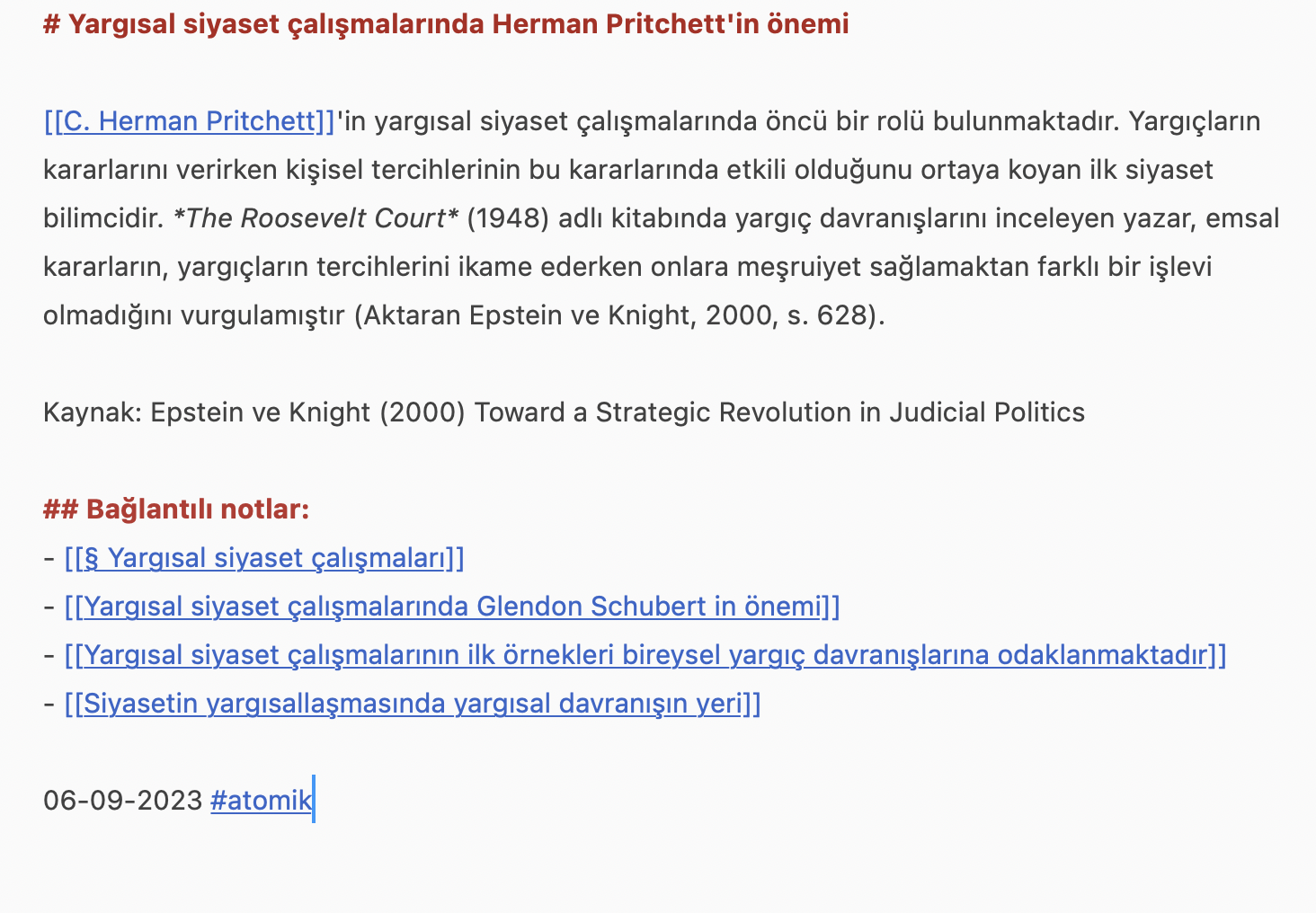
The importance of Herman Pritchett in the study of judicial politics
[[C. Herman Pritchett]] has a pioneering role in the study of judicial politics. He was the first political scientist to demonstrate that judges' personal preferences influence their decisions. The author of The Roosevelt Court (1948), who analyzed the behavior of judges, emphasized that precedents serve no other function than to provide legitimacy to judges while substituting their preferences (as cited in Epstein and Knight, 2000, p. 628).
Source: Epstein and Knight (2000) Toward a Strategic Revolution in Judicial Politics
Related notes:
- [L§ Studies in judicial politics]]
- [[The importance of Glendon Schubert in the study of judicial politics]]
- [[Early examples of the study of judicial politics focus on the behavior of individual judges]]
- [[The place of judicial behavior in the judicialization of politics]]
06-09-2023 #atomic
Howdy, Stranger!
Comments
I don't know if this helps, but my literature notes are stored separately and are labeled as [author name],[year of publication] - [Title of publication]. I try to summarize the publication at the top of each reference note with a few sentences - and then use the bottom of the note for highlighted phrases, tables, or other things I want to save. I simultaneously put the reference in Zotero (but any reference manager would work) so that I always have the reference ready for anything I write in the future.
p.s. Your atomic note looks great!
Interesting question. One of the note types in my system is the person note. The person note keeps everything together, that relates to the person. The atomical unit here is the person. One person, one note. In your example maybe like this:
The person note links two zettels (aka thoughts, ideas):
and
The person note also links a literature note, that contains all the bibliographical data plus anything else I find interesting about this book.
I'd also use a timeline (a variant of a structure note), if the chronological sequence matters, or some other kind of other grouping. Maybe something like this:
This works for me, because my brain is organized around people, time and sources. When I discuss an argument or idea, it think in this pattern:
I find it much easier to retrace historical debates, when I can place each argument in a point of time and attribute each argument to a specific person and source. I also quote original sources for future reference. Using my own words is helpful while learning about an idea. But it's nice to have the original quotes ready, when proof-reading a paper before publishing.
@harr said:
It may be helpful here to point to the section "What is Atomicity", in @Sascha's post "The Complete Guide to Atomic Note-Taking", where atomic notes are defined as notes that contain exactly one knowledge building block. A knowledge building block could also be called, for example, a type of knowledge element or atom.
Everyone seems to have a different set of such types, if they have a set at all. In @harr's note system, person is a type, but I don't have such a type in my system, so @harr's person note on Herman Pritchett is an atomic note in his system but would merely be a strange unconforming random note in my system. (I also don't have literature notes in my note system proper; information about sources goes in my reference manager, which is referenced from the note system by BibTeX citekeys. I see advantages of putting such information in the note system, but I've been doing it my way for so long that it's impractical to change.)
So whether your note in the original post is an atomic note depends on whether it conforms to a type of knowledge atom that you've identified. (I would guess not, because you didn't mention any such type.)
Actually, I also take my literature notes on a separate page via Zotero in this way. But I am hesitant to create atomic notes from these notes. Thank you for your contribution. 🙏
Similarly, I make person and concept notes for academic use. However, your suggested use is quite clear and actually answers my question. It is actually an atomic note independent of the person but connected to the person. Thank you very much indeed.
Together with Zettelkasten, creating an archive/wiki of concepts and people seems particularly important for academic use. In this way, it becomes possible to establish a link between, for example, Weber or Marx and contemporary thinkers.
@eduman said:
You will have to evaluate the usefulness of such types for yourself. In my case, I don't think people notes are sufficiently useful to have them in my system, even though I reference a lot of academic literature. My brain seems to be very good at quickly building mental models of people, so I don't feel a need to duplicate that information in my note system, which is very intellectually "communistic" in that regard: the discourse is what is important in my note system, not the people who are saying it, although of course I reference sources where appropriate.
Makes sense. Person notes are important nodes (with "d") in my network of connected notes.
In my experience Zettelkasten and wiki complement each other nicely. I wouldn't know how to think and write clearly about recent developments in [[Marxism]], without explicit references to [[Karl Marx]], [[histomat]] or [[dialectical materialism]].
Luhmann said: "Ohne zu schreiben, kann man nicht denken; jedenfalls nicht in anspruchsvoller, anschlußfähiger Weise." ("Without writing, one cannot think; at least not in a sophisticated, connectable way.”)
I consider connections the essence of a Luhmannesque Zettelkasten. Luhmann didn't just write down some thoughts and filed them away. He explicitly connected them.
Academic writing also requires many explicit connections. You don't just ramble away. You reference sources and give credit.
Wiki-style links are a relatively new technology that makes connecting notes so much easier. (An increasing number of note-making app is supporting them.) Add square brackets to a phrase and you have a link. Click on the link and capture relevant information. Add the same link in other locations and the same information is reachable with just one click.
I think differently about a problem, when I explicitly add wiki-links to names, sources and concepts in my writing.
@harr said:
I'm sure we all agree about the value of links, but creating nodes for people, and even for most concepts, is just too much busywork for my purposes. All the links in your previous comment are just basic background knowledge that I don't need in my note system. Especially famous people like Marx, Weber, Nietzsche, Dewey—I know enough about them, and I don't need notes about them in my note system! For me the biggest issue here is economy of time and effort in research, but I'm also not doing history of philosophy. I can see the need for notes on research subjects (people) if I were doing small-scale ethnographic research, but I'm not doing that either. This, of course, is not an issue that has a "correct" answer; it's about varying needs, abilities, and time resources.
EDIT: In the past year I've become much more interested in notes defining concepts, as I've become interested in dictionaries and glossaries as a genre of writing. So I expect the number of concept notes in my system to increase dramatically in the future, although in the past I have had very few of them.
Busywork is an issue, agreed. But the goal is not to write a redundant encyclopedic article or copy Wikipedia.
The Zettelkasten debate focuses mostly on internal links. But I use those notes also for external links, eg to general references (like a Wikipedia article) or specialized resources like my favorite Marx-Engels edition.
Those notes solve the bookmarking problem. Where would you save bookmarks about highly specialized resources related to Karl Marx, so that you can find them quickly?
And they solve the Google problem. Theoretically I could google a biography, when I need it. But googling takes time. Finding a good biography takes time. Finding relevant resources takes time. I don't like to google the same thing twice. So I add external links to the person note. And if I came up with a particularly clever search term, I add it as external link as well.
Valuable external resources are now only one click away.
EDIT: Person and concept notes also save time with internal links. I use Obsidian's backlinks, aliases and quick switcher features. They make it very easy to find relevant notes, even without links. For example if I wanted to find all notes that mention Karl Marx, I open the person note and look at the "unlinked mentions". Aliases help to identify concepts, that have multiple names, and to distinguish concepts, that have the same name. It's an Obsidian thing…
I use those notes also to self-test my background knowledge. When I try to write down, what I actually know about a person or concept, the illusion of explanatory depth shatters quickly. A very humbling experience.
Interesting topic. Sparks my curiosity. Thanks!
@harr, yeah, that all makes sense in relation to what you seem to value intellectually and given the way your system is structured.
@harr said:
Where I keep track of thinkers—to the limited extent that I do, because again I mostly manage my knowledge of people in my brain—is in my reference manager. If there's a particular researcher whose work interests me, I'll make a folder (called a "group" in BibDesk, equivalent to a "collection" in Zotero) for that person (along with folders for projects, topics, research questions, etc.). And BibDesk automatically creates person groups (a kind of "field group" in BibDesk) for all creators of publications, and those groups can be sorted by count or alphabetically, a kind of automatic indexing of authors.
A lot of the bibliographic work that you seem to do in your note system, I do in my reference manager instead.
To find all the notes that mention a person, I would search for that person's name. But I don't recall ever doing this because I wanted to know more about the person, only when I wanted to find a quote but I couldn't remember the exact wording, only who said it.
This is a big reason why I can see the usefulness of literature notes, which I don't have in my note system: it would be nice to have an automatic index of all the works that are cited in my note system. Sadly, I don't have this because my citations are just citekeys to my reference manager. But I'm not sad about not having person notes; I just don't see myself using them.
Oh, I'm very aware of such illusions, and when I say that I know enough about, e.g. Marx, I'm not claiming that I know enough to spontaneously dissertate on him like a large language model. I agree that self-testing is important, but I suppose I trust that such self-testing will happen when needed as I go about my research.
If notes are local buffers in your system for information that is available 'out there', like a fridge is a local buffer for food that you can get from a supermarket (or the woods, ...) then cataloguing things you need often makes ergonomic, pragmatical sense.
One of @Sascha's oft-repeated examples is history -- unless you're a historian, there's not much point in doing their diligent work.
Is it worth the opportunity cost to catalogue things (like a makeshift biography of an author) when you could spend the time on something else?
(Well, if one is interested in contextual reading, all the context has to be gathered and assembled somewhere. So sifting through biographies to understand the author properly is a technical requirement in these schools of thought.)
To hedge this a bit against misunderstandings: This is not to say that fanboys "shall not" collect stuff they're interested in There's no note-taking police!
I'm happy when I can finish one of the three notes I start in a day about a mundane, technical topic nowadays, so my personal time investment lies outside of authors.
Apart from a joy in cataloguing, which can be an end in itself, what kind of insights would the collection about an author provide? @harr
Author at Zettelkasten.de • https://christiantietze.de/
I think of collections as curated material and a collector as a discerning person with a clear goal. (The behaviors you describe in The Collector's Fallacy I'd rather call hoarding, busyness, procrastination, vertigo of accumulation, and behavioral addiction. But that's another topic for another context.)
The person note is indeed a place where I collect information about a person. But I collect less information than you might think.
Most person notes are empty, because I primarily care about the connection to other notes. The connection itself is valuable.
When I look up a person, I collect URLs of the most relevant pages I found, eg a Wikipedia entry, a professional homepage, blogs, youtube channels. The idea is not to build the ultimate biography. I don't care about completeness. I only document what I found interesting so far, in case I want to know more later.
External links are valuable because they make it easy to access relevant external resources (the joys of hypertext!). But they also imply valuable information. A Wikipedia entry implies some level of public recognition. A youtube channel implies content creation. A github page implies programming.
As a discerning collector I only collect information about a person, if it serves a well-defined purpose. I tend to start with a concrete question, then write down relevant answers and supporting references.
For example, when I read Sascha's bold claim ("I think Luhmann stopped using his Zettelkasten because he pushed it to the point of failure"), I did two things.
I checked the source. What exactly did Schmidt say? I learned that Luhmann didn't change his behavior sometimes in the early 90s, but more precisely around 1992/93.
Then I asked questions about the person. What happened in Luhmann's life at the time? He turned 65 and retired from his university position (farewell lecture in February 1993).
This prompted a follow-up question. How did retirement change his writing processs? I don't have the answer yet. But I do have an alternative hypothesis, why Luhmann changed his work habits. It's not a limitation of his ZK, but a symptom of changing priorities.
If I wanted to research deeper, much of the note-taking would happen in the person note about Luhmann.
The person note facilitates such plausibility checks, because it's an easily accessible location in my system, where I can collect questions, answers, relevant information, and pointers to relevant information.
You could ask a similar question about the Zettelkasten method:
Apart from the joy of cataloguing one's own thoughts, which can be an end in itself, what kinds of insights does the Zettelkasten method provide?
Follow-up question:
What insights do you miss, if you focus too much on your own thoughts and too little on other people's?
Your comments are really quite mind-opening. I haven't thought deeply about this issue in this way, but my notes on persons and concepts are the product of my own academic specialization. I think that traditions of thought and academic disciplines are based on these persons and concepts.
Clever, but I believe you can only make that analogy if you try to trick
Yes, you replaced the words and the sentence structure is the same, but how's the meaning transferred? -- That's a rhetorical question you don't need to answer, of course. This is a dead end.
While many sentences of similar structure can be created with ease, the question is: what insights does a collection of the author provide to you? You brought up one example of Luhmann's retirement years. I agree that you had a perfectly reasonable question: why did the behavior change in the 90's? → research life-changing events → possible reason: because of retirement.
Your earlier post sounded like you advocate collecting biographical data in general. That sounds like a lot of extra work when taken literally. Maybe I misunderstood that?
I don't know how to reply because I don't know who would defend such a position. I don't (It sounds like that's meant to be a representation of my position, but again: only if you try to trick.)
Author at Zettelkasten.de • https://christiantietze.de/
Not an analogy, but a parallelism. Having fun with words.
This question and the follow-up question is about potential negative side-effects of the Zettelkasten method.
The point is not a collection as in The Collector's Fallacy.
The point is that you can gain valuable insights, when you include the person as a relevant entity in your thinking and as an explicit entity in your linked notes.
You did.
Ok, then I think we don't disagree -- you can include people, geopolitical events, and locations into an inquiry to figure something out if that interests you and furthers your goal. Sure! A historian needs more historical data in everyday work than I do when I'm programming, but that comes with the territory
Author at Zettelkasten.de • https://christiantietze.de/